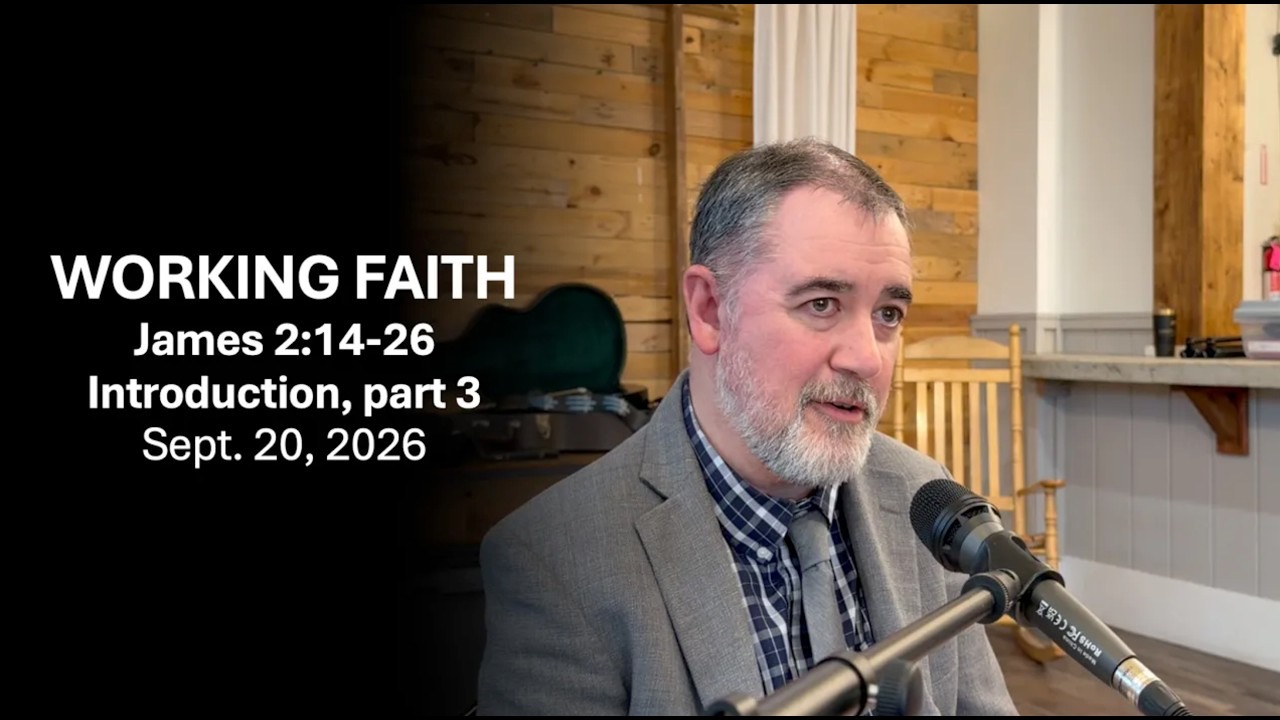
I hate to do this to you, but I am going to ask you to stand and call her a reading God's word together as we go to our text this morning. Uh take your copy of God's word open to James chapter 2. James chapter 2. This is part three and a third installment on this text. James chapter 2 verses 14 through 26. We'll read this together and then then you may be seated.
James chapter 2 beginning at verse 14. What use is it, my brothers, if someone says he has faith, but he has no works? Can that faith save him? If a brother or sister is without clothing and in need of daily food, and one of you says to them, "Go in peace. Be warmed and be filled." And yet you do not give them what is necessary for their body, what use is that? Even so, faith, if it has no works, is dead by itself.
But someone will say, "You have faith, and I have works." Show me your faith without the works, and I will show you my faith by my works. You believe that God is one, you do well. The demons also believe and shudder. But are you willing to recognize, you foolish fellow, that faith without works is useless? Was not Abraham our father justified by works when he offered up Isaac, his son, on the altar? You see that faith was working with his works.
And as a result of the works, faith was perfected. And the scripture was fulfilled which said, "And Abraham believed God, and it was counted to him as righteousness." And he was called the friend of God. You see that a man is justified by works and not by faith alone. And in the same was not Rahab the harlot also justified by works when she received the messengers and sent them out by another Excuse me, by another way. For just as the body without the spirit is dead, so also faith without works is dead. May God bless the reading of his word.
You may be seated. This is our third installment, as I said just a moment ago, and today, this morning, we will finally get into the actual exposition of the text. I've been laying some groundwork in our previous two sermons, and for those of you who were not with us last couple of times I preached, or maybe some of those of you who are guests this morning, just briefly let me kind of go over what we've already talked about. It's important for us to have a a little bit of review for all of us, whether we were here or not, I think. But as I began this series, I pointed out that this passage is not only one of the most disputed and controversial text in the book of James, it is well, it's undoubtedly the most disputed in the book of James, controversial, but it's one of the most disputed and controversial text in all of scripture because James appears to directly contradict salvation by faith alone. And this is explicitly taught by the Apostle Paul in his epistles, especially the book of Romans, but Galatians and Ephesians as well, and so there has been a lot of consternation over how do you square what Paul said with what James said because they appear at first glance to be mutually exclusive.
It does not seem to be it does not seem to be any way to reconcile these two. But we will see as we go along that this these passages are not contradictory at all. They are rather complementary of one another. Now, we talked about what faith is. Before we can understand this text, we need to know both what faith is and where does faith come from? Well, the go-to text for what faith is is Hebrews 11:1.
Faith is the assurance of things hoped for, the conviction of things not seen. As Christians, our faith is grounded in Christ. He is the object of our faith, and faith is the assurance of things what? Hoped for. And so, our hope is in Christ. When we think of hope, usually um here in kind of the earthly realm, if you will, we think of things that are not very certain.
We just kind of hope for them to be true. I hope my team wins the game. I hope we have good weather. I hope they cancel the view. We can We can hope for things like this. Uh but, we don't have any assurance of it, right?
Hope for the Christian is not like that. Hope for the Christian is certain because it is grounded in the person in the work of Christ. Our hope is certain. It's not something that we hope might happen. It will happen because Christ is the author and perfecter of our faith. He is the source and the object of our faith.
And then, the author of Hebrews says, "The conviction of things not seen." This certain assurance, our hope in Christ, necessarily leads to an impact in how we live. The conviction of things not seen. Convictions are different from preferences. Preferences may change, convictions do not. As recent examples and well known examples, uh Robert Jeffress is the pastor of First Baptist Church, Dallas, Texas, one of the largest churches in the country, maybe the largest Southern Baptist Church along with Prestonwood, but Robert Jeffress preached a sermon 15 years ago, I looked it up, 2011. I remember listening to the sermon.
And he preached it on Roman Catholicism. And he rightly called it, I I quote, a cult-like pagan religion. He's right about that. He was very strong against Roman Catholicism. That was back in 2011. But then just a few years after that, he receives an invitation from Fox News to come on and be interviewed on Fox News, it became a regular thing with him.
And then all of a sudden, Robert Jeffress had this amazing metamorphosis, and he started calling Pope Francis a wonderful Christian man and referring to Catholics as our brothers and sisters in Christ. So, what does that tell me? Well, it tells all of us that what he preached in 2011 was not a conviction. It's just a preference. And he was tossed by the wind. Jack Graham, pastor of Prestonwood Baptist Church, another one of the largest, I don't know which of the two is larger, but they're number one and two.
Jack Graham, um if you were to ask him privately, do you believe that a woman can be a pastor? He would say, "No." Because the Bible forbids that, rightly so. If you asked him, "Do you believe in the prosperity gospel, that it's always God's will to be wealthy and physically healed?" He would say, "No." If you asked him, "Do you believe in faith healers?" He would say, "No." Privately. But publicly, he endorses and praises Paula White, quote-unquote pastor Paula White. A man who does not believe in female pastors, who does not believe in the prosperity gospel, openly endorses. In fact, you can go to Paula White's website and see an endorsement from Jack Graham on her very website.
So, what does that tell us? Tells all of us that these things are not really convictions of his, they're just preferences, if that at all. But, Paula White is his access to the White House, so he jettisons his preferences and his true colors come out. This is not what Hebrews 11:1 is about. This is not what faith is. These men desire the applause of men more than they do the applause of Christ.
To use an Old Testament analogy, they have sold their birthright for a bowl of soup. So, faith is the assurance of things hoped for. These things are certain and they lead to convictions that necessarily impact our lives. That's what faith is. And then we ask the question, well, where does faith come from? This is a very, very, very important question.
Where does faith come from? Where does it originate? If faith originates from ourselves, if faith is something that we gin up on our own, then carried to its logical conclusion, salvation is a work. Because it's something that we gin up on our own, and salvation is conferred upon us by God as a reward for our work of exercising faith. And if this is correct, then faith and repentance are both works that we do. And God rewards our work.
And if we believe by ourselves, if faith is something that we gen up on our own, if we can believe on our own, then what can we also do on our own? We can unbelieve on our own. Right? Um last few weeks there's been kind of this open debate going on between uh well with Jenna Ellis and Dinesh D'Souza about Calvinism, the doctrine of election. And Dinesh D'Souza hates the doctrine of election, but he said something the other day, this past Friday, actually, about 48 hours ago, and listen to what he says here. Because coming from his position, he's right.
I quote him. "I am open to being persuaded on this, but it seems that if we must believe in order to be saved, then surely it's possible to stop believing. We have all believed in things that we stopped believing in. Who doesn't know some someone who's sincere and was a believing Christian, but ultimately fell away?" He's right about that. If his view of faith is right. If faith is something that we gen up on our own, if we believe by ourselves, then we can also choose to unbelieve by ourselves.
And so that does away with eternal security. You see how important this question is. And to what Dinesh D'Souza said, "No, I do not know one single person, nor do any of you, who was ever a true, sincere, genuine Christian who later stopped believing. That does not happen." Remember what John said, 1 John chapter 2 verse verse 19? "They went out from us." Why? "Because they were not really of us." That's why they went out from us.
They were never of us to begin with. You see, your ones faith does not come from within ourselves. Faith is something that is given to us by God. God is the source of our faith. He is the originator of our faith. And what God Excuse me, what God gives, he does not take back.
Remember, our minds are darkened, Ephesians 4:18, so they must be enlightened. Our hearts are hardened, Ezekiel 36, so they must be softened. The heart of stone must be taken out and replaced with a heart of flesh. Our will is in bondage to sin. This is what Paul teaches in Romans chapter 6. Remember in Jesus in John chapter 8:34, Jesus said that everyone who commits sin is a slave to sin.
If you commit sin, you are a slave to sin. This doesn't mean an occasional stumbling in sin. This is a pattern of sin. If your life is marred by an habitual unrepented pattern of sin, you are a slave to sin. And a slave cannot free himself. Now, when we think of slavery, we usually think of what we had in this country a couple of hundred years ago and what goes on sadly, tragically, to this day in many countries.
People that are held in bondage against their will. The kind of slavery that Jesus is talking about, the kind of slavery that the Apostle Paul is talking about, slavery to sin, is far worse than that. Because humans in in just earthly bondage want to be free, right? Not so if you're a slave to sin. You do not desire freedom. You love the chains of sin.
You want more of them. So, our minds are darkened, they must be enlightened, our hearts are hard, they must be softened, our will is in bondage to sin, it must be free, and slaves do not free themselves, they must be free. Paul writes in Romans chapter 6 verse 18, he says, "Having been freed from sin, you are now slaves to righteousness." We don't free ourselves, Paul says you have been freed. Notice the passive voice. You didn't free yourself. God freed you.
Faith is a gift from God. So, our darkened minds must be enlightened, our hard hearts must be softened, and our enslaved will must be free, and God does it all. Christ is the author and finisher, the perfecter of our faith, Hebrews chapter 12 verse 2. Paul writes in Philippians 1 verse 29, "For to you it has been granted not only to believe in Christ, but to suffer for his sake." Believing in Christ is something that has been granted to us. Our faith is a gift, it is a privilege for us to believe, it doesn't come from ourselves. Comes from God.
If it comes from ourselves, then we could lose it. If it comes from ourselves, we can turn away from it. If it came from ourselves, faith would be not a conviction, but what? A preference. Preferences can change. Convictions don't.
John 6 verse 29, Jesus says, "This is the work of God, that you believe in him whom he has sent." Whose work is it that you believe in Christ? Not your work, God's work. Ephesians 2, "For by grace you have been saved through faith, and this not of yourselves, it is the what? The gift of God, not of works, so that no one may boast. It is the gift of God. What is the gift of God?
Grace? Yes. Faith? Yes. Salvation? Yes.
It's all of God. It's all of God. Dear ones, if we say that faith originates from us, not only is that a works salvation, but we have also, um, to use a phrase, we have crossed the Tiber. We have gone back to Rome. We have gone back to the works-based salvation of the Roman Catholic Church, which is no salvation at all. If you add any works to grace, then you have nullified grace.
Paul says, Romans 11:6, "But if it is by grace, it is no longer of works. Otherwise, grace is no longer grace." If you think your works have contributed to anything, if your salvation, then you may call it salvation by grace, but it's not grace. You may use that word, but it's not what true grace is. Any mixture of works with grace, and grace is no longer grace. It's all of God. And if it is all of God, if it is His work and not ours, then our salvation is secure.
Hear that? If our If the grace comes from God, if our If our faith comes from God, then our salvation is secure because, Romans 11:29, says, "The gifts and the calling of God are what?" Irrevocable. What God gives, He does not take back. So, if God gives us our faith, it's not ours to lose it. It comes from him and he will not take it back. Our salvation is secure, eternal security.
It's one of the beautiful and comforting doctrines about or truths about the doctrine of election. Because the Arminian side, the free will side, whatever we can generate on our own, we can lose on our own. Not true with the doctrine of election. The gifts and the calling of God are irrevocable. Okay. So, with that as a little bit of a refresher, let us go to our text and we'll focus this morning on verses 14 through 17.
Let's read this again. What use is it, my brothers, if someone says he has faith, but he has no works? Can that faith save him? If a brother or sister is without clothing and in need of daily food, and one of you says to them, "Go in peace, be warmed and be filled," and yet you do not give them what is necessary for their body, what use is that? Even so, faith, if it has no works, is dead by itself. Remember to whom James is writing.
James is writing to Jewish Christians. These were Jews who had been raised to know the Torah, study the Torah, obey the Torah or the law, all of these things, sacrifices, all of these things, and then they came to know Christ as their Messiah, their savior, they embraced Christ, but they had this Jewish background. And many of the Jews, before their conversion, when they were just in Judaism, mistakenly mistakenly believed that salvation was by works. The ironic thing about the Jews, though, is for all of their professed love for the Old Testament. The Jews missed one of the great truths that is recorded not only in the new but also in the old is that even in the Old Testament, even in the old covenant, salvation is by faith. Not works.
The Old Testament is also a It is just littered with these truths that salvation is by faith, not of works. Habakkuk chapter 2 verse verse 4, the righteous will live by what? By faith. Genesis chapter 15, God cut the covenant with Abraham. It says that Abraham believed Yahweh and it was counted unto him as righteousness. So, how were people in the Old Testament saved?
The same way we're saved, by faith. Not by works, but the vast majority of Jews missed that. And they thought they could earn their salvation. They were so wrong. So, here's the scene. These Jews had spent their entire lives believing that they had to earn their salvation by their works, but now they had embraced Christ as the Messiah and believed the gospel, salvation by grace alone through faith alone and Christ alone.
And it was so freeing to them uh because now they understood that their salvation is not a work. Well, it never was to begin with, but that was their misunderstanding of the Old Testament. So, now they truly understand that that salvation is just by grace through faith. And it was so freeing for them to no longer have to feel like they're on this endless hamster wheel of doing works and trying to earn God's favor. Now they understood they didn't have to do that. They just needed to trust Jesus and it was so freeing for them.
Some of them swung over to the other extreme. And then they began to think, "Oh, works aren't necessary at all. There's no place for works at all." This is also error. Some were even saying that faith and works are incompatible, mutually exclusive, that faith and works are somehow antagonistic towards one another. Let me read to you what commentator Alex P. Ross says of this.
This is a great quote. As we understand this passage, he says, "Faith and works are not antagonists facing each other with crossed swords. They stand back to back confronting different foes of the gospel." You see, Paul and James are each confronting different heresies. And that's why at first glance their view of faith seems to be contradictory. They're not contradictory. It's just that Paul was confronting one error, James was confronting another.
Paul was engaging a Jewish legalism that insisted that righteousness was achieved by works. Do these things, observe these feasts, observe these festivals, don't eat certain foods, and then you can earn your way into heaven. That was the error that Paul was engaging and that's why Paul said that if you add works to grace, grace is no longer grace. We are justified by faith alone. James was engaging a different heresy. The heresy that James was confronting was kind of a early version of what we would talk call today antinomianism, anti against nomos law, against the law.
Antinomianism is basically the belief that says the law of God is not important at all. Obedience to the law is not important at all. We talked about that a few weeks ago. Um easy believism. Greasy grace, cheap grace. Just as long as you say you believe that Jesus is the son of God, the Messiah, then you're good to go.
No life change. No repentance from sin. No evidence of conversion, no works, just say you believe and you're in the club. That's the heresy that James was confronting. And that heresy is rampant in the church today, absolutely rampant. So Paul was refuting a work salvation and James was refuting essentially easy believism.
So they're not enemies with crossed swords. They're compatriots in the gospel standing back-to-back, each of them confronting different errors. Does that make sense? Okay. Let's look at the text. James begins rather sharply here.
What use is it, my brothers? What good is it, my brothers, if someone says he has faith, but he has no works? Can that faith save him? James opens this section with a biting piece of sarcasm. What use is it? Confrontational.
What good is it, my brothers, if someone claims to have faith but has no works? Is James downplaying faith and emphasizing works? No. No, not at all. To quote the Apostle Paul, may it never be. James is not downplaying faith.
James opens this way because he has such a high view of faith and he does not want these his readers to embrace a false version of faith. This is a new section but it's not the first time that James has addressed faith in his letter. You might remember back in chapter 1 verse 21, James told his readers to remember to receive the implanted word which is able to save your souls. How do you receive this implanted word? By faith. The next verse, verse 22, he follows that up with but become doers of the word and not merely hearers who delude themselves.
Remember James is a very practical book. We've called it Christianity in blue jeans, right? It's very it's doctrine applied. And so James is not downplaying faith, he's not deemphasizing faith, he's arguing for the right kind of faith. What use is it? What use is it, my brothers?
What use is it, my brothers? Notice the pastoral tone here. Even though he starts and ends in verse 17, let me uh verse 16 with what use is this? What good is it? It's how he begins, how he ends here. It's very sharp and confrontational but notice the tender pastoral tone.
What use is it, my brothers? Here you see the heart of a shepherd as we've seen it earlier in the book of James. James confronts when it is necessary. He's not afraid to do that. He's sharp. He's pointed.
He doesn't soften the hard edges of the gospel. But, he's also pastoral. He's loving. He cares about these people. He cares about them deeply. True shepherds don't beat the sheep.
There is a time for correction, but they do so lovingly. What use is it, my brothers, if someone says he has faith but has no works? Can that faith save him? Notice, too, that James does not say "If someone has faith but has not works." Notice that. He doesn't say "If someone has faith, but he does not have works." He says "If someone says he has faith but has no works, can that faith save him?" If someone says he has faith, if someone claims to have faith. Claiming to have faith is not the same thing as actually having faith, right?
James is very specific here in his language. If someone says he has faith but has no works, can that faith save him? You can claim a lot of things and it not be true. I can claim to have a head full of thick hair. Doesn't make it true. I can claim to be the starting quarterback of the Green Bay Packers.
Doesn't make it true. A man can claim that he's a woman, doesn't mean he's a woman. Simple common sense and observation shows that it's not. So, you can claim a lot of things that aren't actually true. And that's what James is saying here. If someone says he has faith but has no works, can that faith save him?
Many people claim to be Christians who are not. In fact, if the polls are anywhere close to right, according to Barna, we live in the in a country in which about 2/3 of the people in this country used to be a lot higher than that not too long ago. It's now down to about 2/3. 66% of the people in the United States of America claim to be Christian. Let me tell you something everyone. If that was even close to being true, we wouldn't have {quote} {unquote} gay marriage in this country. And we wouldn't be having any debates about abortion if that was even close to being true.
There's a lot of people in this country who claim to be Christians who are not. In fact, the great majority of people who claim to be Christians in this country are not. So, you may say you have faith, but James is saying if you do not have works, what use is it? I want to bring something else to your attention. If you have the King James and I'm I'm not against the King James. I like the King James.
It's a good translation, but it's not the best and bear with me. If you have the King James, you might notice it reads this way. I'll read it to you straight from the King James. Antiquated language at all. It says, "What doth it profit my brethren? Though a man say he have faith and have not works, can faith save him?" Did you catch the difference?
"Can faith save him?" That's not how it reads. The Greek says, "Can that faith save him?" There is an article before faith. This is a very unfortunate rendering by the King James translators. They missed this definite article. The faith is in the Greek is pistis and there's a there's a little article a a hey right before it. That's a definite article that faith.
Not just faith in general. Can that faith save him? If the King James translators had gotten this right, it probably would have cleared up a lot of the confusion. But they missed it. Can that faith save him? It's not that faith doesn't save.
It's not that we're not saved by faith alone. That's not what James is saying. James is saying, "Can that kind of faith save him?" A faith that has no works, can that kind of faith save him? James very much affirms that faith saves. In fact, he'll state this directly later in chapter 5, verse 15, when he says, "The prayer of faith will save the one who is sick or spiritually weak." And included in that saving, James mentions the forgiveness of sins. So, James directly states in just a couple chapters that faith saves.
In chapter 1, verse 21, when he talked about the implanted word, which is able to save your souls, he is talking about receiving that by faith. In verse 12, he talked about the crown of life. Jesus is the crown of life. So, James certainly has eternity in mind. So, James is affirming that faith saves. What he is saying is is there is a particular kind of faith that does not save.
It's a faith that has no works. That kind of faith does not save. James is not talking about an occasional slip, an occasional stumble in the sin. When he says, "When a man says he has faith." Says, that is in the present tense. So, in other words, if a man or a woman is consistently saying, "I have faith." But their life is also showing a consistent lack of evidence of that, that kind of faith does not save. Someone who continually says he is a Christian, but his life continually demonstrates that he's not, no fruit of the Spirit, no change, no works, that kind of faith does not save.
So, the answer to James' question is, of course, no. That kind of faith is of no use. What good is it? None. None. Verse 15.
If a brother or sister is without clothing and in need of daily food, and one of you says to them, "Go in peace, be warmed and be filled." And yet you do not give them what is necessary for their body, what use is that? So, James now gives us a concrete illustration of what this what that kind of faith looks like. He says, "If a brother or sister is without clothing and in need of daily food." And that is an accurate rendering of the Greek. Notice Notice again the pastoral concern for both men and women. If a brother or sister, that is in the Greek, that's not a politically correct translation, that's not trying to be modern. He says that, "If a brother or sister is in need of clothing and daily food." Galatians 3:28 3:28.
There is now, therefore, neither Jew nor Greek, slave nor free, male nor female. We are all one in Christ Jesus, right? Sometimes people think, "Oh, Christianity puts women down." Let me tell you something, my friends, Christianity did more to uplift and honor women than anything else in the history of the planet. By far. By far. He's concerned for brothers and for sisters.
If there's a brother or sister who's without clothing and in need of daily food and one of you says to him, "Go in peace, be warm and filled." Yet you do not give them what is necessary for their body, what use is that? James is specifically talking about a brother or a sister in Christ. He says from among you. From among you. Don't miss this. James specifically singles out members of the church family.
He's not talking about people in general who are without clothing and who are in need of food. He says if there's someone who among you who needs clothing and food. Galatians 6:10 all rights, "So then, while we have opportunity, let us do good to all people and especially to those of the household of faith." So, I've said before in a sermon a few months ago talking about this verse to break this down real easily. If I were to see one of you who is in need of clothing or food. You're in front of me, you need clothing and food, and then there's another person in front of me who is not of the household of faith, who's not a Christian. Maybe a perfectly nice person.
But not a Christian and this other person needs clothing and food. And I can only help one of you, who am I going to help first? I'm helping you first. I'm helping you first. Do good to all people, if you can, but especially to those of the household of faith. And I believe James' statement here, this scenario, I think this makes it very probable that this is something that actually happened.
I don't think he's just kind of coming up with some uh example off the top of his head just to to make something up. I think this actually happened. I think that among his readers, there were some brothers, there were some sisters who were in need of clothing and food, who were going without. I think this was a real need in the church. I think that's why he addresses it. I think that's why he said from among you.
I think that he's that's why he's so pointed with his with his introduction. What use is it? What good is it? I think this actually happened. Without clothing and in need of daily food. Without clothing, the word here in the in the Greek is gumnas, and it it literally means naked.
That's what the word actually means. But it can also refer to someone who's not actually naked, but just has threadbare clothes, insufficient clothes, threads, rags, and in need of daily food. So, this isn't just missing a meal. This isn't 1 day of not having food. This is someone who is obviously in dire straits. They don't have enough clothing, and they're going without food.
Two of the basic necessities of life. And James says, if you see that need and don't help that person, what good is your faith? It's no good. Now, let me tell you what this is not. James is not laying upon us an obligation to enable someone to live above their means. That's not what this is.
The Apostle Paul said in 1 Timothy 6:8, "And if we have food and covering," same two needs he's talking about here, right? Food and covering. "And if we have food and covering, with these we shall be content." We shall be content if we have food and covering. Now, that's not to say that we should not work hard to have a nicer life with, you know, a more comfortable life. That's perfectly fine. Nothing at all wrong with that.
That's what the book of Ecclesiastes in large part is about. So, nothing wrong with that. But, if you're coveting something that you do not have, if you're coveting something that you have not earned, and you're just wanting stuff, it's not really necessary, but you're wanting it, I'm under no obligation to help you with that. That's not what James is saying here. This is also not an obligation to help extricate someone for a hole that they have dug for themselves either by some unwise or sinful decision. It's not an obligation to help someone, um, if they've made a bad decision or a sinful decision and it's led to some hard times, we're not under an obligation to help that person extricate themselves.
If especially if it's a sinful decision. Now, we all make bad decisions. But, James is not saying if this person has a habit of going without because of sinful If someone is addicted to gambling, if someone is addicted to alcohol, and because of these addictions they have they're going without and they need things, we're not in an obligation to enable them in their sin. That's not what this is. It is an obligation to help our brothers and sisters who through no fault of their own find themselves in a place of genuine need. This is not a way to excuse laziness.
Paul said in 1 Thessalonians 3:10, "The man who does not work neither will he So, it's not a a way to excuse laziness. It's none of those things. It is about us helping a brother or sister who finds himself in a place that is hard and difficult. They're going without some of the necessities of life through no fault of their own. A cancer diagnosis and they can't work. A spouse dies.
A husband in particular dies and they can't work. Their house burns down. Something like this, something that is beyond their control. We are obligated to help. We should help. That's the one of the things that a regenerate heart wants to do.
And And if we don't want to do that, especially when we have the means to do that, James is saying, "What good is your faith?" It's no good. It's no good at all. James continues, "One of you says to them, 'Go in peace. Be warmed and be filled.' And yet you do not give them what is necessary for their body, what use is that?" So, you see a person in the household of faith who is cold and hungry. And rather than meeting their needs, you just say to them, "Go in peace. Be warmed and be filled." The sentiment, "Go in peace." is not a bad thing to say.
I mean, we see this in other places in the Bible. It's a good well wish to use those terms. Eli said that to Hannah in 1 Samuel chapter 1. He said to her, "Go in peace." Very sincere. Absalom said said it to his father, King David, in 2 Samuel chapter 15. Said, "Go in peace." Jesus himself.
Remember in um See, where was Luke chapter 7? Luke chapter 7, the woman that was washing her his feet with her tears, and she dried his feet with her hair. She was a sinful woman. Remember that? Uh Jesus said to her, "Your faith has saved you. Go in peace." So, it's a good thing to say when it's said from a sincere heart.
Notice also Jesus said to this woman, "Your faith has saved you." We're saved by faith. But, in this context, when someone says he has faith, and he sees a brother or a sister in need, and he has the means to help, you see someone who doesn't have enough clothes, they're starving, and you're sitting there with a quarter pounder with cheese, and you know, plenty of money in the bank, and you just you're munching on your burger, drinking your milkshake, "Go in peace." You know what that is? That's a mockery. It's a mockery. You're mocking that person, and you're mocking faith, and you're mocking Christ. And working through this passage this week, I couldn't help but think of the parallels between this and Luke chapter 16.
The rich man and Lazarus. Now, I'm not going to preach that whole passage, but you remember the story. Jesus gave this parable. The rich man had everything that the world could offer. Lazarus had nothing. Both of them professed to be believers.
And I say that because Lazarus, when he died, he was obviously a believer because he went to heaven, clearly, right? The rich man also professed to be a believer because when he died and he went to the lake of fire, who did he recognize? He recognized Abraham. He even called him by name. So, this is also someone who claimed to believe in God. Who else did he recognize?
He also recognized Lazarus. Father Abraham, send Lazarus so that he may dip the tip of his finger in water and cool off my tongue for I'm in agony in this flame. Lazarus was poor, Lazarus was crippled, he was diseased, he was starving, begging to be fed with the crumbs which were falling from the rich man's table, remember that? Besides, even the dogs were coming and licking his sores. So, here you have a man without enough clothing, who was starving, had faith. The rich man also claimed to have faith.
He said he had faith. It's not that he didn't know that Lazarus was there, he knew it. He even knew his name. But he didn't lift a finger to help him. Can that faith save him? No.
It did not save him, it didn't. He found himself in the lake of fire. James says, "Even so, faith, if it has no works, is dead by itself." That kind of faith, if it is not accompanied by works, if it is if one commentator puts works this way, faith deeds. I like that. That has a better kind of a connotation to it. If faith is not accompanied by faith deeds, that faith is dead.
That is not a sick faith. That is not a faith that needs help. That is not a faith that is in a spiritual ICU. That is not a faith that needs to be revived. That is a faith that is necro. Dead.
You've heard of necrosis? When your flesh begins to die, necrosis, necro. Dead. Dead. James is not saying that works need to be added to this faith to make it alive. You can't add works to a dead faith and make it alive anymore than you can shine the shoes on a corpse and make that corpse come to life.
It's dead. That faith is dead. Turn with me to Matthew chapter 25. Matthew chapter 25, beginning verse 37. This is exactly, exactly the kind of thing that James is talking about. What Jesus talks about here.
Do you have a dead faith or a living faith? Jesus spells it out. Beginning of verse 37. Then the righteous will answer him saying, "Lord, when did we see you hungry and feed you or thirsty and give you something to drink? When did we see you a stranger and invite you in or naked and clothe you? And when did we see you sick or in prison and come to you?" And the king will answer and say to them, "Truly I say to you, to the extent that you did it to one of these brothers of mine, even the least of them, you did it to me." Then he will also say to those on his left, "Depart from me, accursed ones, into the eternal fire which has been prepared for the devil and his angels.
For I was hungry, and you gave me nothing to eat. I was thirsty, you gave me nothing to drink. I was a stranger you did not invite me in, naked and you did not clothe me, sick and in prison and you did not visit me.' Then they themselves also will answer saying, 'Lord, Notice Notice the title, Lord. They're calling him Lord. They think they're believers. Lord, when did we see you hungry or thirsty or a stranger or naked or sick or in prison and did not take care of you?' Then he will answer them saying, 'Truly I say to you, to the extent that you did not do it to one of these one of the least of these, you did not do it to me.' And these will go away into eternal punishment, but the righteous into eternal life." It's exactly what James is talking about.
If you see a brother or sister in need, and you have the means to help, and you do not, your faith is dead. And you will join these, and you will join the rich man in the lake of fire. The worm does not die and fire will not be quenched. One commentator noted, he said this, quote, "If your faith does not benefit others, it will not benefit you, either." Well said. Just want to close with the gospel. Has there been a time in your life when you have been convicted by God's Holy Spirit through his word that you are a sinner, that you have broken God's laws.
All have sinned and turned All have sinned and fallen short of the glory of God. All have turned aside and become worthless as Paul says in Romans 3. We have all broken God's laws. We have all incurred the wrath of God. And because we have sinned against God who is eternal, the punishment of that sin is also eternal. And if we die in our sin, we will very rightly and very justly join the rich man in Luke 16, join these that Jesus would address on his left, "Depart from me." We'll hear the words of Matthew 7, those who said, "Lord, Lord, did we not prophesy in your name?
Did we not cast out demons, perform miracles in your name?" And Jesus will declare to them, "I never knew you." "Depart from me, you workers of iniquity." They said they had faith. They called Jesus Lord, Lord, Lord, "Did we not do these things?" False. "I never knew you." The bad news is that is what each and every one of us deserves. But there is good news, and the good news of the gospel is that God sent his son, God the Son, the Lord Jesus Christ, to this earth. And Jesus lived a perfect life. One person, two distinct natures, truly God, truly man.
He had to be the God-man because only man should pay the penalty of sin. He had to be God because only God can pay the penalty of sin. And Jesus lived a life of perfection. His active obedience satisfied every demand of the law on our behalf. And he lived it to perfection so that when he died on the cross, his perfect life could perfectly satisfy God's wrath. Making an end to the wrath of God for those for whom he died.
And on the third day, bodily raised from the dead, proving himself to be who he said he was. And if we will repent of our sin, turn from sin, and place our trust in him, his active obedience will confer upon us his righteousness. A righteousness that none of us has on our own. His righteousness will be counted to us. Our sin counted to him on the cross, and God the Father treated him as though he were a sinner, even though he was not. And his righteousness counted, imputed to us.
And when we stand before God, we will stand before God the Father with a perfect righteousness of none other than the Lord Jesus Christ himself. That is the good news of gospel. Your sins can be washed away. Your sins, though as scarlet, can be white as snow. Has there been a change in your life? I dare say probably everybody in this room, looking around, I think everybody in this room would say we have faith.
But has that faith changed you? Has there been a change in your life? Do you And some people have more dramatic conversions than others. You don't have to have a Damascus Road, Saul of Tarsus kind of doesn't have to be that dramatic, but has there been a change? Do you love the Lord? you desire to know him? Do you have a love for his word?
Do you desire to obey his word? Do you have a love for what is pure, a love for what is holy? Do you have a godly sorrow over your sin? Does your sin grieve you? If your sin grieves you, that's a really good sign. Cuz if you're lost, it wouldn't grieve you.
Does your sin grieve you? Do you have a love for the brethren? Do you have a love for Christ's bride, the church? If these things are in your life, if you do desire to please Christ, if you do love what is holy, if you do desire to grow in the grace and knowledge of the Lord Jesus Christ, these are all hallmarks of the regenerate heart. Salvation's not perfection, it's direction. Okay?
All right.
Read Less