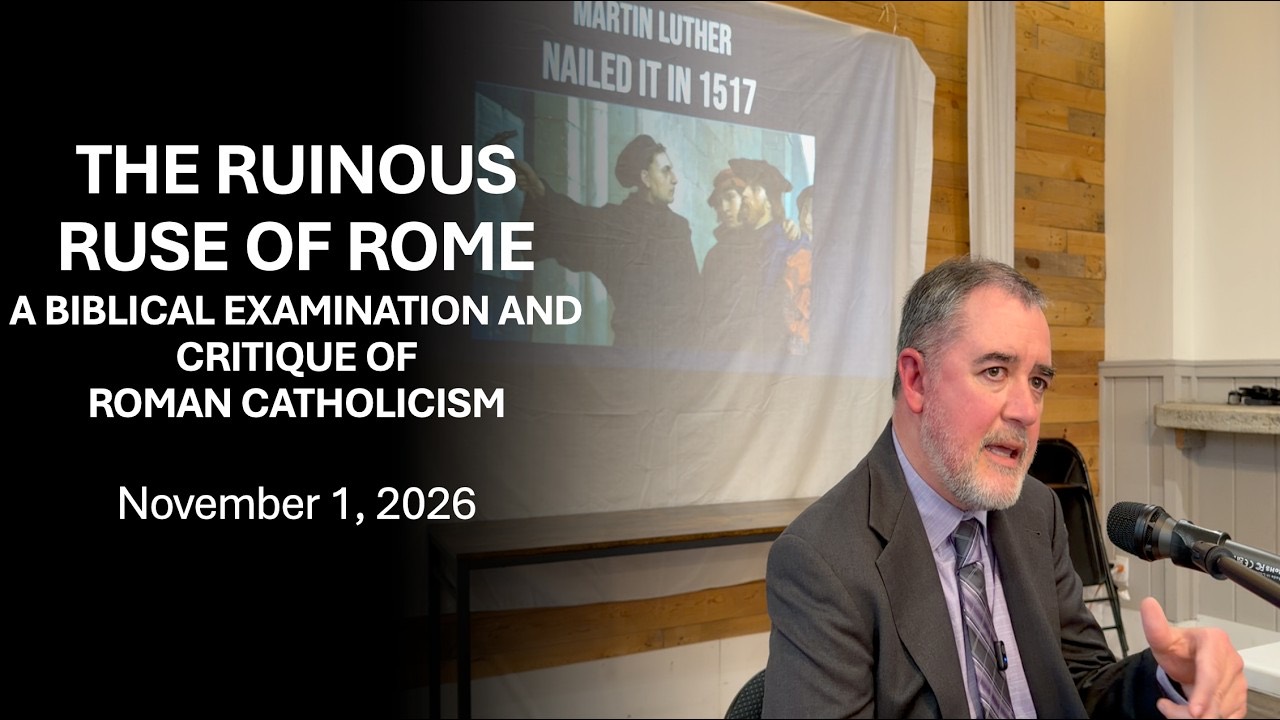
Hello dear ones, Justin Peters here. This is a sermon that I preached at the church that I pastor, Grace and Truth Community Church. I preached it on Sunday, November the 1st, and it is a bird's eye view of Roman Catholicism. I show how the Roman Catholic Church has quite literally anathematized the five solas of the reformation that salvation is by grace alone through faith alone in Christ alone for the glory of God alone in scripture alone is our authority in all matters of faith. So um I will walk through those things. Please know that my purpose in presenting this sermon is not to offend for the sake of being offensive.
But I have told people often from the pulpit that the most loving thing we can do for people is to tell them the truth. The most hateful thing we can do is to know the truth and not tell them. So um if you are a Catholic, if you have uh friends or family members who are a Catholic, please send this sermon to them and ask them to watch it. And if you're a Catholic, please do watch this and know that it is uh not my desire to be offensive. I I want to reach Catholics with the true gospel and not the aberant gospel that keeps so many people in spiritual bondage and deception and on an endless hamster wheel of trying to earn their salvation. So please do watch this.
I hope it will be helpful to you and go all the way to the end. The sermon is about I think an hour and 10 hour and 15 minutes or so. And then at the conclusion of the sermon, uh, I'm going to come back and have a few concluding but very important thoughts, some things for Catholics to ponder as they consider what they are being taught from the powers that be in the Roman Catholic Church. Please do go to the end and watch my conclusion. Thank you so much. My message this morning is entitled the ruinous ruse of Rome.
Roman Catholicism is, I believe, the largest organized theological cult in the world. And we're looking at that this Sunday morning because just yesterday was October 31st. And that is Reformation Day for us. We don't recognize Halloween. It is Reformation Day. on October 31st, 59 years ago, 1517, there was a man by the name of Martin Luther. And Martin Luther nailed it.
In 157, Martin Luther was a Roman Catholic priest. and he was weighed down with the hopeless system of the Roman Catholic Church of trying to earn his way into heaven. His conscience accused him of his sin and he tried to work his way into heaven. He even beat his own body as some kind of a punishment for the sin that he knew he had committed and it just seemed absolutely hopeless to him. And on October the 31st, 1517, Martin Luther took the 95 thesis that he had written and he went to the door of the church there, the castle church in Vittenberg, Germany, and he nailed those 95 thesis to the door. He had no idea at the time what he was beginning. In fact, most of his 95 thesis dealt dealt really with the corruption of the Roman Catholic Church.
And as the reformation the name implies he was trying to reform the church but uh the Roman Catholic Church was so corrupt and so heretical it was beyond true reformation. But he didn't know what he was starting. In fact Luther wasn't even truly converted until about 2 years after this in 1519. But some students took his 95 thesis and unbeknownst to him they began making copies of his 95 thesis. By this time the printing press had been invented and so they were able to make many many more copies and then what you could just do by hand. And so they started mass- prodducing these 95 thesis making copies of them and spreading them all throughout Germany.
And Luther didn't even know they were doing this, but it caused quite a stir and the fire caught on. And that is what began in earnest what we call today the Protestant Reformation. And then Luther was converted. And he began preaching uh salvation by grace alone, through faith alone, and Christ alone. And you may have heard of the five solas, the five solas of the reformation. Solola simply means alone.
And there are five solas of the reformation that we all as Protestants adhere to because the Bible teaches them. Solar gratia salvation is by grace alone. Solid it is by faith alone. Solus Christristus through Christ alone. Soladea gloria for the glory of God alone. and solos scriptor scripture alone. Scripture alone is our authority as Christians.
And so what I'm going to do in this presentation, we're going to look at each of the five solas and I'm going to put up some tables and you'll see on the left side biblical Christianity and then you'll see on the right side what the Roman Catholic Church teaches about these things and we will contrast them. So let us begin with soligratia. Salvation is by grace alone. Biblical Christianity and that is redundant but there are so many people who call themselves Christian that well you need to specify that true biblical Christianity teaches that salvation is of the Lord. It is by God's grace alone. Psalm 37:39 literally says that salvation is of the Lord.
Titus 2:1, for the grace of God has appeared, bringing salvation to all men. It is by God's grace alone. You may have heard the term monergism. Uh it's a theological term that we use to describe that salvation is the mono one urggon work in Greek. the one work of God. We believe in monergism that go salvation is all of God and it is none of us. So salvation is of the Lord.
It is the grace of God that has appeared bringing salvation to all men. It is God's work. Biblical Christianity holds that man apart from Christ is totally depraved. And total depravity does not mean that every man or woman is as bad as he or she could be. But what it does mean is that apart from Christ, we are dead in our trespasses and sins. That's what Romans chapter uh Ephesians chapter 2 teaches.
We are dead in trespasses and sins. Romans chapter 3, there is none righteous. Know not one. There is none who understands. There is none who seeks after God. All have turned aside. together they have become worthless.
So there is nothing in and of ourselves that would cause us to seek after God. God must seek after us. And biblical Christianity holds that grace is the unmmerited favor bestowed upon us by our sovereign God. It is solely from God and we can do nothing to merit it. The Roman Catholic Church, however, rejects this. out of hand. The Catholic Church teaches that salvation is only through the church.
And if you do not belong to the Roman Catholic Church, then you are outside of God's grace. The Catholic Church rejects total depravity, total inability. Says that man is not truly dead in his trespasses and sins. that there is still a divine spark within man and man can choose on his own to come to Christ. And the Catholic Church has a very different understanding of grace. The Catholic Church teaches that grace is a thing or a force as they sometimes refer to it that is merited by works through the observance of the sacraments. So grace is something that we can earn.
But that completely redefineses grace. Grace by definition is the unmmerited, unearned favor of God. God freely bestows it upon sinners. It is not earned in any shape, form or fashion. If you earn grace, then grace is no longer grace. So, solar gratia, salvation by grace alone is completely rejected by the Roman Catholic Church.
Now, let's look at what the Bible teaches about justification versus what the Roman Catholic Church teaches about justification. Remember we just did a series in James chapter 2 working through that. But for your refreshing here, justification is the term that we give to denote the divine act by which God declares a sinner to be innocent of his sins. It is a judicial act of God in which the sinner is declared righteous as though he has already perfectly satisfied God's law. All of us as Christians, if you know Christ as savior and lord, you are justified. You have the justification, you have the righteousness of Christ himself that has been imputed to you.
And it does not mean that we are now sinless. We still commit sin. But as one of the reformers described us uh s Christians, we are covered by the grace of God. We have the righteousness of Christ, but we still sin. So he described us as snowcovered dung hills. So it's a graphic picture, but pretty fitting.
Let's look at what the Bible teaches about justification. Romans chapter 5 8-9. But God demonstrates his own love toward us, and that while we were yet sinners, Christ died for us. Much more then, having now been justified by his blood, we shall be saved from the wrath of God through him. As John MacArthur has rightly pointed out, it is not the liquid itself, not the I mean you and I don't have the actual obviously blood of Jesus on us, but it is the vicarious, the substitutionary death of Christ on the cross by which we are justified, by which we are made just, made righteous before God. Titus 3:7.
So that having been justified by his grace, we would become hes according to the hope of eternal life. Justification is by God's grace and by God's grace alone. However, the Roman Catholic Church denies this. I'm going to read to you several excerpts from the Council of Trent. Now, the Council of Trent was kind of the Roman Catholic answer to the Protestant Reformation. Protestant Reformation began in earnest uh officially on October the 31st, 1517 when Martin Luther nailed it.
And um it caught on and so the Roman Catholic Church scrambled and they said, "We got to have some answer for these Protestants." And so they formed a council that lasted from 1545 to 1563. long council. I hope they packed a lunch. And so they came up with these um cannons to answer the Protestant Reformation. Canon 14 says this. If anyone saith that man is truly absolved from his sins and justified, because he assuredly believed himself absolved and justified, or that no one is truly justified, but he who believes himself justified, and that by this faith alone absolution and justification are affected, let him be anathema. So the Catholic Church teaches that if you believe that salvation is by grace alone, you are anathema.
Now what does anathema mean? Well, it's not good. Anathema, it is a Greek word. Let me read this to you. This is from Pope Zachary, one of their popes back in the 8th century. But he wrote this.
Wherefore, in the name of God, the all powerful, Father, Son, and Holy Ghost, of the blessed Peter, prince of the apostles. Let me pause there just for a second. Roman Catholics believe that Peter was the first pope, and they believe in this unbroken apostolic succession ever since Peter. Kind of awkward if Peter was the first pope because the Roman Catholic Church doesn't allow their priest or the pope for that matter to get married. And yet in Matthew chapter 8, we read about Jesus healing Peter's mother-in-law. Now, to paraphrase U Forest Gump, I may not be a smart man, but I know to have a mother-in-law, you've got to be married, right?
Awkward. and of all the saints in virtue of the power which has been given us of binding and loosing in heaven and on earth. We deprive himself and all of his accomplice accompllices and all his abettors of the communion of the body and blood of our Lord. We separate him from the society of all Christians. We exclude him from the bosom of our holy mother, the church in heaven and on earth. We declare him excommunicated and anathematized and we judge him condemned to eternal fire with Satan and his angels and all the reprobate. Tell us how you really feel that word anaatized.
If you if the Roman Catholic Church pronounces you anathema, they believe that when you die, you will go to hell. You don't even get to go to purgatory. You just go straight to hell. It's a biblical term. Romans chapter 9, Paul writes, "For I could wish that I myself were accursed." That's the word anathema. Separated from Christ for the sake of my brothers, my kinsmen according to the flesh.
It does mean if if someone is anathema, anathematized. Uh it does mean that they are condemned. Galatians chapter 1, Paul writes, "But even if we or an angel from heaven should proclaim to you a gospel contrary to the gospel we have proclaimed to you, let him be accursed. Let him be anathema. As we have said before, and so I say again now, if any man is proclaiming to you a gospel contrary to what you received, let him be anathema. Let him be accursed, cut off." That is what that word means.
And we will see that the Roman Catholic Church has quite literally anathemaized the gospel itself. The entirety of the gospel. The Roman Catholic Church has declared anathema. Canon 12 from the Council of Trent. If anyone saith that justification received is not preserved and also increased before God through good works, but that the said works are merely the fruits and signs of justification obtained, but not a cause of the increase thereof, let him be anathema. They literally believe that you can increase your own justification through good works.
Friends, that is a works salvation and that is a different gospel. So the only thing that is truly anathemaized should be anathematized is Roman Catholic doctrine. I'm going to I want to show you this quote from I'm going to jump the tracks here a little bit. Rick Warren. Rick Warren writes this. We have far more in common than what divides us.
When you talk about Pentecostals, charismatics, evangelicals, fundamentalists, Catholics, they would say we all believe in the trinity. We believe in the Bible. We believe in the resurrection. We believe in sal that salvation is through Jesus Christ. These are the big issues according to Rick Warren. So, it's just all you all hold hands and sing kumbaya.
We all we're all we we have little differences here and there on the edges, but we all still believe in the same things. No, no, no. The Roman Catholic Church has a different Jesus, a different atonement, and a different gospel. These are not secondary differences. These are not this. We're not talking about who you think wrote the book of Hebrews.
We'll see that the Catholic Church anathematizes the gospel itself. Romans 11:6 Paul writes, "But if it but if it is by grace, it is no longer on the basis of works since otherwise grace is no longer grace." Dear friends, if you add one hint of works to your salvation, if you think one hint of your works in any shape, form or fashion merits in any capacity, even the slightest amount of grace, then you've nullified grace. Grace is no longer grace. And something that we've got to be careful of with the Catholics, with the Mormons, with uh even the Jehovah's Witnesses, some of these large cults, they have co-opted some biblical language. They and they are using some lingo that we as evangelicals use and rightly use. They're they're hijacking words.
It wasn't too long ago, like say 20 plus years ago, a Catholic would never even call himself a Christian. Oh, we're not Christian. We're Catholic. But now, Roman Catholics have wised up a little bit. They're wanting to broaden their tent. Oh, we're Christian.
Mormons are doing the same thing. Oh, we're Christian. Mormons used to not call themselves Christian. We're Mormons. We're Church of Jesus Christ Latter-day Saints. Now they call themselves Christians.
Roman Catholics are doing the same thing. And Roman Catholics will even now talk about being saved. You used to never hear a Roman Catholic talk about being saved, but now they're picking up on our lingo. Oh, we're all on the same team here. No, no, we are definitely not. The second solid salvation is by grace alone and it is through faith alone.
Biblical Christianity, we are justified by faith alone. This is imputed righteousness. Romans 4:5, as I've said before, this is the cult 45 to Roman Catholicism. But to the one who does not work, but believes in him who justifies the ungodly, his faith is credited as righteousness. Paul is very clear. It is not by works that we are justified.
We are justified by faith. Our faith is counted to us as righteousness just as it was in the Old Testament when Abraham believed Yahweh and his faith was counted to him as righteousness. But the Roman Catholic Church does not believe this. They reject it. They teach that we are justified by faith and works through the sacraments. And this is infused righteousness.
The works that we do and the seven sacraments. Sacraments being baptism, confirmation, penance, marriage, anointing the sick, holy orders, and the eucharist. Those are the seven sacraments. And the Catholic Church believes that it rejects imputed righteousness and it holds to infused righteousness. And we're not just we're not just debating here about how many angels can dance on the head of a pin or something like this. The difference between imputed righteousness and infused righteousness is the difference between heaven and hell.
It's the difference between the true gospel and a false gospel. Catholics believe, see, let me back up. We as Christians believe that our sins were imputed to Christ on the cross. Our sins were counted to Christ and God the Father treated God the Son as though he were a sinner even though he was not. Our sins imputed to Christ. Christ satisfied God's wrath on the cross.
And when we trust Christ as savior and lord, his righteousness is imputed to us. It's counted to us. That is imputed righteousness. That's what the Bible teaches. Catholics believe in infused righteousness. They believe that when you go to mass, when you go to their church, you go to mass and you take of the sacraments and especially the sacrifice of the mass that we'll talk about in just a second and you eat the bread and you drink the wine, you get a shot of Jesus.
You get a little infusion of Jesus. It's like a like an IV. You get hooked up to the IV and you get a little shot of Jesus and you're good to go for a while, but then it wears off. You commit some more sins. So, you got to come back and get you some more righteousness. Another infusion of righteousness.
Different gospel. Different gospel. Romans chapter 3 27-28 Paul writes, "Where then is boasting? It is excluded. By what kind of law? of works? No, but by a law of faith.
For we maintain that a man is justified by faith apart from works of the law. And this justification, this is the legal justification. This is God's judicial decision to make us righteous. And that comes by faith apart from works of the law. Romans 5:1. Therefore, having been justified by faith, we have peace with God through our Lord Jesus Christ.
Salvation is by grace alone through faith alone. No mixture of works. Yet the council of Trent rejects this. Canon nine. If anyone saith that by faith alone the impious is justified, let him be anathema. Let that sink in.
If you believe that you are saved by faith alone according to the Roman Catholic Church, you're anathema. You will die and go to hell. Canon 12. If anyone saith that justifying faith is nothing else but confidence in the divine mercy which remits sins for Christ's sake or that this confidence alone is whereby we are justified let him be anathema dear friends that is the definition of faith faith is truly nothing else but the confidence in God's mercy and the divine mercy which remits our sins for the sake of Christ. There's your definition of what faith is. And the Catholic Church says if you believe that, you're going to hell.
These aren't secondary issues. And all of these anathemas remain official Roman Catholic doctrine to this very day. They have never been rescended. They're still on the books. Still official Roman Catholic doctrine. We had a reformation for a reason.
John Calvin stated this quote, "I wish the reader to understand that as often as we mention faith alone in this question, we are not thinking of a dead faith which workketh not by love, but holding faith to be the only cause of justification. It is therefore faith alone which justifies and yet the faith which justifies is not alone. So in other words, we are saved by faith alone. But as we've been talking about in our series through James in James chapter 2, saving faith is never alone. Okay? We are justified by faith alone.
Salvation is by faith alone. But saving faith is never alone. Saving faith always produces works. But works are not the cause of our salvation. They're not the ground of our salvation. They're not the grounding of our justification or our faith.
No, works are the byproducts. They're the fruits of our faith. We are saved by faith alone. But saving faith is never alone. Solus Christ. We are saved by grace alone through faith alone in Christ alone.
In biblical Christianity, there is one mediator. 1 Timothy 2:5, for there is one God and one mediator also between God and men, the man Christ Jesus. One mediator between God and man, the Lord Jesus Christ. We have one mediator. We have one redeemer, the Lord Jesus Christ, who has offered his life as a once-for-all single, never to be repeated sacrifice. That's biblical Christianity. But in Roman Catholicism, we have a plethora of mediators.
The Pope is a mediator, all the bishops, all the cardinals, and all of the priests. Thousands upon thousands of priests. They are all mediators. They are gobetweens between God and man. Biblical Christianity, we have one redeemer. Not in Roman Catholicism.
In Roman Catholicism, you throw Mary in there and she is a co-redemptric. Now, this has been a a discussion within Roman Catholicism, like are we really going to make this an official part of Roman Catholic doctrine? And um they have said no. But what they teach belies their profession because as we're going to see Mary is in effect a co-redemptrics along with Christ and they do worship Mary. So they may say that she's not a co-redemptric but she is. She is.
And the Catholic Church reject rejects the once-for-all sacrifice of Jesus on the cross. know they they resacrifice Jesus every single time they have mass and this is going to get to I mean it's so much of there's so many blasphemies so many heresies of the Roman Catholic Church but if I had to boil it down if I had to like if we were if we were in an elevator together and we had like 60 seconds and you said in 60 seconds tell me what's wrong with Roman Catholicism I'm gonna have to go straight to the mass. Reading to you from the Catholic Catechism Paragraph 1367 says this. The sacrifice of Christ and the sacrifice of the Holy Eucharist are one single sacrifice. The victim, now let me pause. The victim to whom they are referring, that's Jesus. They're talking about Christ.
And they call Jesus a victim. Dear friends, Jesus never has been. He is not now, nor will he ever be a victim. He is the ultimate victor. He's the King of Kings, the Lord of Lords, the one who upholds all things by the word of his power. He is no victim.
But the victim is one and the same. The same now offers through the ministry of the priests who then offered himself on the cross. Only the manner of offering is different. This sacrifice is truly propitiatory. Fancy word, but here's what that means. Propitiation.
It means to uh it mean it refers to a wrath removing sacrifice to satisfy wrath to to appease wrath. That is what Christ did for us on the cross. He propitiated God's wrath. He satisfied God's wrath on the cross. Not for Catholics. Catholics believe every single time they have mass that Jesus is being resacrificed on the cross.
They believe that when the priest, as I have pictured here, the priest, in fact, I think that's Pope Benedict a couple of popes ago. But that that wafer that he's holding, that's not just a piece of bread. Not to Catholics. Oh, no. That's actually the flesh of Jesus. And the wine is actually his blood, not symbolically.
Actually, they believe in something called transsubstantiation. And when they when the priest offers up the host, that's what the cracker is called, the host, that becomes the actual flesh of Jesus. And the wine becomes his actual blood, the doctrine of transubstantiation. And so when you eat the cracker and when you drink the wine, you're getting a shot of his righteousness, infused righteousness. And they believe that every time they have mass, they are sacrificing Jesus over and over and over and over, thousands upon thousands of times, every single day in thousands of Catholic churches all around the world. That is blasphemy.
Blasphemy. And they teach that that sacrifice. And in in layman's terms, real plainly, they believe they're killing Jesus. And that becomes a wrath appeasing sacrifice just like the cross. Really nothing special about the cross when you think about according to Roman Catholicism. It was Jesus' first sacrifice, but the first of millions.
Utter blasphemy. Utter blasphemy. The Bible teaches imputed righteousness. If you don't have this verse memorized, it's a good one to commit to memory. 2 Corinthians 5:21. He made him who knew no sin to be sin for us so that we might become the righteousness of God in him. He made Christ who knew no sin to be sin for us.
Jesus did not literally turn into sin, not in an ontological sense, but he was made an offering for our sin. God treated Christ as though he were a sinner, even though he was not. For Christ also died how many times? Once. Once for all the just for the unjust. Christ the just died once for all for us the unjust.
I want to show you a number of verses in the book of Hebrews. And you note takers, these are good references to mark down. Hebrews 10:10, the writer of Hebrews says, "By this we will have been sanctified through the offering of the body of Jesus Christ." How many times? Once for all. Once for all. Hebrews 10:12.
But he having offered one sacrifice for sins for all time, sat down at the right hand of God. He offered himself as a once-for-all sacrifice for all time, never to be repeated. And when he did that, he sat down. His work of atonement had been completed. Now Jesus is still doing work right now, but it's not atoning work. He's interceding for us.
He's upholding all things by the word of his power. He's keeping the entire universe together. He's busy. He's doing a lot right now. But one thing he is not doing is atoning for sins. He never will again.
For by one offering he has perfected for all time those who are sanctified. I mean how much more clear can you get? Hebrews chapter 7. For it was fitting for us verses 26 and 27. For it was fitting for us to have such a high priest, holy, innocent, undefiled, separated from sinners, and exalted above the heavens, who does not need daily, like those high priests, to offer up sacrifices, first for his own sins, and then for the sins of the people. Because this he did once for all when he offered up himself.
The writer of Hebrews is drawing a parallel yet a clear contrast between what Christ did and the Old Testament sacrificial system. The Old Testament priests, they would go in daily slaughtering animals to appease God's wrath for sin. First for their own sins, then for the sins of the people. And in the Old Testament, it was a slaughter house. They slaughtered the animals by millions and they would do this over and over and over every single day. But Jesus is the ultimate fulfillment of that.
He offered his life as a once-forall sacrifice, never to be repeated. I honestly don't know what the Roman Catholic Church does with the book of Hebrews. I honestly don't know what they do with it. The book of Hebrews is it is like a systematic theology that point by point refutes the Roman Catholic Church. It's almost like the Holy Spirit in his omnipotent omniscience divine wisdom knew that one day a few centuries after Christ ascended back to the earth or back to heaven, excuse me, that there would be this cult come along called the Roman Catholic Church. And Christians would need a systematic theology to refute this cult.
And so he gave us the book of Hebrews. I really don't know what the Roman Catholic Church does with Hebrews. What did Jesus say on the cross? It is finished. Right? His work of atonement completed on the cross.
It is finished. Never to be repeated. If you were to ask a Catholic, do you believe in the deity of Jesus Christ? Every Catholic would say, "Yes, of course." I would submit to you that Roman Catholic doctrine taken to its logical conclusion is a denial of the deity of Christ. Why? The only way that Jesus sacrifice on the cross could not have been perfect and sufficient to atone for all sins of all time.
The only way that his sacrifice on the cross could not be sufficient is if his person was not sufficient. A perfect person offers a perfect sacrifice. Right? So by the Roman Catholic doctrine of transubstantiation and the sacrifice of the mass resacrificing Jesus over and over and over and over and over carried to its logical conclusion, I believe that is an outright denial of the deity of Christ. So Catholics would say, "Oh, we believe in the deity of Christ." Well, no, you really don't. When you look at what your doctrine teaches, no you don't.
So that's why I say that Catholics, not only do they have a different gospel, they have a different Jesus. It's not the Jesus of the Bible. Catechism of the Catholic Church, paragraph 1378 says this. In the liturgy of the mass, we express our faith in the real presence of Christ under the species of bread and wine. The Catholic Church has always offered and still offers to the sacrament of the eukarist the cult of adoration. Their words, not mine.
Out of the fullness of the heart, man speaks. Isn't that interesting? That's their stuff. I'm just reading it to you. I want to show you this quote from Charles Spurgeon. The mass is a mass of abominations, a mass of hell's own concocting, a crying insult against the Lord of glory.
It is not to be spoken of in any terms but those of horror and deedestation. Whenever I think of another sacrifice for sin being offered by whomever it may be presented, I can only regard it as an infamous insult to the perfection of the Savior's work. Amen. And amen, brother Spurgeon. Talk a little bit about their doctrine of purgatory. And some of you out of curiosity, raise your hand if you were saved out of the Catholic Church.
I know there's at least one hand. John, that's right. You were John is one of our guests this morning. John, anybody else? No, my wife was. So, the doctrine of purgatory is is is one of the things that the Roman Catholic Church has used to keep people in fear and keep people in bondage and keep people giving to the Catholic Church.
It's defined this way. Paragraph 10:30 and 10:31. Final purification. That's purgatory. Purgatory is final purification for quote all who die in God's grace and friendship, the elect, but still imperfectly purified so that they may quote achieve the holiness necessary to enter the joy of heaven. So, it's this place where you go, you're in the you're in God's grace. you're you're amongst his friends, the elect, and their misunderstanding of of that term, but you're still not you're you're kind of in the neighborhood of God, but you're not perfectly justified yet.
So, you got to go when you got when you die, you get to go to a place called purgatory, and it is described as a lake of fire. Not to worry, though, it's not permanent. You won't be there for all of eternity. You'll just be there for who knows how long. And and Catholics don't have an answer for that. Well, how long will I have to spend in purgatory having all these other sins burned off of me and punished and atone for?
Well, we don't really know. Could be a long time. But the good news is is that if you have a loved one who has died and according to Roman Catholic doctrine, your loved one is now in purgatory because nobody's perfect. So everybody, if you're a Catholic, if you're a Catholic and you believe in this doctrine, you you will die in terror knowing that as soon as you close your eyes in death, your next conscious thought is going to be in the lake of fire. And you don't even know how long you're going to be there. And so you know this is a you believe this truth or you believe this lie I should say and if your family member has died and gone to purgatory.
Well the Catholic Church does have some good news for you. You can shorten your loved ones stent in purgatory by buying indulgences. You can give the Catholic Church money and that will shorten your loved one's time in purgatory. as one of their priests back in the 1500s used to say um his name was Johan Tetsel. He said, "For every coin into the coffer rings, a soul from purgatory springs." So you can get grandma, grandpa, mom and dad out of purgatory by giving them money. That's how the Roman Catholic Church has enriched itself. Doctrine of purgatory.
And yet again, the Bible refutes this so clearly, referring to Jesus, Hebrews chapter 1:3, having accomplished cleansing for sins, sat down at the right hand of the majesty on high. Titus chapter 2:14, Jesus gave himself for us so that he might redeem us from all lawlessness and purify for himself a people for his own possession, zealous for good works. Does Christ redeem us from some lawlessness? Most of our lawlessness, all lawlessness, and we are purified for himself. 1 John 1:7. But if we walk in the light as he himself is in the light, we have fellowship with one another. And the blood of Jesus's son cleanses us from some of our sin.
Cleanses us from most of our sin. Cleanses us from all sin. There is now therefore a little condemnation for those who are in Christ Jesus. No condemnation. If you are in Christ Jesus, there is no condemnation. Dear ones, if you know the Lord Jesus Christ as your savior, every sin that you have ever committed, past, present, and future, has already been forgiven. has already been forgiven. judicially speaking.
Now, I'm not saying that we should not confess our sins. We should. First John 1:9, if we confess our sins, he is faithful and just to forgive us our sins and cleanse us from all unrighteousness. That is not 1 John 1:9 is not a judicial forgiveness. That's a relational forgiveness. That is just to keep a short sin account with God, to remain in fellowship with him, and to be used by him for his glory.
But judicially speaking, judicially speaking, when we trusted Christ as savior and lord, God stamped us with the righteousness of his own son and he proclaimed not guilty, innocent, forgiven. The doctrine of purgatory is an abomination. Is it is an affront. It is an insult to Christ and his work. And it is what the Catholic Church has used to enrich itself. There's I tried to find out like Google how much is the Roman Catholic Church worth?
What's its wealth? And nobody even knows. Nobody even knows with all the buildings and the cathedrals and the gold and artwork and all of that. There's there's you can't even calculate the wealth. It's obscene. Our next sol glory salvation is by grace alone through faith alone in Christ alone for the glory of God alone.
Biblical Christianity God alone is due glory for our salvation but not in the church of Rome. In Roman Catholicism many people get glory for our salvation. But God is having none of that. Isaiah 42 I am Yahweh. That is my name. I will not give my glory to another, nor my praise to graven images.
God is a jealous God. He says, I will not give my glory to another, nor my praise to graven images. And yet, what do we see when we walk into a Roman Catholic church? Everywhere we look, graven images, statues of people, Mary and Joseph and the disciples and the saints and on and on and on and they bow down. The priests bow down and they worship these things. They kiss them.
It's gross. Not to us, oh Lord. Not to us, but to your name give glory. That's the heart cry of someone who has been redeemed. Not to us. Not to us, oh Lord, but to your name.
To your name alone give glory. But that's not true in the Roman Catholic Church. Now, this is an interesting table. There are interesting parallels between Roman paganism and Roman Catholicism. And I would submit to you that Roman Catholicism is really nothing more than a baptized version of Roman pagan religions. Roman paganism, Isis was regarded as the Egyptian mother goddess goddess, excuse me, goddess religion.
And Isis was referred to as the queen of heaven and the mother of God. Does that sound familiar? In Roman Catholic, in the Roman Catholic system, Mary is referred to as Theoacos, the godbearer. And they give Mary the title queen of heaven and mother of God. Isn't that interesting? Isis, queen of heaven, mother of God.
Mary, queen of heaven, mother of God. Dear friends, Mary is not the mother of God. Mary is not the mother of God. And some of you may be thinking, well, wait, Jesus is God, right? Yes, Mary was his mother. Yes.
So therefore, Mary was a mother of God. No, Jesus was the human mother of Jesus human nature. Mary had nothing to do with Jesus deity. nothing to do with Jesus deity. There was nothing even miraculous about the birth of Jesus. Jesus was born the way all of us were born. What was miraculous was his conception.
That's what was miraculous. God the son has existed from all of eternity past. Jes Mary had nothing to do with bringing in Jesus deity. She was his earthly mother of his human nature, not his divine nature. Roman paganism, Mithriism. Mithraism believed and practiced this sacrificial meal of eating flesh and drinking blood.
And when they did that, their god Mithros was present. Mithros was in the flesh and it was in the wine, drinking of the blood. Same thing with the Roman Catholic Eucharist. real presence, not symbolic. You see, it's a baptized version of Roman paganism. Henotheism is a term that we give to denote the belief in many gods, but only one is truly supreme. And that is what Roman Catholicism is.
Roman Catholicism is essentially henotheism. They acknowledge that yes, God is God and he's kind of the supreme God, but we have all these patron saints. We we've got all the we've got the uh this pantheon of saints that we can pray to. And if you are familiar with Roman Catholicism, they've got this, you know, St. Agatha, they got St. Joseph, they got St.
Thomas, they St. whoever, all these saints that they pray to. These are just dead people that they pray to. And they all do different things for you. And St. Joseph, if any of you are trying to sell your home, I'm not sure, but if you're in the process of if you want to put your home on the market, then you can go to a Roman Catholic bookstore and you can buy a little statue of St. Joseph, purchase it, and you're supposed to take the old boy and bury it in your yard, and St.
Joseph will help you sell your house. And I guess if you're in a hurry to sell your house, you need to buy a bigger statue of St. Joseph and bigger Joseph more quickly. Your house will sell. This is paganism. But I'm not I'm not even I'm not making that.
I've been in a Roman Catholic bookstore before and I looked at I had a I wasn't going to buy it, of course, but I picked it up and it was in a box kind of like an action figure. And I turned over and looked and it had a description of what St. Joseph will do for you. paganism, Roman paganism, uh you had the Roman emperors and Roman emperors were considered to be gods. Whatever emperor it was at the time, city of Rome was the center of the Roman Empire and the Pontific Maximus was revered as a god. The the Caesar, the emperor, Pontific Maximus. Compare that to Roman Catholicism, the bishop of Rome.
That's one of the titles they have for the pope, bishop of Rome, and he is supreme. And the pope takes on, one of the names of the pope is pontific. It's baptized paganism. It's all it is. Want us to look at Mary a little bit. What they believe about Mary.
Roman Catholics believe that Mary was a perpetual virgin. Not only was she a virgin when Jesus was born, but she stayed a virgin. That's not true, dear friends. Jesus had siblings. He had he had at least six siblings because the gospels referred to as brothers and sisters. And we know the names of four of his brothers and two of his sisters or well, we don't know the names of his sisters actually, but it says that he had sisters.
So, he had at least two sisters. So Jesus was the oldest of seven children. And after Jesus was born, Mary and Joseph had these other at least six kids, had them the oldfashioned way. And so that's why we refer to, for example, as James as the halfbrother of Jesus, but she was not a virgin. She was not a perpetual virgin. They give her undue exaltation.
They pray to her. Uh prayer is an act of worship. They believe that Mary was sinless. They believe that Mary was untouched by sin. And yet Mary herself in Luke chapter 1 says, "My spirit rejoiced in God, my savior." Mary herself referred to God as her savior. Now, if Mary was sinless, she wouldn't need a savior, right?
But even Mary herself acknowledges her own sin. But no, Catholics say no, she was sinless. And they believe that Mary never even died. They believe that Mary was assumed into heaven. That Mary just floated up into heaven like like Jesus did. They believe that Mary never died.
That's why they say, "Oh, we can't find Mary's bones." Well, a lot of people's bones we can't find. Assumed up into heaven. They believe that she is the mediatrix and co-redemptrics along with Christ. And they do worship Mary. Make no mistake about it. Catholics don't like it when we as Protestants say, "Oh, you Catholics worship Mary." They take offense at that.
They say, "No, no, no, no. We don't worship Mary." Don't you, though? Let me read this to you. This is from Pope Pas I 9th dated 1854. But he's he writes this. the blessed virgin Mary to have been from the first instant of her conception by a singular grace and privilege of almighty God in view of the merits of Christ Jesus the savior of mankind preserved free from all stain of original sin. Mary had no sin and so they give to her a status that only God has.
And they pray to Mary. Prayer is an act of worship. Now this is interesting. This is from a Catholic devotional from this is a prayer of someone called St. Alonsus de Laguri. But I know you can't read that.
So this is what it says. I worship thee, great queen. Oh, you don't worship Mary, huh? Well, your devotional says that you do. I worship thee, great queen, and give thee thanks for the many favors thou hast bestowed on me in the past. Most of all, do I thank thee for having saved me from hell.
Whoa. This is a Roman Catholic devotional from St. Alfonsus and he is thanking Mary for saving him from hell. If that's not worship, what is it? Which I had so often deserved. I promise ever in the future to serve thee and to do what in me lies to win others to thy love.
To serve Mary? To win others to Mary. I thought we were supposed to lead people to Christ. In thee I put all my trust, all my hope of salvation. Receive me as thy servant, and cover me with the mantle of thy protection, thou who art the mother of mercy. If that's not worship, then somebody please tell me what it is.
When Catholics tell you, "Oh, we don't worship Mary." Oh, yes they do. Oh, yes they do. I'm going show you something. Um, the Catholic Church is dark in so many ways. This is I'm going to show you a video clip that came out uh just a couple of months ago. And that is the skull of St.
Agatha, some lady who died supposedly she was martyed uh in the 4th century, so in the 300s. And this is supposedly her skull. Now, did you know that every Catholic church, you know, the table that they have with the elements and all up at the front, every Catholic church is supposed to have a relic of some sort. So whether it's a you know a bone from some saint or a bone from whoever John the Baptist his fingernail or toenail or whatever you know there have or a piece of the cross it's been said if that if you were to gather up all of the fragments of of the cross that the Roman Catholic Church says that they have you could reconstruct Noah's ark but uh this is supposedly the skull of St. Agatha. Watch what they do with it.
This is in Sicily just a couple months ago. Watch. He put her skull in the head of this statue and kissed it. Oh. Now he's going to give it a crown. And they parade Agatha around.
People bow down to it, pray to it. Now, I don't know who that guy is, but uh he's rolling his eyes. Even Even this guy isn't buying it. That statue back there, friends, that's that's sick. That is twisted. And this kind of stuff goes on all the time.
It's it's dark. It's demonic. That's what it is. It's demonic. Roman Catholics have a very unbiblical view of prayer. They pray to Mary in any one of their thousands of saints.
You there's so many people you pray to in Roman Catholicism who never get around to all of them. But Jesus said this in Lukeap 11. One of his disciples said to Christ, "Lord, teach us to pray just as John also taught his disciples." And Jesus said to them, 'When you pray, say, 'Father, hallowed be your name. Your kingdom come.' There is not one example anywhere in scripture, old or new testament, of anyone praying to anybody but God. We are not to pray to anyone but God. They pray the rosary which is made up of dozens of meaningless and repetitious prayers.
A single rosary has one apostle creed, six our father, six glory bees, 53 hail Marys. Easy to lose count. And uh be sure you put at the end holy hail holy queen at the end of your rosary prayer. And yet Jesus said in Matthew chapter 6, "And when you are praying, do not use meaningless repetition as the Gentiles do, the pagans do, for they suppose that they will be heard for their many words." Jesus said, "Don't use meaningless repetition." And what is a rosary? Meaningless repetition. Talk a little bit about the pope, the papacy.
This is a picture of Pope Francis, the previous pope, and now the current pope, Pope Leo I 14th. And Pope Francis was referred to as the humble pope because he supposedly cooked his own food and he didn't like to wear the red papal shoes that most popes wear. He just liked black shoes. So they called him the humble pope. And yet the main titles that they give to their popes belies any humility. Bring this to your attention.
They call whoever their pope is at the time the holy father. We have one holy father. They also refer to the pope as the head of the church. Who is the true head of the church? Jesus. Ephesians 5.
Right. And another title that they give to the pope is the vicor of Christ. The substitute of Christ on earth. Who is the true substitute of Christ on earth? Holy Spirit. Right?
Jesus said, "It is to your advantage that I go away." Why? Because the pariclete, the Holy Spirit will come. God the Father, God the Son, God the Holy Spirit. They give those titles to the Pope. And dear friends, if you think you are the Holy Father, if you think you're the head of the church, if you think you're the vicer of Christ, you ain't humble. I don't care what color your shoes are, you're not humble.
Is utter utter blasphemy. Hebrews chapter 7:23-2. This does away with any priesthood, does away with a papacy. The writer of Hebrews says, "And the former priests on the one hand existed in greater numbers because they were prevented by death from continuing." He's referring to the Old Testament priests and there was a lot of them, greater numbers because they all died. But Jesus, on the other hand, because he continues forever, holds his priesthood permanently. Therefore, he is able also to save forever those who draw near to God through him since he always lives to make an intercession for them.
Jesus was our great and he is our final high priest. There are no more priests. He's the final priest. So you go into a Catholic church or even an Episcopal church and it's priest so and so like, "No, you're not. I have a great high priest and he put an end to your priesthood. I don't have to go through you to get to God.
I go through my great high priest. He is the one who gives me access to God's throne of grace." It's just utter utter blasphemy. And finally, solos scriptor. Scripture alone is our authority. Biblical Christianity, our only source of authority is the Bible. But not in the Roman Catholic Church.
In the Roman Catholic Church, you've got the Bible usually taken out of context. But we're going to add to the Bible the apocryphal books. And we're going to add to that church tradition. They elevate church tradition to the same authoritative level of scripture. And we're going to add to that papal bulls. That's when the pope speaks ex cathedral when he sits in his fancy chair and he issues some kind of an edict.
That's called a papal bull. And when the pope does that, he is speaking with infallibility. In other words, what he says is canon. like it is as authoritative as any in any verse in the Bible. That's the kind of authority a papal bull has. Never mind that the popes over the centuries have contradicted each other all the time. Like it Roman Catholic theology it is this convoluted gordian knot of just a mess. all these councils, Council of Trent, Vatican, visions, miracles, they had vi that's what one of the things that the Roman Catholic Church has in common with the charismatics.
They claim to have visions and miracles. For the Roman Catholic Church, it's weeping statues and finding the image of Mary burned in your toast, that kind of stuff. And for charismatics, it's lengthening people's legs. But they deny solos scriptura with the apocrypha. The apocrypha is a collection of 11 books. Tobed, Judith, wisdom, ecclesiasticus, baroo, letter of Jeremiah, prayer of Manassus, first and second Ezra, first and second Mcabes.
These are all books. Now to be fair, these books do have some historical information in them, but they also have a lot of errors in them. uh they have geographical errors, they do have historical errors. And so if they have error, they cannot be inspired by by the Holy Spirit, right? The true cannon of scripture is determined by God. It's discovered by man. Anytime you hear a Catholic say, "Oh, we gave you the Bible." No, you didn't.
No, God gave us the Bible. the the canon, the books that are supposed to be in this book in the Bible, these 66 books, they were determined by God and the and it's discovered by man. And there are a plethora of reasons to reject the apocryphal books. There's errors all throughout them. Some bizarre theology, too. Just wacky Looney Tune stuff. The Apocryphal books were never included in the Jewish cannon.
They predate the time of Christ. their Old Testament era books. And yet the Jews never accepted these books as part of their cannon of scripture. Never. Neither Christ nor the apostles ever quoted from the apocryphal books. Never. They are not to be included in the Bible.
Now I want to show you something interesting. Matthew 4:1 17 says this, "Repent for the kingdom of heaven is at hand." Now, this is something called the Reams New Testament. And I know you can't see that, but the highlighted part says this. This is the Roman Catholic rendering of Matthew 4:17. Do penance for the kingdom of heaven is at hand. Oh, not the same thing as repent, is it?
They just changed the scripture. Just changed the Bible. Do penance. Say your Hail Marys. say you're our fathers. Do this. Do that.
Give us money. Buy indulgences. They just changed scripture. I want to give you just a bird's eye view of three of the reformers that we owe so much to today. John Hus, William Tinddale, and Hugh Latimer. John Hus, he was a someone we would call a pre-reformer.
He came before Martin Luther. John Hus was a Roman Catholic priest in Bohemia. And he did what no Roman Catholic is supposed to do. He began to read and study the Bible for himself, widely regarded as the first reformer. And as he began to study the Bible for himself, he was converted and he began to preach at the Bethlehem Chapel. And he insisted in preaching in Czech, not Latin.
Some older Catholics can tell you about the days when they would go to Catholic mass and they wouldn't understand a word of it because it's all in Latin and nobody none of the people spoke Latin and so the common people couldn't understand what was being read or said. So John Hus, he decided, "No, I'm going to preach. I'm going to preach the gospel and I'm going to preach it in check in the country he was in so the people can actually know and understand what the gospel is." Well, that's a big no no. The Catholic Church, he challenged the Roman Catholic Church on indulgences, their doctrine of salvation. He challenged the entire papal system by teaching that Christ is the head of the church, not the pope. He was arrested.
He was given a mock trial. And he was even given opportunities to recant his heresy. But he refused to do so. And because he refused to recant, he was burned alive at the stake. And it is said that John Hus's last words were this these. Lord Jesus, it is for you that I patiently endure this cruel death.
I ask you to have mercy on my enemies. His last words, William Tinddale. He was an English reformer, fluent in eight languages, brilliant man, often referred to as the captain of the army of the reformers. He became convinced of the authority and the sufficiency of scripture. And he said this, "I defy the pope and all of his laws. If God spare my life air many years, I will cause the boy that drives the plow to know more of scripture than you, Pope." He succeeded in getting over 6,000 Bibles printed.
It is a kind providence of God that right about the time the the Protestant Reformation was was forming and these early reformers and Martin Luther himself were rebelling against the heresy of the Roman Catholic Church in God's kind providence. It was that same period in history that the printing press was invented and documents and papers and Bibles could be produced more quickly and spread. The Archbishop of Canterbury burned many of these 6,000 Bibles. He burned everyone he could get his hands on at St. Paul's Cathedral. And then they arrested William Tinddale.
They imprisoned him in 1534 for one year and one and a half years. And then Tinddale was strangled after that short stay in prison. They strangled him and then after he was already dead from being strangled, then they burned his body. And his last words were, "Lord, open the eyes of the king of England." His last words before they strangled him. And within two years of his execution, a Bible was placed in every English parish and made available to every person wanting to read it by the order of the king of England. Two years later, he was executed for printing Bibles.
I mean, two years earlier, executed for printing Bibles. And his last words, Lord, open the eyes of the king of England. And God opened the eyes of the king of England and by his own order everybody had access to scripture. The effective fervent prayer of a righteous man avaleth much. Hugh Latimer. You see the dates of his life.
Hugh Latimer lived after the reformation had already begun and he was a fierce opponent of the reformers. He hated the reformers. Hated the reformation and he had a friend of his who actually did exposition of scripture and he mocked him for doing so. But then something happened to Hugh Latimer. God extended to Hugh Latimer his sovereign grace. He was converted through the testimony and witnessing of a man named Thomas Bilney.
God saved him soundly. And then not long after his conversion, he began to do expositional preaching himself. What he mocked his friend for doing, he began to do. He drew large crowds. It's amazing. You read some of these stories, whether it's Hugh Latimer or uh Whitfield or even Spurgeon, they would preach open air preach to thousands and thousands of people without amplification.
It's amazing how they did that. I need amplification for you in this little room. He was imprisoned in the Tower of London for six years, released for a short time, but he was imprisoned again under the reign, the tyrannical reign of Bloody Mary. And like the other reformers, he was given opportunities to recant his heresies and submit to Rome and submit to the Pope, but he refused to do so. And he was burned at the stake with one of his fellow reformers, a man named Nicholas Ridley. They were executed at the same time, tied to the stake together.
And Hugh Latimer's last words were these. Play the man, Master Ridley. We shall this day light such a candle by God's grace in England as I trust shall never be put out. And that light has never been put out. It burns today. In true biblical churches, these are the shoulders on which you and I stand as Protestants.
The Roman Catholic Church has quite literally anathematized the gospel. Solar Gratia, solid, solace, solid deo gloria, solar scriptor all anathematized by the Roman Catholic Church. It is a different gospel. So what do we do now? We do not hate Roman Catholics. We do not hate Roman Catholics.
We do however hate Roman Catholicism. Psalm 119 104. From your precepts I get understanding. Therefore, I hate every false way. I hope that all of us in here will love Roman Catholics but hate Roman Catholicism. And that we will love Roman Catholics enough to tell them the truth.
That's how you show love. If you want to show hate, know the truth. Don't tell them. That's hatred. And we give them the gospel. Paul said,"For I am not ashamed of the gospel, for it is the power of God unto salvation for everyone who believes for the Jew first and also to the Greek.
The power of God is the gospel." So if you have Catholic friends, family members, give them the gospel. Share with them the gospel. That is the power of God under salvation. Sometimes I'm asked, "Do you believe, Justin, that uh Catholics can be saved?" I believe Catholics can be saved if they trust Christ and Christ alone. But I do not believe you. Let me say it this way.
You cannot believe what the Roman Catholic Church teaches and be a Christian. It's not possible. There is a smattering of a few very young, very immature sheep in Catholic churches that they have. They may have gotten saved, but they heard the gospel somewhere other than the Catholic Church, read a gospel track, heard it on the radio, whatever. Somewhere they heard the gospel and they were converted. and they may remain in the Roman Catholic Church for a season, for a little while, because all of us start off as baby Christians, right? Every every one of us does.
The funny thing about babies, though, is that babies don't stay babies. Babies grow up. And if God saves you, he will sanctify you. And some someone cannot remain in the Roman Catholic Church and be a Christian. That's not possible. So the only Christians you would find would be very very young, very immature believers.
There may be some lost sheep in Catholic churches. Lost sheep who have not yet heard the voice of the shepherd. One day they will and they'll come out. So I hope this has been helpful for you dear ones. Salvation is by grace alone through faith alone and Christ alone. Come to Christ.
Come to him alone. Trust in him and what he has done for you on the cross. and he will save you. Your sins imputed to Christ on the cross. His righteousness imputed to you when you turn to him in repentance. Place your trust in him and Christ is our reward. That is the good news of the gospel.
Okay, dear ones, I hope that that was helpful for you. Just giving you a bird's eye view of what Roman Catholicism teaches, the Catholic Church teaches. It is a curious juxiposition for me as I give you these concluding thoughts. We've just seen how the Roman Catholic Church has quite literally anathematized the gospel itself. So according to official Roman Catholic doctrine, if you believe that salvation is by grace alone through faith alone in Christ alone, you are anathema. You will die and go to hell.
And yet the previous pope, Pope Francis, and the current pope, Pope Leo I 14th, these two men are notoriously liberal by Catholic standards, very very liberal. Pope Francis of course is dead. But while he was the pope, Pope Francis made a number of statements in which he taught that sincere or you know genuine Buddhists and Hindus and Muslims will go to heaven as long as they're sincere even if they're completely outside Christianity uh their version of Christianity uh they will go to heaven. He said that homosexuals uh will go to heaven when they die. He even said that atheists will go to heaven when they die. So Pope Francis was for all intents and purposes a universalist.
Uh I guess about the only people he would condemn to hell would be people like me and you if you believe that salvation is by grace alone through faith alone and Christ alone. So Pope Francis was extraordinarily liberal and in 2023 there was this thing called the Feducia supplicants and that came out of the Vatican and in this Pope Francis pronounced that it was permissible for Catholic priest to give a blessing to homosexual marriages. Now, in fairness, it wasn't a full endorsement saying we are okay with homosexual marriage, but yet I mean, in other words, the Catholic Church didn't like redefine marriage. The Catholic Church would still say marriage is between a man and a woman. Well, if you believe that, then why are you telling priests that it's okay to give a blessing to homosexual couples who get quote unquote married? And I say quote unquote married because marriage is God's creation.
It's God's institution. God defines marriage, not the United States Supreme Court or any other court. So when two men or two women get quote unquote married, they're not married in God's eyes. That's not a real marriage. But at any rate, uh, Pope Francis said that it was it was good. It was good to give homosexual couples who get quote unquote married a blessing.
That doesn't make any sense. I mean, if you say that marriage is between one man and one woman, then how and anything outside of that is how do you give your blessing to something that is not truly marriage? It makes no sense. But nonetheless, uh, according to Pope Francis, priests should give their blessings, whatever that even means, give their blessing to homosexual marriages. And Pope Leo I 14th has continued that. He affirms that from Pope Francis.
And he is just as universalistic as Pope Francis was. uh he has issued statements as well saying that all religions um will lead people to God and will uh all religions can give you peace and meaning and life and all that kind of stuff. So not out not flat out saying that uh not flat out denying that Jesus is the savior, but I mean if you can be a Buddhist or a Hindu and still get to God, who cares? And that's my point. The Roman Catholic Church makes no sense. I mean, they have all of these this this labyrinth of how you've got to do penance and say your Hail Marys and certain sins are more serious than other sins and you got venial sins and mortal sins and all this this this convoluted labyrinth uh this system of complexity that's just bewildering. It's this endless hamster wheel of trying to earn your salvation and earn forgiveness and yet they their popes which are the head of the church uh come out and basically say hey kumbaya you know you can be a Buddhist you can be a Hindu you can be a Muslim you can be an atheist it's all good um so if that's true then what's the point what's the point of being a Catholic it it it doesn't mean anything.
It It's They are so hopelessly convoluted in not only their theology, but just basic basic logic. It makes no sense. So, the true gospel is that you are a sinner. You have broken God's laws. You stand condemned. You have no righteousness on your own.
Your works are as filthy rags. As Isaiah 64:6 says, "You cannot earn your way into heaven. So we all stand condemned. We have no righteousness on our own. But God the Father sent God the Son to this earth. And God the Son became a man.
He w Jesus was one person with two distinct natures, truly God and truly man. He had to be the God man because only man should pay the penalty of sin. He had to be God because only God can pay the penalty of sin. And Jesus lived a perfect life of perfect satisfaction to God the Father. Never broke any of God's laws. He willingly gave his life on the cross.
A once-forall, never to be repeated sacrifice. And on the cross, Jesus endured not only the physical pain of the crown of thorns and the beatings and the lashings and the nails and all of that, but he took upon himself the full undiluted fury of God's wrath that burns against the sins of his people. He satisfied God's wrath on the cross. Said, "It is finished." Died and on the third day, bodily raised from the dead, proving himself to be who he said he was. God in human flesh. And if you will turn from sin and come to Christ empty-handed, trusting not in yourself, trusting not in your works, they will profit you nothing.
Lay your works down. Trusting not in a priest. Don't go to a priest and confess your sins. He's just as sinful, if not more so, than you are. He can do nothing for you. We have a great high priest.
His name is Jesus. come to him empty-handed, seeking not only a savior from hell, which we should, but a savior from sin itself. And if you come to Christ, Jesus will save you. Jesus says, "The one who comes to me, I will in no wise cast aside." If you come to Christ, he will save you. He will give you a new heart with new desires, new affections. And one day when this short vapor of a life is over, Jesus himself will be our reward. That is the good news of the gospel.
May God bless you and I pray that the truth that has been presented here will find good fertile soil in your heart, in the lives of others who watch this video. May God bless you. Till our next time together, may the grace of our Lord Jesus Christ, the love of God, and the fellowship of his Holy Spirit be with you all.
Read Less