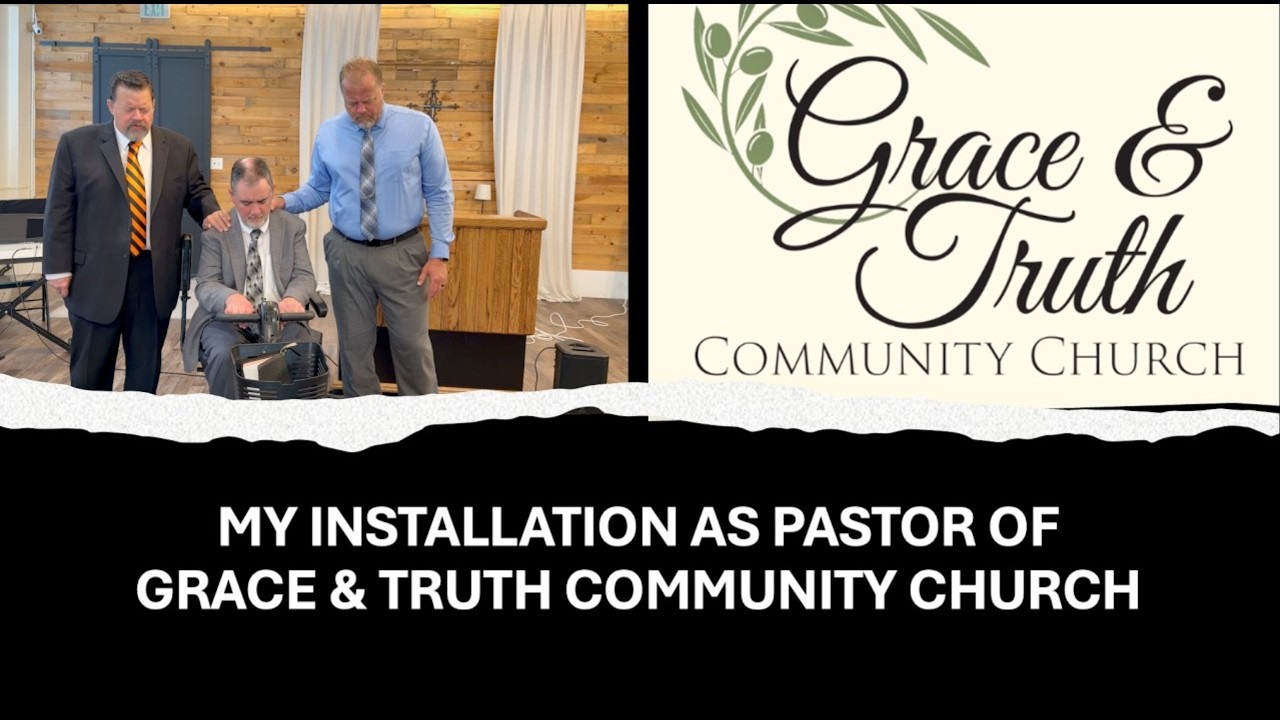
Welcome to the program, ladies and gentlemen. My name is Justin Peters. I hope that this finds you and your family doing well today. Want to thank you so much for joining me. This is a bit of a different video from what you are accustomed to on my channel. This is my installation service as pastor of Grace and Truth Community Church.
Some of you may have heard already that I'm pastoring a church now and indeed I am. We meet at a little place called the Front Porch in Laurel, Montana. We are renting that place on a a weekly basis and that's where we meet. But um our first official meeting, I guess, was back December 28th of 2025. And um I was serving as the effective pastor uh from that point forward. But the plan was always to bring in another man.
And I was on a monthsl long search to uh uh have another man come and serve as pastor. We brought a couple of men up to preach for us. But the reality was just setting in with with everyone that uh with a church of just 25 or so people uh supporting a man financially in the pastor, it's just not a feasible thing for a church body that small. Uh but as the months went on, um hearing from people, uh people began to prevail upon me that they wanted me to be the pastor of the church. And that's that's kind of what happened. And it has now been made official, I suppose, with my installation service this past Sunday, July 19th.
Phil Johnson came in to preach, as did Jim Osman. Uh they both came in and preached. So, it was a very meaningful service, and I thought some of you might like to see that. So, that's what this video is. Uh it's a recording of the service. We I cut the music out.
It's just the the uh preaching. So, I'm going to put timestamps below in the description so you can navigate this. The first 6 or 7 minutes or so is uh me just with some introductory comments. I'll have a timestamp for that if you'd like to skip that and go straight to Phil Johnson's sermon. Timestamp below for that as well where that begins. And then a timestamp for where Jim Osman's sermon begins down below.
And then after Jim's sermon is my official installation and I come forward, they had me come forward and they lay hands on me. I did not speak in tongues, but they did lay hands on me and uh prayed over me. And that was a very uh special time, very meaningful time I think for all of us, myself included. And there is something really funny in there too. So you want to you would like to see that for sure. uh timestamp down below in the description uh right as my installation begins. You'll get a kick out of it.
So, uh typical Jim Osman, you'll enjoy it. All right, dear ones. So, I hope this is helpful for you. If if you would ever like to come and visit us, uh we would love to have you. I'll put a link down below in the description to our church's website as well. And so if you're ever in the greater Billings area on a Sunday and want to join join us for worship, we would be delighted to have you.
And if you live in the south central portion of Montana, um or even the northern part of Wyoming, and we're not too terribly far away from there either. Uh and you're looking for a church home, we would love to have you as well. All right, dear ones. Well, without any further delay, here is my installation services as pastor of Grace and Truth Community Church. Okay, dear ones, good morning. Morning.
Good morning. Hope everyone is doing well this morning. Uh it's a joy to be with you on this Lord's Day. just uh less than a year ago, I never would have dreamed that I would be pastor of a church plant. And yet here in God's providence, here we are. And God's providence is always always good. And though this is my official installation, uh our first Sunday as a church body was December the 28th.
And so it has been I guess I've been the pastor in effect, the pastor for the last eight months or so. And uh it has truly been a joy to be with you and to serve as your pastor. And I think as the months have gone on, the Lord has done a work in all of our hearts and has certainly knit mine and Kathy's to yours. And uh it's been such joy. It truly has uh to see growth uh not just numerically, but growth in depth and conviction of God's word. And by his good graces that will continue as we strive to serve Christ. this morning.
Very special day this morning. We have a number of guests with us. And for all of those of you who are guests, welcome. We want to welcome you to Grace and Truth Community Church. Um, but the guests that will be leading us this morning, we have Josh and Charlotte Comtock. Josh and Charlotte have been friends of Kathy and me for 10, 11 years or so.
And uh, we've gotten to know them. Josh is a deacon at Coupney Community Church in Sanpoint, Idaho. and he attends uh he goes with me on most of my international trips. Josh goes with me and he's been an enormous help to me in so many ways and he will have many stars in his crown because of all the the ways that he has helped me in our international travels and he also serves on my board of directors and Josh and Charlotte helped to lead the music at Trinity Community Church as well. We have with us Jim and Dedri Osman. Jim and Dedri have been friends of ours for 15 or so years. And Jim serves as the pastor of Coupney Community Church, Sandp Point, Idaho.
And uh that's where Kathy and I were members for several years until we started having grandkids and the grandkids pulled us eastward. Um but it's a joy to have Jim and Dedri with us. Jim also serves on my board of directors. And then Phil and Darlene Johnson, they are with us as well. Phil has just recently retired within the last few weeks retired from serving as the executive director of Grace to You, a ministry I think with which all of us here are familiar and we are grateful for. He served with Grace to You and alongside John MacArthur for 43 years and uh just many many years of faithful ministry and service to the Lord and it's an honor to have him with us.
All of these men, Josh Commtock and Jim Osman and Phil Johnson have been dear friends of mine and they have served as um models for me in Christian character and integrity. They've been a source of encouragement and counsel for me as well. And so I just uh could not be more thankful to the Lord to have them here with us. And um Jim hates it when I say this, but Jim and Phil Johnson are two of my favorite living preachers. Uh two of my favorite preachers to listen to. And so to have them both here at my installation service is a is a wonderful blessing and kind providence of God.
And so uh it is a joy to have all of these Phil, Darlene, Jim, Dedri, Josh, and Charlotte, dear friends of Kathy and me. So, uh, very special thing. Let's go to the Lord in a word of prayer and we will begin. Well, it is both a joy and a privilege for Darling and me to be here this morning. And I want to start by saying how much I appreciate Justin Peters and especially the courage he has shown for dealing with difficult doctrinal and ecclesiastical matters. Hang on a second.
Oh, sorry. I don't even know what I'm saying. Anyway, I appreciate his courage. the way he has uh gone to battle when necessary to defend doctrines and uh practical issues in the evangelical church and especially in these post-modern times. It is very rare to see anyone express biblical convictions with without trying to soften or mitigate everything that might, you know, seem out of step with the times. Things that would be unpopular. people just don't want to say and sometimes it's necessary to say things that would be unpopular. Justin is one of those rare men who has the courage to state truth plainly and to stand strong when the storms of opposition are aimed directly at him.
And so I have the mo utmost respect for him and in no small part for that reason. He ministers faithfully and constantly and uh on a worldwide scale. I've actually been overseas with him a couple of times and I hate those long flights overseas and all the inconveniences associated with travel and because of his physical condition. Obviously those problems are multiplied exponentially and you know I I uh I'm suffering from the pains of old age and I'm like I'm not going to fly anymore anyway. But he goes everywhere and does everything without complaint. And uh I love him for that.
He uh and also regardless of how much worldly opposition he he takes, you know, gets he takes seriously the uh apostolic mandate to guard the treasure that we have been given. And in that same spirit, I have chosen a passage this morning from the Apostle Paul's letters to Timothy. 2 Timothy 2. And we're going to look at verses 14- 26. So 2 Timothy 2. Now, you realize, I hope, that Paul's main aim in writing these two epistles to Timothy was to encourage and equip him to take up the mantle after Paul went to heaven. 1 Timothy 6:20. Oh Timothy, guard what has been entrusted to you.
And again in 2 Timothy 1:14, don't by the Holy Spirit who dwells within us guard the good deposit entrusted to you. And it's a fact that most of us are keenly aware of the of that that the fact that that there's a generation of godly men who were mentors to my generation and they've been dying off a lot in the past year and a half, two years. Uh just in the past year alone, we we have lost John MacArthur and Vodie Balcom and more recently Alan Martin. Some of you might not know his name, but he's no less important than either John MacArthur or Bodie Malcolm. Those men and a slew of faithful witnesses before them left all of us a legacy that we have a sacred duty to guard. And in our text, Paul instructs Timothy how to do just that.
So, we're looking at 13 verses from I'm going to lower this a we're looking at 13 verses from 2 Timothy 2. This is basically the second half of the chapter. 2 Timothy 2 14- 26. And I love this text. But I have to confess to you that in a very painful and personal way, it challenges me and rebues me. And I'll be honest, this is a passage of scripture that steps on my toes pretty hard. So I want to scan a context with you before I read the text.
The most familiar part of this passage, of course, is verse 15 where Paul urges Timothy to be diligent in the quest to present himself before God as one approved, a workman who has no need to be ashamed of rightly handling the word of truth. And this is also where in verse 17, Paul compares false teaching to gangry and even names. two false teachers by name, Himaeus and Phileus, who he says have swerved from the truth. So he's instructing Timothy to be faithful in every sense, be hardworking, be plain spoken, and even be outspoken. Outspoken because two chapters after this is where he is going to tell Timothy, preach the word and do that in season and out of season. Re rebuke, reprove, and exhort. And he says, "Do that even when people are beginning to have their ears or people are begging to have their ears tickled with a more pleasing kind of storytelling." And so Paul's final message to Timothy is an extended plea for him to have courage and to proclaim the truth boldly and to be prepared to defend the truth against those who don't like it.
And he gets right to the point in verses 13 and 14 of the opening chapter here in second Timothy with this command. Follow the pattern of the sound of words that you have heard from me and guard the good deposit entrusted to you. And then notice in the very next text 15 Paul names by name again he names two other ecclesiastical miscreants. One of the saddest verses actually in all of Paul's writings. You are aware he says that all who are in Asia turned away from me among whom are felis and herogynes. And he tells Timothy be faithful to guard the legacy that I'm leaving to you even if it seems like you're the only one left.
And that's his charge to Timothy. It's an it's an exposition actually of the closing exhortation he gave at the very end of his first epistle to Timothy. 1 Timothy 6:20. Oh Timothy, guard the deposit entrusted to you. And that remains Paul's main message to his protege all the way to the end of his life. All those familiar pastoral texts that I know you've heard again and again about rightly dividing the word of truth and preach the word in season out of season. Be watchful in all things.
Endure afflictions. Do the work of an evangelist. Fulfill your ministry. All of that is simply an extension and an application of Paul's desire to see Timothy follow the pattern of sound words and guard the good deposit that had been entrusted to him. And notice that expression. I've used it several times this morning already.
Guard the deposit entrusted to you. That is not only the closing admonition of first Timothy. That's where Paul starts this epistle. in 2 Timothy 1:es 13 and 14. And he stresses that throughout his writings to Timothy that faithfully guarding the good deposit is is going to be a continuous struggle. It's not an easy thing and it's not something you do once and it's done forever. It's a fierce striving that entails conflict and persecution and perhaps even martyrdom.
And nobody knew that better than Paul. He was living it. And so he keeps saying things to Timothy like share in suffering for the gospel and all who desire to live a a godly life in Christ Jesus will be persecuted and endure suffering. He's saying ministry, faithful ministry involves adversity and trouble. Faithful ministry is nothing less than spiritual warfare. And both of the epistles Paul wrote to Timothy are filled with admonitions for him to be strong and be courageous and wage the good warfare, fight the good fight of the faith.
So this isn't a new idea for Timothy. It's not anything he's never heard from Paul before. But this is precisely where our chapter starts on a militant note. Chapter 2:3. Share in suffering. Notice this. as a good soldier.
Don't miss this. Paul is likening pastoral ministry to soldiering. Just one more reminder to Timothy that ministry involves warfare. It's a battle. It's an unrelenting battle to proclaim and to preserve the truth in a context where the truth is often met with animosity and opposition was no different then than it is for us today. And it's not just the unbelieving world, but I want you to notice in the context I just covered with you quite often and and I think more and more often nowadays in our time, even large segments of the visible church react to unpopular and inconvenient truths, sometimes with overt hostility.
The time has come, as Paul said it would, when people will not endure sound teaching, but they've accumulated for themselves teachers who suit their passions and tickle their ears. They've turned away from listening to the truth and they've wandered off into myths. And that is the state of the larger evangelical movement in America today. And Paul is telling Timothy and and so by extension he's saying this to all of us, especially those who are pastors or elders or teachers at any level. If you cater to that demand for people to have their ears tickled, if you if you cave to that at all, if you're not engaged in the fight to guard the good deposit that was entrusted to you, then you're not really being faithful to your calling. So be faithful.
That is Paul's message boiled down to a simple two-word command. Be faithful. And I want you to look at verse 11 here. Paul seems to be quoting something that would be familiar to Timothy because he calls it a saying. It's a reliable saying. He says trustworthy and it's arranged in poetic fashion.
So I think this was probably a hymn or a portion of a hymn about martyrdom and the blessing of suffering for Christ's sake. And it was probably a chorus that was sung in first century churches in their worship services. And it went like this. If we have died with him, we will also live with him. If we endure, we will also reign with him. If we deny him, he will also deny us.
If we are faith faithless, he remains faithful for he cannot deny himself. And that little hymn or poem or however you want to look at it, that saying that faithful saying is the lead in to our text. And it, by the way, it's a it's a hymn that would, I think, make a great theme chorus for an evangelical conference someday because it's all about faithfulness. both the enduring faithfulness of God who remains faithful even if we are faithless and the hymn also celebrates the rewards of living faithfully if we endure we will reign with him and then right after the hymn you have our passage so I'm going to read it now verses 14- 26 Paul says remind them of these things solemnly charging them in the presence of God not to dispute about words which is useless and leads to the ruin of the hearers ers be diligent to present yourself approved to God as a workman who does not need to be ashamed accurately handling the word of truth but avoid godless and empty chatter for it will lead to further ungodliness and their word will spread like gang green among them areas and phitus who've gone astray from the truth saying that the resurrection has already taken place and they upset the faith of some nevertheless the firm foundation of God stands having this seal. The Lord knows those who are his. And everyone who names the name of the Lord is to depart from wickedness. Now in a large house there are not only gold and silver vessels, but also vessels of wood and of clay, and some to honor and some to dishonor.
Therefore, if anyone cleanses himself from these things, he will be a vessel for honor, sanctified, useful to the master, having been prepared for every good work. Now, flee from youthful lusts and pursue righteousness, faith, love, and peace with those who call on the Lord from a pure heart, but refuse foolish and ignorant speculations, knowing that they produce quarrels. And the Lord's slave must not be quarrelome, but be kind to all, able to teach, patient when wrong, with gentleness, correcting those who are in opposition. If perhaps God may give them repentance, leading to the full knowledge of the truth, and they may come to their senses and escape from the snare of the devil, having been held captive by him to do his will. Now, that passage is in effect Paul's own commentary on 1 Timothy 4:16 where he told Timothy, "Keep a close watch on yourself and on your teaching." And here he's simply expounding on that two-pronged command. How can how can how can we both elders and church members guard ourselves and guard the teaching?
And this passage is a fairly comprehensive answer to that question. How do you do it? What's the practical steps? Here it is. And it's a three-fold answer. Paul says, first of all, verse 15, be an approved workman.
And he's saying, guard your teaching. Second, verse 21, be a sanctified vessel. And there he's saying, guard your own heart. And third, verse 24, be a humble slave. And there he says, "Guard your attitude." And it's all right there in this passage. So let's look at these one at a time.
Here is how to be a faithful guardian. First of all, be an approved workman. Guard your own teaching. One intriguing fact that is obvious from even a cursory study of Paul's New Testament epistles is that the early church was, and this is a sad fact, but it's true. The earliest church was already beset with heretics and false teachers and they existed from the very beginning. All of Paul's epistles except the little book of Phileiman.
All of Paul's other epistles deal with problems that stemmed from false teaching in the church. He wasn't concerned about the opposition from the outside. He acknowledged it and said it's inevitable. But the stuff he had to correct was the false teaching that was coming from within the church. And not only not only Paul, but the apostles John and Peter both likewise had to address and correct significant doctrinal errors in every one of their epistles. Even in Christ's letters to the churches in Revelation 2 and 3, a major and recurring theme throughout those letters from Christ is the damage that had been done to those flocks by heretics and false prophets and unorthodox teachings and antonyomian behavior and even right apostasy that had already infected those churches from within.
And one other thing that the New Testament stresses is that false teaching from within the visible church is actually a greater far greater threat to the spiritual health and well-being of the church than all of the combined persecution and antagonism and ridicule and every other kind of opposition we get from the world. That's not really a threat to the purity of the church. But the stuff that comes from within that is and Satan's primary attack on the church is not being carried out by atheists who openly despise Christianity and deny the truth of scripture. We get real worried about people like that. That's not the biggest threat. The most relentless and effective assault on the body of Christ from Satan comes from within the visible church of professing believers. a community of professing believers.
You know, the devil himself disguises himself as an angel of light. That's 2 Corinthians 11:14. And verse 15 goes on to say, "His servants also disguise themselves as servants of righteousness. They come into the church." Scriptur is warning us that even the visible church is filled with satanic agents. Servants of Satan disguise themselves as servants of righteousness and they inject false beliefs and corrupt teachings that then spread like gangry. Paul says and even names two examples by name verse 17 Iona and Phileus who swear from the truth.
Look at their error. They were saying that the resurrection has already happened. They're upsetting the faith of some. Now this guyas by the way was a real rogue. He was the he was the Rob Bell of the first century. You know, he never met a heresy he didn't like.
And Paul first mentions him in 1 Timothy 1:20 where there he is linked with someone named Alexander. And apparently, I think that's the same Alexander the copper smith that's mentioned in 2 Timothy 4:14 of whom Paul says he did mean great harm. We don't know what he did, but whatever Alexander was doing was destructive to both faith and morality. He was probably teaching a blasphemous corruption of the principle of grace that fostered lewd or lascivious behavior because Paul says Alexander and Himnaeus had abandoned both faith and a good conscience and uh they had made shipwreck of the faith. He said and he says, "I've handed them over to Satan so that they may learn not to blasphe." So these guys, they pretended to be believers, but Paul was convinced they weren't. And Paul had used his apostolic authority to summarily excommunicate these guys, which is what he means when he says he's handed them over to Satan.
He's basically excommunicated him. But notice in second Timothy, Himaeus is still troubling the church. And now he's got a new partner. Now he's linked up with Phileus and and together they are pedling a view of New Testament esquetology that says the resurrection has already happened. Today we call that predism. In other words, they were claiming that all of the end times prophecy that really matters has already been fulfilled.
And they were saying up to and including the resurrection of the dead. So they didn't believe in a literal bodily resurrection of the saints. And that of course was and it still is a fullfrontal attack on the cardinal doctrine of the Bible. Jesus himself had promised the resurrection of the dead in John 5:25. Truly, truly I say to you, an hour is coming and is now here when the dead will hear the voice of the son of God and those who hear will live. And I think Himaeus was probably telling people that the resurrection was only a spiritual rebirth and is not a literal bodily reality.
Of course, dead bodies that have decayed don't rise from the dead. He might have even been quoting Paul's words from Romans 6:11 where Paul says, "Consider yourselves dead to sin and alive to God in Jesus Christ." So there is a kind of resurrection that we have already experienced. It's not bodily resurrection though. And there were a half dozen ways these guys could have been trying to justify their pet heresy. The same her same same techniques heretics today use to twist scripture. And in fact I also suspect that Himaeus and Phas were a whole lot like the hyper predtoists that we have today.
They are quarrelome and arrogant and always trying to pass themselves off as eminent scholars who understand and know better than anyone else. And they're always spoiling for an argument or begging for a debate, convinced that the only reason anyone would ever refuse to debate them is because their arguments are just unassalable. So they're really arrogant. Have you ever noticed that the people who pedal these kinds of doctrines today always seem to be full of bombast and intoxicated with their own fleshly arrogance? Hineus had to be like that because Paul had already turned him over to Satan, excommunicated him, and now he's back but with a new sidekick and still enticing people to stray from the truth. But now he's got a different heresy.
The error here was significant and spiritually toxic. There's something about this particular heterodoxy that has a partic peculiar tendency to to ferment debauchery and to destroy genuine faith. According to verse 16, these guys were leading people into more and more ungodliness and even verse 18 destroying the faith of some. And so Paul names these men. and he singles them out for his disapproval. He's not reluctant to do that. He's not ashamed to do that.
He says precisely what their error was. He likens their influence to gangry. He's not mincing words here. It's clear that these guys posed a profound threat to the church, having already overthrown the faith of some. And so you might expect the apostle to amount a vigorous and detailed answer to their aberant doctrine. And in fact in a different context in 1 Corinthians 15 that is exactly what Paul does.
He meticulously refutes this notion that you can be a believer a Christian and not believe in the literal bodily resurrection of the dead. But notice here in this context, he doesn't go into those arguments. He he scorns the pretense of their enlightened scholarship by calling it profane and vain babbling. It's says it's vacuous. It's superficial. It's frivolous words to no prophet whose only fruit is the ruin of its hearers.
He simply tells Timothy, "Don't waste your time quarreling with these guys." Now clearly Paul doesn't mean that Timothy should just ignore the heresy. Paul himself doesn't ignore it. He names it and he simply dismisses it for what it is. And he's signaling to everyone on all sides that this is a bad doctrine so bad it doesn't even deserve to be treated with any kind of scholarly gravitas. Just dismisses it. And again, he's right to do that because the doctrine of bodily resurrection is one of the core issues of Christian conviction.
We believe that the saints are going to rise bodily from the dead. And so, the doctrine that was at stake is by no means trivial. And if you don't believe that, read 1 Corinthians 15. Uh Paul spends a great deal of time there declaring the importance of this doctrine where he says if there is no resurrection of the dead then our preaching is in vain and your faith is in vain. Christianity doesn't mean anything important if there's no resurrection from the dead. and he shows his commitment to the importance of this doctrine in the painstaking way he answers it in 1 Corinthians 15 point by point for the sake of people in Corenth who were confused but it's significant isn't it he doesn't do that here what is the difference it's simple here the question is whether he should engage people like Himaeus and Phas in a prolonged debate about the issue And Paul says to that question, "No, charge your people before God not to quarrel about words." And he's not saying that words are unimportant. He's not saying all words are trivial or inconsequential.
Words are important and especially in matters of faith and doctrine. And as a matter of fact, words are vitally important. Don't forget that in chapter one of this same epistle, Paul told Timothy, hold fast the pattern of sound words which you heard from me. Guard those words. The words are important. But here in our chapter, he's saying not to get into a protracted argument with someone who has already refused correction because verbally sparring with someone like that is a worthless waste of words. just words.
So, chapter 1:13 says, "Hold fast the pattern of sound words." And this verse means, "Don't get drawn into arguments over mere words." The person who's devoted to propagating a heresy like this is not going to gain anything from your squabbbling other than a widening of his own audience and maybe an inflated sense of his own self-importance. So, don't give them that. verse 16. It will just lead people into more and more ungodliness and their talk will spread like gangry. And by the way, Paul's going to return to this point in verse 23 when he's going to say have nothing to do with foolish ignorance controversies. So we have to ask what is the most effective response to a deadly error inside the church? even a damnable heresy like the hyper predtoism of Himaeus and Vitus. What should we do instead of quarreling about words with people who have already swerved from the truth?
And Paul's answer to that question is the familiar command of verse 15. Do your best to present yourself to God as one approved worker who has no need to be ashamed. Rightly handling the word truth. Now, so many preachers have done wonderful expositions of that verse that I'm not going to be laboring here. You're you're probably aware, I would guess, that the English expression accurately handling or in the King more familiar King James rightly dividing is actually translated from a single Greek word orthotoo, which literally means to make a straight cut. Paul is telling Timothy, "Handle God's word carefully.
Interpret it correctly. Cut it straight." That would be a literal translation. Cut it straight. Teach it plainly without revising it without adding to it, without taking away from it. You're not working with God's approval. If you're not doing it that way, and if you're not doing it that way, then you ought to be ashamed.
Remember, Paul worked as a tent maker. So, making your cuts straight was an important part of that work. and he uses that as illustration of how we should handle the word of God. Be careful in how you divide it or or cut it. But in this context, he's also making a bigger and even more specific point. He's telling Timothy that the optimal and most important and and most consistently effective way of being faithful to guard the good deposit that was entrusted to you, the most effective way to do that is to devote yourself to the careful, diligent study of God's word. Handle it correctly and do all of that as unto the Lord for his approval.
Don't don't worry about what people think or how they might respond. Do it for the Lord. That's the actual point. Be an approved workman and work hard to guard your own teaching from error. And in the process, you will do more to preserve and propagate the truth than you could ever do through a purely polymical and argumentative approach. Instruction is a better way to deal with error than taunting and insults.
Even though taunting and insults have their place, they do. I mean, look at Elijah if you don't believe me. But instruction in the long run is a better way to deal with error. Now, he's again, he's not saying like some people today do that that we should never engage in any kind of argumentation about doctrine. This is after all the Apostle Paul who is by no means averse to pointing out heresy and refuting. He did it all the time.
And as I said earlier, all of the apostles in virtually every one of the New Testament epistles, all of them exposed, and Jesus did too, exposed and debunked false doctrines, they did it carefully and emphatically and without compromise. And Paul did it with more relentless intensity and energy than anyone else. So he's not telling Timothy to do something different. No one hated false doctrine more passionately than the Apostle Paul. False teachers, you know, stalked his trail and and they would sew confusion behind him in every church he ever planted, speaking twisted things to draw away the disciples after them. There is no way Paul would have discouraged Timothy from refuting those falsehoods.
But here's what I want you to see. How we review error is also vitally important. Paul didn't aspire to be a full-time palmist. Nor did he want that for Timothy or for any other church leader for that matter in Acts 20 when he tells the Ephesian elders that fierce wolves would come in among you not sparing the flock. And then he says to them, pay careful attention to yourselves and to the flock. In other words, don't get so fixated on the wolves that you lose focus on yourself and on your own teaching and on the flock that God has entrusted to you to care.
And in the sentence immediately precedes that command. He reminds them what his own style of ministry was like. And it wasn't about arguing with with heretics. He did do that. But the core of his ministry, what occupied his time, he describes it this way. I did not shrink from declaring to you the whole council of God, doctrine and training in righteousness as well as reproof and correction.
Paul's rep reproofs and rebutes and exhortations were always tempered with complete patience and teaching. And that is precisely how he wanted Timothy to teach. Now, Paul was of course capable of sharp rebutes and stern warnings, harsh words, even biting sarcasm at times. There are occasional examples of all of those things in the writings of Paul, but they are fairly rare by in comparison. That was never his default tone. 1 Thessalonians 2:7, he says, "We were gentle among you like a nursing mother taking care of her own children." So what gave Paul the ability to remain both dignified and gentle even when the most gangrinous kind of false teaching reared its ugly head. It was his unshakable confidence in the sovereignty and the steadfast faithfulness of God.
It wasn't a wasn't a self-confidence. It wasn't any kind of arrogance. It was his confidence that God is sovereign and steadfast and faithful. Right on the heels of describing the destructive impact of Himaeus and Phileitas, he says this, but God's firm foundation stands bearing this seal. The Lord knows those who are his and let everyone who names the name of the Lord depart from iniquity. two statements, both of them are taken and paraphrased by Paul right out of Numbers chapter 16. These are Old Testament references that he's woven into this epistle.
And number 16, that's the passage that tells us about the rebellion that was led against Moses by Kora where, you know, the earth opened up and swallowed up about a ton of rebels. I forget the number, but it was a lot. And the point I think he's making is that if we stand for the truth and speak up for the truth and proclaim the truth in the face of error, God himself will humble the rebels. That part isn't really our job as guardians of the truth. Although it's fun sometimes, it's not really what we're called to do. Vengeance belongs to the Lord.
We're we're not called to be God's avengers. The real challenge for us is to humble ourselves under the mighty hand of God so that at the proper time he may exalt us. One thing is clear, Paul did not share that combative temperament that so many people nowadays associate with discernment. He was nothing like those podcasters who who say they're do doing discernment ministry who just seem to relish conflict. They love to get angry and be angry and be insulting and be demeaning to people. I know you've seen them.
Their their native mode of expression is harsh, costic, hyperritical, bitterly sarcastic, and always canankerous and constantly quibbling. Never never softening any of that with any kind of expressions of love or care for the people whose error they're answering. That attitude actually disqualifies a man from eldership in the church. 1 Timothy 3:3 says, "An elder can't be a drunkard." That we understand. He can't be a lover of money. That makes sense as well. But sandwiched right between those two disqualifying statements is this one.
He must not be pugnacious, but be gentle, peaceable. Because after all, true discernment is motivated by the Holy Spirit. And the fruit of the Holy Spirit is love, joy, peace, patience, kindness, goodness, faithfulness, gentleness, self-control. There is not a hint of bellacosity anywhere in that list. And so, by all means, guard the truth, but start by guarding your own teaching. And that includes the tone and temperament with which you teach.
Does it make you uncomfortable for me to dwell so long on this particular point? Makes me uncomfortable because doubtless you will quote to me this proverb physician heal yourself. And if you want to point out that and some of you maybe have read my blog over the years or seen me online want to point out that there are times when I have seasoned my own words or salted my blog posts with a little more grace. I'll hang my head in remorse and plead guilty. And I've already admitted this section of scripture convicts me. But notice how prominent this theme is in our passage.
It's where Paul starts and it's where he ends. Verse 14, don't quarrel about words. Verse 23, have nothing to do with foolish, ignorant controversies. You know that they breed quarrels. And then from that verse to the end of the chapter, he keeps stressing the need to be gentle and patient rather than harsh and pugnacious. So, so we're not yet done with this point.
We need to come back to it again before I finish with this text. But that's the first thing that we have to do in order to be faithful guardians of the deposit that we are called to steward. Resist being quarrelome. An illtempered, contentious spirit is the log in the eye of everyone I have ever known whose only real passion is to call out the errors of other people. And for anyone who that's their approach to discernment, that constant polymical angry style, if that looks and feels like gamesmanship, they're doing it wrong. Paul says it like this, "Be an approved workman.
Guard your teaching. Guard your own teaching first of all. Here's a second duty for the faithful guardian. Number two, be a sanctified vessel. Guard your own heart. In verse 20, he employs an analogy that was never far from his mind.
It's the idea that human beings are vessels made by God for God's own infinitely wise and sovereign purposes. And some are made for honorable purposes and some for dishonorable. They're all useful, but they're not all equally honorable. Their dignity is not determined by what they are made from. It's determined by what they are made for. For example, you might have a a spatoon made out of solid gold, but it's still just a thing to be spit into.
On the other hand, you might store jewels and money in a container made of clay. That's a vessel for an honorable purpose. That's exactly the kind of illustration Paul is using here. And by the way, he borrows this analogy from the Old Testament. It's rooted in Jeremiah 18 where God is the great potter. And the same word picture is also mentioned in Isaiah 29:16, also mentioned in the book of Lamentations.
In fact, here's Lamentations 2:4. The precious sons of Zion, worth their weight in fine gold. How they are regarded as earthn pots, the work of a potter's hands. Earthn pots worth their weight in fine gold. But that's not because of anything intrinsic in them. They're just dried up clay.
But their immense value is owing to the purpose the potter has designed them for. And Paul uses exactly that imagery in 2 Corinthians 4:7 where he says this about being entrusted with the truth of the gospel. We have this treasure in jars of clay to show that the surpassing power belongs to God and not to us. Think about that. We, that's you and me, are like vessels of clay, which means we are in and of ourselves crude and inconsequential and without much intrinsic value or true beauty. But we are useful to the Lord for a holy purpose and that gives us inestimable worth and dignity.
And therefore, Paul says it behooves us to keep ourselves pure. Be a sanctified vessel. Guard your heart. Verse 21. If anyone cleanses himself from what is dishonorable, he will be a vessel for honorable use, set apart as holy, useful to the master of the house, ready for every good work. Now, notice this is our duty.
God's sovereign will to save us from our sin doesn't doesn't nullify our duty or real responsibility to mortify the sin. In fact, look back at verse 19. These two statements adapted from Numbers 16. Expressly affirm both the sovereignty of God and the responsibility of the human vessel. The Lord knows those who are his. That's God's sovereignty.
And let everyone who names the name of the Lord depart from iniquity. That's human responsibility. In verse 21, Paul is merely expounding on that responsibility that we have, stressing the principle of human responsibility. So verse 19, depart from iniquity. Verse 21, cleanse yourselves from that which is dishonorable. And here's how to do that.
Verse 22, flee youthful passions and pursue righteousness, faith, love, and peace along with those who call on the Lord from a pure heart. flee what is unholy and follow what is holy. Now, of course, the context, as we've seen already, makes it clear that one of the youthful passions that we have to flee, he's not just talking about lust, although he certainly includes that. One of the youthful passions we have to flee is that biting combiveness that young men are especially prone to. But it's clear that that's not all he has in mind either. The the Greek term epitheia speaks of evil desire. In the NIV, it says the evil desires of youth.
Don't usually quote the NIV, but they get the sense of that perfect. And the the term is just that broad. It's a it signifies a covetous craving for anything or something that cannot be righteously or lawfully obtained. So it covers everything from that sort of arrogant pheriseical sense of superiority to any other kind of fleshly self-gratification. And yes, sexual lust is included, but that's not all of it. Most translations say lust and epitheia is often used to signify concubisence, which is an old world word that simply means sexual lust.
And he says, "The passions of the flesh wage war against your soul." And that is true of all such passions, the the proud youthful arrogance as well as burning sexual lust. They're all the same. They all wage war against your soul. So guard your heart from those things and then mortify those dishonorable passions because verse 21, if anyone cleanses himself from what is dishonorable, he will be a vessel for honorable use, set apart as holy, useful to the master of the house, ready for every good work. So to review verses 14- 19, be an approved workman, guard your church's teaching. 2:es 20 and through 22, be a sanctified vessel. Guard your own heart.
And now third verses 23- 26, be a humble slave, which means guard your basic attitude. Notice verse 24. Paul refers to Timothy as the Lord's servant. And the Greek word there signifies a slave. We we hear the word servant. We think like a server, like the waiter in the restaurant. is not that.
It's an abject slave. Someone who is literally owned, possessed by his master. 1 Corinthians 6:19. You're not your own. You were bought with a price, a slave. That's how every pastor and every Christian is supposed to selfidentify. The pastor, you know, is not the CEO of the church.
He's the Lord's servant. And the task he has been given involves shephering and teaching. And his work therefore involves leading but not lording it over those who are allotted to his charge. Jesus said if anyone would be first, he must be last of all and slave of all. But that's a command not only for the pastor. That's a command for all Christians.
Cultivate the attitude of a slave rather than the arrogance of a Pharisee. Paul himself, you know, had been trained and lived for years as a Pharisee, uh, pedenting theological nitpicker, passionate about things like ceremonial orthodoxy and Sabbath obser observance, really to the point of literal violence where he voted for the death of Steven, the martyr. In fact, here's Paul's own testimony about that from Acts 26:es 10 and 11. I not only locked up many of the saints in prison after receiving authority from the chief priests, but when they were put to death, I cast my vote against them and I punished them often in all the synagogues and trying to make them blaspheme and in raging fury against them. I persecuted them even to foreign cities. He's saying that with shame.
That's the old Saul of Tarsus. What he did Jesus represented the polar opposite style and temperament. Matthew 12:es 18- 20. He will proclaim justice to the Gentiles, but he will not quarrel or cry aloud, nor will anyone hear his voice in the streets. A bruised reed he will not break, and a smoldering wick he will not quench until he brings justice to victory. So Jesus by doing that put the Pharisees to shame.
But he did it chiefly with his teaching. He didn't chase them around. carping at them about their theological errors. They did that to him and he answered all their challenges and he admonished his his disciples about the evils of the Pharisees hypocrisy in a very long discourse in Matthew 23. That whole chapter is filled with stern and plain spoken words of woe and warning. There are actually seven formal pronouncements of woe and condemnation in that one chapter. That that was Jesus.
But he was never unkind or abusive. And significantly, even when he stopped Saul of Tarsus on the Damascus road, if you ever noticed, it was not with harsh words of condemnation, but it was a tender appeal. Saul, Saul, why are you persecuting me? And that encounter changed everything about Paul, including the ruthless way he had always handled his theological opponents. His attitude now was marketkedly different. As I said, he used both stinging sarcasm and severe words of condemnation about the Judaizers because their relentless efforts to confound the gospel and law were leading people under his pastoral care astray.
He told Titus, you know, that the lazy cretins that needed a sharp rebuke. And in Acts 3:10, he speaks directly to Elilamus, the magician, and he says, "You son of the devil, you enemy of all righteousness, full of all deceit and villain. Will you not stop making croo crooked the straight paths of the Lord?" That's a that's a sharp rebuke by any measure. As we've seen, sharp rebukes are occasionally necessary. But here's the point. Not usually and certainly not all the time.
Sometimes, even in the face of gross evil, a sharp rebuke might be inappropriate. On one occasion, Paul gave a sharp rebuke to the high priest. But he apologized when he realized whom he had rebuked. that fierce cruelty and and brutal callous savage zeal that he had as a Pharisee, zeal for condemning and punishing all of his adversaries. By the time he's saved, that's utterly gone. And you see that boast clearly right here in our text and how he counsels Timothy. He tells Timothy verse 24, "The Lord's servant must be kind to everyone, patiently enduring evil." And I think he means it.
In fact, there's no doubt he means it. This final paragraph of 2 Timothy 2 returns to the theme that ties this whole passage together and he now summarizes the point as plainly as possible. Verse 23, have nothing to do with foolish ignorant controversies. You know that they breed quarrels. Now, obviously, not every controversy can be automatically classified as foolish and ignorant. I'll say it again.
Paul himself was at the vortex of controversy through most of his ministry, if not all of it. It was controversy over key tenants of gospel truth. He was not arguing with fresh seminary graduates over the fine points of their dispensational charts. He was defending the core truths of the gospel. But sometimes controversies over those cardinal doctrines can be foolish and ignorant as well. Remember Himaeus and Phileitus taught a doctrine that in effect denied the future bodily resurrection of the saints.
That is not a trivial error. But Paul doesn't engage them in any kind of controversy. He doesn't want Timothy to either. Himaeus's unteachability was wellestablished by now and that made a controversy any kind of controversy with him useless and in fact helpful to Imanas not helpful to the truth and therefore that was a that would have been a foolish controversy and Paul no doubt would have patiently instructed anyone who was confused by him's false teaching the way he did in 1 Corinthians 15 but he isn't going to legitimize Himaeus by engaging him in a public dispute or a fight on Twitter. But the Apostle Paul, in fact, he's nothing like those people whose only ministry is to use the internet to maximize scandal every time they find a doctrinal error or an inconsistency somewhere. Paul rejects that kind of controversy mongering because he says it engenders strife.
And we know it does. It breeds contentiousness and quarrels among foolish, unlearned people whose passions are fueled more by their own ignorance than by their understanding of scripture. Because and you know that because insults and derision are their default tone and that is of no help to people who are merely confused. An unkind and abusive polymical style can literally drive people deeper into error. Proverbs 26:21. As charcoal to hot embers and wood to fire, so is a quarrelome man for kindling strife.
Proverbs 15:1. A soft answer turns away wrath, but a harsh word stirs up anger. Romans 12:21. Overcome evil with good. and the the brutal arrogance that you often see in online discussion forums that is absolutely contrary to the true aim of a godly teacher who wants to obey the spirit of scripture. Verse 24, the Lord's servant must not be quarrelome, but be kind to everyone, able to teach. And given the context here, he means gifted and eager to teach rather than, you know, someone who's always just itching to dispute, apt to teach, patiently enduring evil, correcting his opponents with gentleness.
God may perhaps grant them repentance leading to a knowledge of the truth and they may come to their senses and escape from the snare of the devil after being captured by him to do his will. So that's the actual goal. He makes it very clear there. The goal is not to condemn people but to deliver as many as you can from the strongholds of error. And Paul's words to Timothy about this are too numerous and too emphatic to just brush them aside. religion that is pure and undefiled before God does not consist in ceaseless disputation and the weapons of our warfare are not carnal. So, let me say this as candidly as possible for for the sake of of anyone who might hang out in internet forums and and think that, you know, this is a great thing to to have these constant arguments about trivial points of theology, especially those who think they're really gifted in the area of political theology and esquetology.
They want to argue about, you know, the timing of the rapture or whatever. If you want to be a guardian of the truth, but you consistently ignore or even throw scorn on the clear message of this passage, you sacrifice a significant amount of credibility in everything else you say. Because rational people won't take you seriously, nor should they. if they know you're just dismissing what Paul says here and the way you carry out your ministry. If you really want to be a faithful guardian of the truth, you need to guard your own heart against any temptation to ignore or downplay or explain away or minimize the truth of what Paul is saying to Timothy in this chapter. Now I say all that and I hope I hope if you know me at all you know that I believe with all my heart that error must be candidly confronted and corrected. Why I love Justin so much because he does this he does it patiently.
He does it with as much grace as anyone you'll ever find online. And yet he's often the target of the bitterest condemnation from people who fancy themselves, you know, great discerners or whatever. I hate error and by all means put away falsehood and let each one of you speak the truth with his n neighbor. But while you are doing that, Paul says, let all bitterness and wrath and anger and clamor and slander also be put away from you. Those things are as bad as the heresy. And along with all malice, he says, "Put it away and be kind to one another, tenderhearted, forgiving one another as God in Christ forgave you, and speak the truth in love." You have a great model for that in Justin.
That is how you also can be faithful in your guardianship of the truth. you won't have maybe the the same kind of forum and outreach that Justin has, but in your circle of influence, strive to do this. Be an approved workman. Be a sanctified vessel and be a humble slave. In other words, keep a close watch on your own teaching. Diligently guarded guard your own heart and your imagination and your thought life and your passions and your personal purity. And while you are at it, keep careful control of your attitude.
Wage good warfare, having faith and a good conscience, and hold fast fast the faithful word as you've been taught, and you will be able by sound doctrine both to exhort and to convict those who contradict. If all those things in order are in order, you will be a good soldier of Christ Jesus. You are supremely blessed to have a pastor who models all of that for you. Honor him by imitation. He might well say, as the Apostle Paul says, "Be imitators of me just as I also am of Christ." Let's pray. Father, we thank you for Justin and for his longtime sacrificial service boldly and courageously to the body of Christ.
You've given us a model of faithfulness, courage, discipline, warm-hearted devotion. May we imitate him as he imitates Christ. And give Justin and this church a long and blessed ministry. Give give the people of this congregation firm hearts with regard to the truth and loving hearts for their neighbors. And for those whom you place in this fellowship, give us all generous hearts towards brethren with whom we disagree. Give us tender, caring hearts for those in our world who are held captive by the lies of the devil. and give us courage to speak the truth in love, especially when it's necessary to confront error.
May we always speak the truth in love. May we be passionate for the truth and may that passion always be tempered not by fleshly arrogance, but by the meekness and humility of Christ. For his sake, for his glory, and in his name we pray. Amen. All right. Will you turn your Bibles to the book of Hebrews to chapter 13?
We're going to be looking at verse 17. Hebrews 13 verse 17. I'm just preaching on one verse. Phil preached on 13. And if you were hoping that my sermon is going to be 113 the length of Phil's, you're about to find out how sorely misplaced your hope is. But your attention span is probably spent by now, but it couldn't have been spent in any better way than listening to Phil go through that vital passage.
I would just ask of you just a little bit more attention this morning as we turn to a passage that emphasizes the responsibility of those in the church toward their leaders. Phil's passage and his address had to do with the responsibility of a pastor and consequently also a church to guard the truth. within this passage addresses the responsibility particularly of those inside the congregation toward their leaders. So Hebrews chapter 13, we'll just read together this one verse, verse 17. Obey your leaders and submit to them for they keep watch over your souls as those who will give an account so that they will do this with joy and not with groaning. This would be unprofitable for you. That is a very concise, straightforward command.
There's not a lot of explanation given in the passage. It's not elaborated on very much. But if you look at this passage, it is filled with a lot of rich details. This command seems a bit antiqu ant antiquated to our modern years because we live in an individualized society where we are conditioned to be separated from others and we are conditioned to get together with others on our own terms through our electronic devices where we can sort of curate our own environment and select our own leaders and submit to and select our own teachers almost in in a whimsical fashion. And just with the touch of a button or the tap of our finger, we can have access to anyone and anyone's teaching that we want. This command also seems a bit unnecessary to our modern life.
I mean, after all, why would I submit to leaders? Who would be my leader? I could I can go to church on Zoom. I can watch John MacArthur preach even though he is in the Lord with the Lord in glory. I can watch Phil Johnson preach or Mike Ricardi preach or Vodie Bacham's sermons and we can bring all of those into our home. We can put them up on the screen.
We can have uh fellowship with people in online churches. And why is it that I would need to submit to the pastor or the leaders of a local body and in fact this command seems even a bit ridiculous to American ears. Submit to leaders. We don't submit to authority. We're Americans. We rebel against authority.
We cast off authority. We want to have revolutions to get rid of authority. So the whole notion of submitting to those who are in leadership and submitting to those who are in authority and particularly obeying that kind of authority seems quite unamerican. But the truth is that you and I submit to all kinds of people in all kinds of environments in all kinds of ways at times. In fact, you will submit to the do instructions of a doctor who tells you to pursue a certain path of treatment or or a certain regimen for your own health. You would submit to law enforcement officers to their instruction when they're giving traffic, directing traffic or controlling the crowd.
We submit to and obey the advice of financial advisors when they're giving us instructions on our investments. We submit to all kinds of people. Here's the key. When we believe that what they're saying and what they are doing is in our best interest and for our good, we're willing to submit to them and the truth holds true as well in submitting to those who are in leadership and authority over us in the church. In those situations that I just mentioned, we're convinced that they know what is best for us and we believe that and we know that they are and believe that they are leading in our best interests and have our well-being in mind and therefore we're willing to submit to them. and in the church. That is certainly true with those who are elders and deacons within the church.
And that is why the author of this letter encourages his readers to submit to those who are leaders inside of their congregation, be they elders or deacons. And I'm about to make the case that I think what he has in mind here particularly are the elders of the pastors of the church. I want you to see that submitting to authority, particularly spiritual authority, is a profitable thing for the Christian. It is a profitable thing for the Christian. So let's ask the first question. Who are the leaders about whom the author is writing here?
How would we understand this reference to leaders? And what kind of leaders are they? Are they elders or are they deacons or are they civic leaders or are they political leaders? Are they leaders of industry? What kind of leaders is the author describing? And I think that the clue to that is in the text itself in verse 17.
You'll notice he makes mention to those keeping watch over your souls as those you must give an account. The description there of keeping watch over souls indicates a spiritual leadership, a shephering and soul care. And though the author does not here use any of the words that are typically referring to the office of elder or overseer, he doesn't use the the word that is translated elder. He doesn't use the word that is translated overseer or even the word that is in Ephesians 4 translated as pastor which is the word for shepherd. He doesn't use any of those terms. He is describing those who are doing the work of shephering.
Spiritual oversight and spiritual watchfulness is what he is describing there. He's already made reference if you look up in verse 7 of the same chapter the authors made reference to their former leaders. He said, "Remember your leaders who spoke the word of God to you and considering the result of their conduct, imitate their faith." And I think we can deduce that these are elders that are in view in this passage because of the description of their work. It is one of keeping watch over souls. He's describing shephering and soul care. And not only that, that there is here the command to obey and to submit to them.
And that is the type of language that would you would expect to be used for those who submit to the leadership of the church, the spiritual leadership of the church, elders and possibly deacons. The New Testament only gives this type of authority to the elders of the church. And you'll also notice that the command here is plural. The word leaders is plural and not singular. It doesn't say submit to your leader, but to submit to your leaders, plural. And the New Testament pattern is you have a plurality of elders, a plurality of godly men who jointly shepherd a local flock.
And so he's describing here that that council of men. And he is showing to us that good godly servant church leadership is God's good gift to his people. You heard that? Well, good godly servant church leadership is God's good gift to his people. And conversely, a congregation of people who honor and submit to and love and obey that leadership is God's good gift to the leaders. In other words, you congregation are a good gift to your leaders and your leaders are a good gift to you when everybody performs the role that God has ordained for them.
I want you to see in this verse that there are three reasons we should obey and submit to our spiritual leaders. First, because of the nature of their care. They keep watch over your souls. Second, because of the dangers that we face. There's a reason that they have to keep watch over your souls. And then third, because of the account that we must all give.
So, first, because of the nature of their care. There was a call here to remember the example of their former leaders. That's up in verse 7 where he describes them as those who spoke the word of God to them. And he reminds them of that remarkable quality that they had. These were men in the congregation who had taught the people and led the people and loved them well by speaking the word of God to them. And so the author here commands his audience to love them by obeying and submitting to them.
Two commands, both of them imperatives, and they kind of go together. The idea of obeying and the idea of submitting, these are similar ideas. There's some overlap in them, but they are a little bit distinct. The word obey here means to listen to or to follow, to yield to one. And the word submit here means to give way to or to defer to. And when we read the word obedience, you probably are thinking of the kind of obedience that Paul demands of children in Ephesians 6:1.
Children, obey your parents to the Lord, for this is right. I'm able to recite that verse from memory because I've said it to my kids thousands upon thousands of times over the course of my parenting. children, obey your parents in the Lord, for this is right. And and that word that is used for obedience in Ephesians 6 is is a word that describes an unquestioning and immediate obedience. This is not that word. This is a different word that describes heeding something or following something. It has the aspect of persuasion and being made certain of something to be persuaded or to be convinced of something.
And sometimes this word obey here is translated trust or place your confidence in to be convinced of or persuaded of something. So it is not a blind senseless compliance to somebody's dictates but instead as John Olen the Puritan points out in his commentary in the book of Hebrews this is a word that signifies an obedience on persuasion an obedience on persuasion. Now what is the instrument of that persuasion? The clue is up in verse 7. They spoke the word of God to me. So listen, as a congregation, my congregation has no biblical responsibility to obey me if I tell them what color their clothing has to be or what the brand of their tie has to be or what their hairstyle has to be.
None of that is within my jurisdiction or my realm of authority as pastor of the church. But as leaders when we speak the word of God to our people and we persuade the people that this is what the word of God says this is what our responsibility is. It is the responsibility of the people to obey that leadership upon persuasion. You ought to be convinced from the word of God that something is true. And if your pastor is teaching you the word of God, speaking the word of God to you, giving you that truth, then the wise and biblical thing to do is to obey them upon the persuasion of the word of God. The word submit here means to yield or to defer or to give way to something.
It is a stronger word. It's a little bit broader than submission. It means to submit your interests, your preferences, your ideas to those who are in leadership over you. again based upon the persuasion of them speaking the word of God to you. Alexander Stro in his book on biblical eldership says this quote, "A spirit of obedience and submission to authority is fundamental to Christian living. Submission is the fruit of genuine humility and faith. It is the mark of the spiritfilled life.
True submission to God naturally expresses itself in obedience and submission to earthly authority. Thus, genuine submission to God and his word expresses itself in obedience and submission in the home, in marriage, at work, in society, and in the local assembly of believers. There are two sides or two aspects to the authority that leaders have. One of them is the authority that is used to admonish and to encourage and to to to strengthen the church and the church body of believers. 1 Thessalonians 5:12 and 13. Paul says, "We ask of you brothers that you know those who labor among you and lead you in the Lord and admonish you." Talking about leaders there. He's talking about elders.
And he says that you regard them very highly in love because of their work. Live in peace with one another. There is an authority that is given to leaders in the church that is to be used for the admonishing and instructing of the church. Sometimes the second side of that is an authority that is used to rebuke and to reprove and to correct. Titus 2:15, these things speak and exhort. Reprove with all authority.
Let know and disregard. Sometimes as mentioned, there is opportunity to deal with false teachers and false converts and to refute those who contradict. And Titus was to do that and to set in order what remains, appointing elders in every city. And it was necessary for him to reprove and to rebuke those who taught contrary to sound doctrines and sound words. There is also the authority that an elder has to serve the flock. The elder is to labor and to love, to teach, to console, to exhort, to encourage, instruct, and to do good to the flock.
And the elers's authority is given to him by God. All elder authority is delegated authority, and it is given to God for the purpose of others, for the benefit of others. Authority is never to be used in the church for one's own self, but always for the flourishing and the benefit of those who are served through that authority. In fact, that is true of all authority. All authority, whether it is in the civil realm, in the church, or in the home, is to be used for the sake of others, for the flourishing and the good of others. So husbands are to use their authority not to make sure that they get what they want, that their food is done their way, that the house is kept their way, that their wife does what they want, that their needs are met.
That authority is to be used for the good of his home, his wife, and his children. The same thing in the church. An elers's authority is not to be given is not given to him so that he can get everything he wants, but rather so that he can use that authority for the admonishment and the correction of the flock for their sake, for their good, and for their flourishing. And the work that an elder does is described here as keeping watch over your souls. The word keeping watch there literally translates a word that means to keep oneself awake. It's sometimes used metaphorically of watching or guarding or caring for people like in an ancient city a city watchman would stand up as a watcher on the wall looking keenly aware and alert to the danger that might come across the horizon to threaten the well-being of the inhabitants of the city. describes a watchfulness or a conscientious diligence to keep watch over one's soul, their their self.
In fact, the NIV translates this, they keep watch over you. The word soul that is translated soul there describes the inner person, the mind, the life, the heart. And here it seems to have reference to the inward spiritual dimension of life. He's describing soul care, which is what pastors are to be about. The pastor is not the one who is intended to be marketing a brand or marketing buildings or land and being involved in trying to jin up numbers or generate impressions on social media. The work of the pastor is to guard the flock because he is concerned for the souls of the people who sit under his instruction week after week.
And that guarding, keeping watch over the souls to be accomplished by the instruction from the word, by feeding and nurturing the flock, by guarding against falsehood and spiritual dangers, by warning and admonishing regarding sin, compromise and false doctrine, by promoting and encouraging faith and faithfulness and obedience to exhort and encourage even faithful endurance all the way to the end. That's what a pastor's job is. So we are to submit to our leaders because of the nature of their care. It is soul care that they are involved in. Elders and deacons have authority from Christ to care for his people and it is a care that is intended for the good and flourishing of the flock that God has committed to their charge. Second in the passage I want you to notice that we submit not only because of the nature of their care but because of the dangers that we face.
That is implied by the words keep watch over your souls. describes the work of an overseer who would look out over and watch over the flock to guard against false doctrine and dangers. The word shepherd has the idea of keeping watch over a flock to be an overseer or to look out over the people of God whom he has purchased with his own blood. It describes leading them out to pasture, feeding and tending them, protecting them from wolves or predators, from hierlings and thieves and robbers, and sometimes even from sin. A pastor's job is not simply to watch the horizon for theological threats that threaten the flock, and to watch for wolves who might at any moment come in the door with a desire to divide the flock or to exploit the people who are there. But this pastor's job was also to watch over his flock for times and times in which they might be tempted to give in to the deceitfulness of sin. The selfdeception of sin is a strong force and the allure of the flesh and the temptations that accompany that.
And we have an almost irrational ability to rationalize our sin to excuse it and to justify it and to ignore our own weaknesses. A pastor's job is to watch his flock and and to see when sin is crept up and seeks to take captive those who are in his own flock. And of course, a pastor is to watch out for false doctrine, false prophets, false teachers, small errors sometimes that will hamper your progress in the faith. And there are large errors that will sidetrack you and get you off into damnable heresy that will destroy your soul and take your reward from you and and rob you of spiritual faithfulness and fruitfulness. So shepherds need to know the history of heresy and the history of doctrine and to be able not only to teach but as Paul said to Titus, able to refute those who contradict that teaching because the danger is real and it is everpresent. And as Phil has already mentioned, a number of the passages that I have planned on quoting for you here this morning, false prophets arose among the people, and there will be false teachers among you.
And from the earliest stages of the Christian church, from almost days or weeks after the ascension of the Lord Jesus Christ, false prophets and false teachers sought to ravage the church of God for their own sake. Paul warned the Ephesian elders, saying, "Be on guard for yourselves and for all the flock among which the Holy Spirit has made you overseers, to shepherd the church of God, which you purchased with his own blood. I know that after my departure, savage wolves will come in among you, not sparing the flock." And from among your own selves, men will arise, speaking perverse things to draw away the disciples after them. Therefore, be watchful, Paul said to them, remembering that night and day for a period of three years, I did not cease to admonish each one with tears. So, elders must have the ability to deal with error and aggressively if necessary and an ability to refute those who contradict because Paul said of the false teachers that threatened the churches in the island of Cree to Titus. He said, "There are rebellious men, empty talkers and deceivers who must be silenced, teaching things they should not teach for the sake of sorted game." So Paul told Titus, "Reprove them severely because they were men who turn away from the truth." Paul said, "They professed to know God.
By their works they denied him, being detestable and disobedient and unfit for any good work." So that's the role of a shepherd to keep watch and to watch over you, to protect out of love because they do so from a love from pure heart and a sincere conscience and a sincere faith. And qualified shepherds are should be able to identify a threat when it is far away on the horizon before anybody in the church even knows that the threat is existing or even moving. I've been pastoring now for 30 years in a church that I pastor. I probably don't look old enough to be a pastor for 30 years, but I started when I was about 12. And and over the course of 30 years, I've seen almost every fad and almost every false doctrine possible blow through evangelicalism. And a a pastor has to be able to spot false doctrine and a false teacher from a long ways away.
Long before somebody in the congregation walks up to them with a book by Benny Hinn, Good Morning, Holy Spirit, and says, "Pastor, what do you think of this person and this book?" A good shepherd will know what the threats are and be able to keep watch over you for the sake of your own soul. In fact, the author of Hebrews did this very thing in chapter 13. Look at verse 9. He warns them, "Do not be carried away by varied and strange teachings." And this had something to do with food that they ate and dietary restrictions. For it is good, he says, for the heart to be strengthened by grace, not by foods through which those who which were uh who were so occupied were not benefited. This book is full of warnings about unbelief and apathy, indifference, laziness in the faith, warning, warnings against apostasy, warnings against mingling Judaism and Christianity, warnings against sin, immorality and the flesh.
The dangers are many. So we should we should submit to our church leaders not only because of the nature of their care but also because of the dangers that we face. And then third, I want you to notice that we shouldn't submit to them because of the account that we will both give. In verse 13, he says, "They keep watch over your souls as those who will give an account. So that they will do this with joy and not with groaning, for this would be unprofitable for you." So there is accountability for both the leader as well as those inside the church. Both parties are reminded here that there is a profit to this relationship.
When the shepherd does what he is supposed to do and the congregation does what it is supposed to do, they mutually benefit one another. And if they don't, they are mutually going to give an account to the Lord for what they have done. The phrase who will give an account describes the leaders. They have to stand before the great shepherd of the sheep which is mentioned down in verse 20 of this passage. mentions Christ who is the chief shepherd, the great shepherd of the sheep. The leaders have to give an account to him and the congregation has to give an account for their obedience because to not submit to leadership and to not obey those who are in authority over us is itself an act of treason against Christ, an act of disobedience to him. Because if you have a good undersheperd who does his job and you refuse to submit and obey that and heed their teachings and their warnings, you are in effect rejecting the chief shepherd himself.
And when the chief shepherd appears, the pastor will get his reward for faithful service, for loving service and sacrificial service. And the congregation will get the reward from that chief shepherd for their submission and obedience to that loving instruction. Now, this is not to suggest that pastors are saved by their works. Of course, we're only saved by the work of Christ on the cross, who loved us, died for us, and rose again in ourstead, and has imputed to us his righteousness and taken our sin upon himself and saves us through repentance and faith, that gift that God gives. We are saved by that. But this does describe a reward for our works.
The shepherds have to give an account to the Lord. And of course we if we are faithful when he appears we will receive the unfading crown of the Lord. And there is accountability for the sheep as well because the author mentions that this if they don't if they don't obey in such a way as to make the job of their pastor joyful it would be unprofitable for them based upon whether a congregation is a cause of joy or grief to the shepherds. Those who are in the congregation will receive either reward or they will suffer loss. But all of us must give an account before the chief shepherd. So we submit to and obey those who shepherd our souls so that they may do so with joy.
And our job sitting under those in spiritual authority over us is to make their job easy. We think of the role of a pastor and we can we can name all kinds of things that pastors are to do. there to teach and to counsel, to reprove, rebuke, to visit the sick, to bury the dead, visit the dead and bury the sick, to study, to answer questions, to know my needs, to pray for me, to guard the flock, etc. But the sheep have a solemn responsibility as well. Your job is to make their job easy. They make your life a joy and you make their job easy. And when all of that happens like that, the fruitfulness and the faithfulness of that congregation will outshine the sun.
As sheep, we are to live under the authority of those over us and under their instruction in such a way that shephering is a joy and not a burden. Our job is to make the shepherd's job joyful, a delight, a pleasure, and a treasure. So he will keep your Christian life safe. you keep his work a joy. Make it easy. If you want to be a good congregation, make the job of your shepherds a joy. Because if somebody is doing something good for the fruit of your soul, they're nurturing you and feeding you, protecting you and encouraging your growth.
If you respond to that in such a way that it encourages them and makes that job easy and joyful, they will do it even more. And then you will both benefit. In that case, you will get more care and more joy in that work and they will get more joy and more delight out of their work. And you will both receive from the chief shepherd the reward for faithful service and faithful submission. But when a shepherd is grieved because the congregation makes his life miserable by not submitting to and obeying that authority, then you end up getting less of that sacrificial soul care that Christ intends for his people. The shepherd gets worn down and discouraged and disheartened and gets out of ministry.
And we live in a time when we need more good men pastoring churches, not less. So do not make it unprofitable to them by resisting or disobeying or rejecting the good soul care that your shepherds give you. And in the long term, we will all stand before the chief shepherd. And how will it go for us? We stand before him to give an account on that day. And he will demand an account both from the leader for his work, service, and leading and from those in the congregation for how well they submitted to and obeyed and made the life of their pastor a joy.
Nobody escapes this reckoning. So brethren, do not bring disaster upon your soul and forfeit your reward. Don't work against your own interest by making the job of your leaders miserable. Make it a joy. Good godly servant church leadership is God's good gift to his people. And a congregation who honors, submit to, and obey that leadership is God's good gift to the leaders.
So let me offer you this closing charge from verse 18, the very next verse. Look what he says. Pray for us for we are convinced that we have a good conscience desiring to conduct ourselves well in all things. This shepherd wanted to discharge his duty well to conduct himself honorably in all of his work. And so he asked the congregation to pray for him. He's one of the leaders to that end.
So if you would like to know how to make the life of your shepherds and your leaders a joy, do this. Pray for them. Pray for the leaders of your church that they will fulfill their duty, that they will labor well, that they will keep a good conscience, that they will remain above reproach in all things. Matthew Henry said this quote, "They should pray that God would teach those who are teach them and that he would make them vigilant and wise and zealous and successful and that he would assist them in all their labors, support them under all their burdens, and strengthen them under all their temptations." That's how we pray for our shepherds. So pray for your elders. Pray for more elders.
Pray for their faithfulness. Pray for their joy, their happiness, and their delight in shephering. Follow their example, heed their warnings, obey their instructions in the word and in the Lord, and do your best to make your elders's duty a delight. A good elder will long to see his people grow in grace and faith. They delight to see your spiritual fruit, to minister to you and to serve you. They delight to see you labor for good, and they pray for you.
And a co good congregation will understand that as well or I think that you will see in this verse a recipe for your own faithfulness, joy and great blessing. And the degree to which you are diligent to heed this is the degree to which you will enjoy the profit that comes to your soul. It is the degree to which you will aid in and promote the faithfulness and the fruitfulness of this work hopefully for years to come. So, brethren, I exhort you to labor in this together that you may finish well, that you may cross the finish line, and that you may receive from the hand of the Savior, the chief shepherd, your soul's reward. Now, we are here to officially recognize Justin as an elder here in this church, and I would like to call Phil and Justin to come forward at this time. You have observed Justin for a number of years.
Many of you have. He has served you well. You have seen him teach. You have seen him preach. And you have had ample opportunity to observe both his qualifications as well as his character. And it is time now for us to recognize Justin for the work that he does here in shephering you.
And Phil and I are going to lay hands on Justin. I'm going to pray first and then Phil is going to pray. And I would ask you to stand with me as we do this. You going to stand up or you just going to sit there? You going to stand up? You just going to sit there?
I'll pray. Our father, it is our joy to be able to be here today to lay our hands upon Justin, to be with this congregation, to be part of this process and to have observed Justin for all these years to know that by your good providence, you have planted this church and you have called these believers to yourself and then together here to form this faithful work. And it is my prayer for this congregation that they would labor in love, serving you well, faithfully, heeding the exhortation and the commands of your word, to serve in love and joy together, and that you would grant them fruitful and faithful obedience to those whom you have put over their charge. and to the chief shepherd himself. We long for that day when we will stand before you to rejoice together in your good gift of leaders in the church as well as good congregations who serve you well. So I pray that you would strengthen those who are here that you would add to the number elders and deacons who will come alongside and serve and serve well. And we pray that this would be something that is established for the glory of Christ, for the good of his name, for the advancement of your word and your kingdom.
We ask this in Christ's name. Lord, we recognize that all glory belongs to you. And yet your word also tells us to give honor to those to whom honor is due. So we thank you for Justin and for his testimony which has literally reached around the world for the way you have used him. And as he steps into this new role, Lord, we pray that you would give him strength. We give pray that you would give him increased wisdom and patience and love for the flock.
Lord, magnify his gifts for the benefit of this precious flock. We pray also for Kathy as she faces a new role as a pastor's wife which requires incredible patience and strength. And we pray Lord that you would grant that as well. We pray for this entire congregation that they would grow under the teaching of their pastor, that they would uh flourish under the ministry of your word and that Christ would be honored in everything that is done in this congregation as they gather to worship on Sundays. May this church grow. May its testimony have a a far outreach and may may it last for decades and decades.
To the honor of Christ in whose name we pray. Amen. Amen.
Read Less