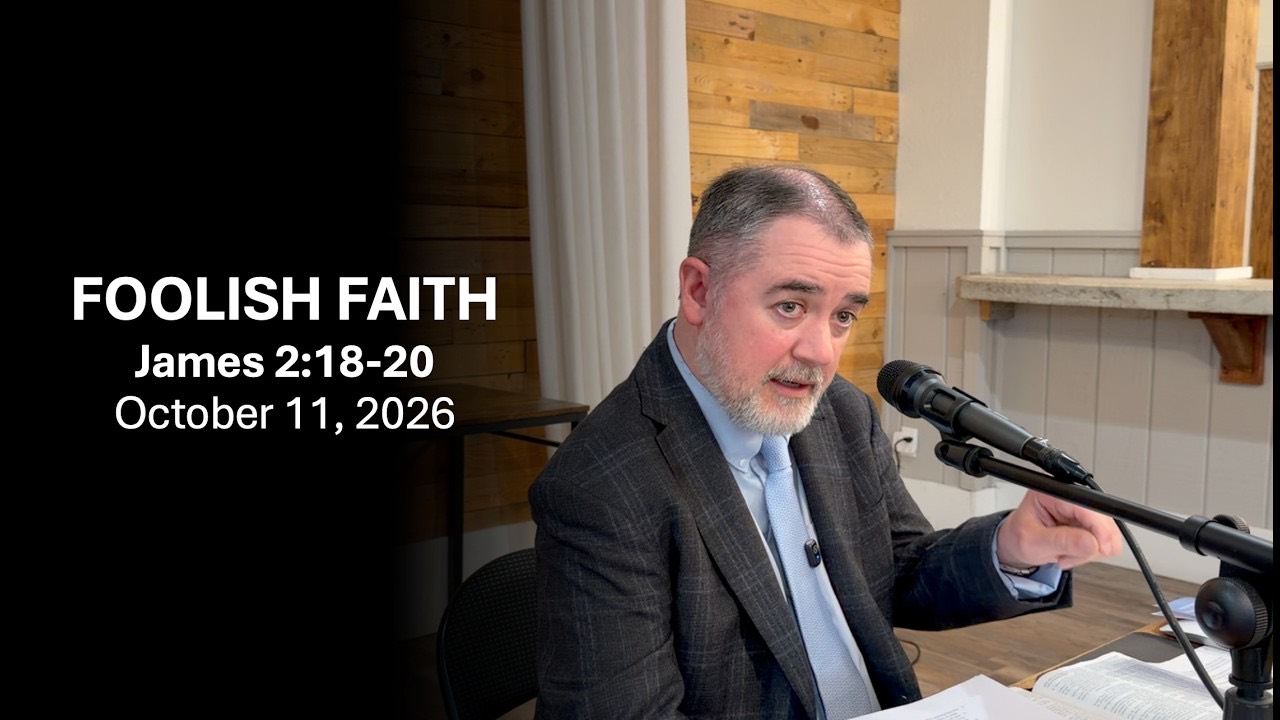
I invite you again to take God's copy of God's word and open to James chapter 2. James chapter 2 and we will read verses 14- 20. The section here is through verse 26. That'll be the end of the chapter. And we've been taking our time through this passage because as I've said this is one of the most uh misunderstood passages in all of the Bible. It has been very controversial because some have taken it to believe that James is somehow at odds with the apostle Paul.
The apostle Paul affirms over and over that we are saved by grace alone through faith alone and Christ alone is the hallmark of the reformation. And at face value at first reading it might seem that James is saying no, we are saved by faith and works. But we're so we're spending our time to see that this is not what James is saying. James and Paul are not at odds with one another. They are saying the exact same thing, just coming at it from different directions. So um invite you to stand as we read God's word together.
James chapter 2, we'll read verses, we'll just read verses 14- 26. I have the whole context in our mind, but our focus this morning will be verses 18- 20. What use is it, my brothers, if someone says he has faith, but he has no works? Can that faith save him? If a brother or sister is without clothing and in need of daily food, and one of you says to them, "Go in peace, be warmed, and be filled, and yet you do not give them what is necessary for their body, what use is that?" Even so, faith, if it has no works, is dead by itself. But someone will say, "You have faith and I have works.
Show me your faith without the works and I will show you my faith by my works." You believe that God is one. You do well. The demons also believe and shudder. But are you willing to recognize, you foolish fellow, that faith without works is useless? Was not Abraham our father justified by works when he offered up Isaac his son on the altar? You see that faith was working with his works and as a result of the works faith was perfected and the scripture was fulfilled which says and Abraham believed God and it was counted to him as righteousness and he was called the friend of God.
You see that a man is justified by works and not by faith alone. And in the same way, was not Rahab the harlot also justified by works when she received the messengers and sent them out by another way? For just as the body without the spirit is dead, so also faith without works is dead. May God bless the reading of his word. You may be seated. So, just as a little bit of review, just so we can all have it fresh on our minds, uh, last week I did a different sermon, more of a topical sermon.
So, it's been a couple weeks since we've been in this text. So, just by way of review for a little bit, we've been discussing the past several weeks uh, this text and we've seen how faith is grounded in the person of Christ. Hebrews 11:1. Now faith is the assurance of things hoped for, the conviction of things not seen. And we talked about how hope as a Christian is not hope as we normally think of in a worldly sense. It's not hope in the sense that I hope we have good weather.
I hope my team wins the ball game. It's not that kind of hope. Our hope as Christian is grounded in the person and work of Christ. So our hope as Christians is as certain as Christ is certain. How certain is Christ? Well, who is Christ?
He is none other than the creator of the entire universe. Every person, every planet, every star, every galaxy in all of the universe comes from Christ. He is the creator and the sustainer of all of the universe. And so I would say that is pretty certain, is it not? That is absolutely certain. He is the King of Kings and the Lord of Lords.
And it is he who is the grounding of our faith. Romans 11:36, for from him and through him and to him are all things. To him be the glory forever. He is the grounding of our faith. He is the object of our faith. He is the author of our faith.
So our hope as Christians is just as certain as is he. We've seen how faith originates not with us but rather with God. Faith is not something that we jin up within ourselves. Faith is not something that we muster up ourselves. It is granted to us by God. This is so so very important for us to understand.
So much hinges on this. Faith is a gift from God. Ephesians 2:8 and9 Paul says, "For you are saved by grace through faith and that not of yourselves. It is the gift of God." Well, what is the it? The it is everything. Grace is a gift of God.
Faith is a gift of God. Our salvation is a gift of God. Paul says it is not of yourselves. It is a gift of God, not of works. Paul says, "So that no one can boast." Just as Paul wrote to the Philippians in Philippians chapter 1 29, he says, "For to you it has been granted not only to believe in Christ but to suffer for his sake." So you we see that believing in Christ is something that is granted to us. It's a gift.
It's a privilege. It comes from God, not from within ourselves. So, is repentance a gift of God? We've got to understand this. So crucial. Both faith and repentance are gifts from God.
We don't do them. Few notetakers, a few references here. Acts 5:es 30 and 31. Acts 5 30 and 31 says this. The God of our fathers raised up Jesus from the dead whom you put to death by hanging him on a tree. This one God exalted to his right hand as a leader and a savior to grant repentance to Israel and forgiveness of sins.
There it is right there. Repentance is granted. Acts 11 17-18. Therefore, if God gave to them, listen how many times we hear the the theme of giving and granting. If God gave to them the same gift that he gave to us also after believing in the Lord Jesus Christ, who was I that I could prevent God's way? And when they heard this, they quieted down and glorified God, saying, "Well, then God has granted to the Gentiles also the repentance that leads to life." So no less than 1 2 3 four times in those two short verses we see that repentance is something that is granted to us by God. 2 Timothy chapter 2:es 24- 26 the Apostle Paul writes in the Lord's slave must not be quarrelome but be kind to all able to teach patient when wronged with gentleness correcting those in opposition if perhaps God may grant to them repentance leading to a full knowledge of the truth and they may come to their senses and escape the snare of the devil having been held captive by him to do his will.
This talking about false teachers and their only hope for repentance is if God grants it to them. If perhaps God may grant to them repentance leading to a full knowledge of the truth. This precious truth, dear ones, that God grants to us faith. He grants to us repentance. This gets to the very nature of who God is. Remember some months ago when we were back in James chapter 1 verse 17, every good thing and every perfect gift comes down from the father of lights, right?
With whom there is no variation or shifting of shadow. So every good gift, every good and perfect gift comes down in an unending stream from God our father. God is by his nature a giftgiver. He gives us that which we need. God is a giver. He gives to his children good and only good gifts.
And this gives us as believers, the recipients of those gifts, a great deal of assurance of our salvation. Or at least it should. Salvation, dear ones, cannot be lost. Uh you'll hear people you'll hear debates about well once saved always saved and they'll say well that's not in the Bible. Well the phrase itself is not in the Bible. Kind of like the word trinity is not in the Bible but eternal security is absolutely taught in the Bible.
Salvation cannot be lost. Salvation cannot be lost. Why can it not be lost? because it is a gift given to us from God. That's why it cannot be lost. We didn't deserve it. We didn't produce it.
It didn't come from us. Came from God. We're merely the recipients of God's kind gift. Faith is given to us. Repentance is given to us. Salvation is given to us.
And what God gives, he does not take back. What God gives, he does not take back. As Paul said in Romans 11 29, for the gifts and the calling of God are irrevocable. The gifts and the calling of God are irrevocable. What God gives, he does not take back. Not only is salvation a gift to us, but we are gifts from God the Father to God the Son.
We are gifts. So God gives us salvation and we are gifts from God the father to God the son Jesus Christ. Remember what Jesus said in John 6:37. All that the father does what? Gives to me will come to me. All that the father gives me will come to me.
In Jesus what we sometimes refer to as the high priestly prayer. The longest recorded prayer that we have of Jesus in John 17:2 Jesus said this even he's praying to his father even as you father gave him authority over all flesh that to all whom you have given him Jesus is referring to himself that to all whom you have given him he may give eternal life. We are love gifts from the father to the son. And all that the father gives to the son, the son will give to them eternal life. God will no more take back from us what he has already given to his son. He will not take from his son.
He will not take from us. If you are a Christian, you are given by God as a love gift to the son. When did this happen? When were you given as a gift from the father to the son? The day you were saved? The day you were converted?
No. From eternity past. From before the foundation of the world. Before anything existed except God himself. That is when God the father gave us his gifts to his son. Carried to its logical conclusion.
Follow my logic here. Follow, scratch that. Don't follow my logic. Follow the logic of scripture. Carry to its logical conclusion. The belief that you can lose your salvation or the belief that salvation can be lost in general strikes at the very heart of who God is.
If our salvation can be lost, follow this. If our salvation can be lost, then God is not who he says he is. You see that? Because what God gives, he does not take back. The gifts of God are irrevocable. Right?
So if our salvation can be lost, and it's a gift, then if God can take that back, then that strikes at the very heart of who God God is. If salvation can be lost, then God cannot be trusted. If salvation cannot If salvation can be lost, then God is not who he claims to be. And if God is not who he claims to be, then there is no perfect and supreme being at all. Very few people make this connection, but they should. The belief that you can lose your salvation carried to its logical conclusion.
Not only does it lead you to not having assurance of your salvation, it leads to fullblown atheism. It leads to full-blown atheism. Do you see it? If salvation is a gift, and it clearly is, and if we can lose that gift, if God were to take back what he's already given, then that means he is not who he says he is, that means that there is no supreme and sovereign being and it leads to full-blown atheism. So James here is not saying that faith does not save. He is saying that a certain kind of faith does not save.
And our last time together, we looked at verses 14-1 17 and saw that James said, he asked rhetorically, can verse 14, can that faith save him? That kind of faith. What kind of faith? A faith that has no works. Can that kind of faith save him? And the answer to that is a resounding no.
That kind of faith does not save. Remember we said last time that if if faith does if your faith does not benefit others it will not benefit you either. So with that as background let us go to our text this morning verses 18- 20. Let's read those again specifically. But someone will say verse 18 you have faith and I have works. Show me your faith without the works, and I will show you my faith by my works.
You believe that God is one, you do well. The demons also believe and shudder. But are you willing to recognize, you foolish fellow, that faith without works is useless? So in verse 18, James does something that's kind of interesting here. He introduces an interlocutor. Now that's a fancy word for just saying he introduces a hypothetical speaker here.
Interlocular inter it's hard to say interlocutor. He introduces a hypothetical speaker here. But someone will say you have faith and I have works. Show me your faith without the works and I will show you my faith by my works. So this hypothetical speaker that James is using here, he's using it to draw into focus the difference between a living faith and a dead faith. Remember that James audience, remember who is James audience?
James audience are this is a very early New Testament book. In fact, the first New Testament book that was written and his audience was comprised completely of Jews who embraced Christ as their Messiah and became Christians. Right? So they all of them like 100% of them have a background in Judaism. And these Jews wrongly believed that the Old Testament taught that you were saved by works. It doesn't teach that.
A lot of people think it does. A lot of people who who are Christians think the Old Testament teaches that. It doesn't. The Old Testament never taught that. Old Testament never taught salvation by works. Old Testament always affirmed salvation by faith.
Remember in Genesis 15:6 it says that Abraham believed Yahweh and it was reckoned unto him as righteousness. And Paul quotes that in Romans chapter 4 and James quotes it here later in chapter 2 as well. So salvation has always been by faith. So this interlocutor, this hypothetical speaker James draws in to show us the difference between a living faith and a dead faith. So James audience believed that they could earn their salvation and that was not correct. And so what they did when they with that mistaken understanding of the Old Testament when they heard the gospel that salvation is by grace alone through faith alone.
Some of them overcorrected. Some of them the the pendulum swung too far with some and they said, "Oh, we're saved by faith alone. All we have to do is believe a few things and we're saved by faith alone. That means we don't have to do works. That is error too. And so this is what James is addressing.
He's addressing that mistaken understanding of what faith is. The interlocutor here is basically saying this. One person says this and another person says that. In other words, one person says faith and works. Another person says no works. I just have faith.
And so James says in verse 18 to this interlocutor, to this hypothetical speaker, he says, "Show me your faith without the works, and I will show you my faith by my works." Show me your faith without the works. I will show you my faith by my works. How How do we show faith? When James says to this hypothetical speaker, "Show me your faith." Uh, that's a that's kind of a problem for him because faith is invisible, right? I can't just look at you and see your faith. Like, I can't I can't see gravity.
We know gravity exists. Pick up my mouse here and drop it. What's What's going to happen? It's It's going to fall. I can't see gravity, but I know it's real. If I'm up on my crutches and I'm walking on my crutches and I'm on a tile floor and my crutch tip hits some water, I may not see gravity, but I'm going to see the effects of it.
Down goes Frasier. Some of you younger folks need to Google that. So, I can't see gravity, but I we can see the effects of it, right? So we can't see faith but real faith should have real tangible fruit. Real faith produces real results and the results we can see the works that faith produces. True faith produces.
We can see those things. And this is what James is getting at. Show me your faith and I will show you my Show me your faith without the works which is a false faith. I will show you my faith by my works. James is saying to this speaker, you can't show me your faith because you have no works to accompany them. That's not real faith.
But I can show you that my faith is real because I have works. I have faith deeds that are the natural result of true saving faith. So what are these works that genuine faith results in? I want to give you two categories of works. And the first one's going to sound a little odd, but I'll flesh it out. The first kind of works that our faith should produce are negative works.
Not in the sense that they're bad, but they are works that are against something. And as Christians, there are things that we should be against. So it's negative in that sense. We work against some things. The first one, I'll give you two things that we work against. First one, number one, is sin. sin.
Real faith produces negative works in that we are fighting against contrary to sin. Paul says in Romans 8:13, "If you through the spirit mortify the deeds of the body, put to death, mortify the deeds of the body, you will live." We fight against sin. Colossians chapter 3:5. Therefore, consider the members of your earthly body as dead to sexual immorality, impurity, passion, evil, desire, and greed, which is idolatry, Paul says. So, you see, we are fighting against sin. These are negative works, as it were, because we are going against something.
We're going against sin. Hebrews 12:4, the writer of Hebrews commended his readers for striving against sin. He said, "You you have you're striving against sin, not yet to the point of blood." And what he meant by that, to the point of the shedding of blood, what he meant by that is that they were being persecuted. Their property was being stolen. They were being persecuted, but not to the degree yet that they had actually had to shed their blood. Not that kind of persecution.
But the writer of Hebrews commends his readers as you are striving against sin. Romans chapter 7. Romans chapter 7 is a number of verses there towards the end of the chapter. And we see the apostle Paul in this like he's having a conversation with himself and he says that thing which I want to do I do not do and that thing which I hate I do and the willing is in me but the ability is not. And you see this almost almost kind of almost schizophrenic kind of discussion that the apostle Paul is having and he's saying I want to do what is right. The willing is there but the ability isn't and that thing which I hate to do I end up doing.
And so this you see this intense struggle that the Apostle Paul had with sin. And some say well that must have been Paul writing about himself before his conversion. I don't think it was at all. I think what we see in Romans chapter 7, this struggle that the Apostle Paul had with sin, this fighting that he had, this the war that he was going to, that's what Christians do. Christians go to war with their sin. And as long as we are on this side of the veil, as long as we are on this side of eternity, we will always do battle with our flesh. there will always be that war with sin.
Here's the paradox of the Christian life is that as we progress in our sanctification, as we progress in our holiness, as we grow in the grace and knowledge of the Lord Jesus Christ, as time goes on, there should be a general pattern in our lives of a decreasing pattern of sin. Not that we won't ever sin, but it should become more infrequent, a decreasing pattern of it. And there should be an increasing pattern of holiness, an increasing pattern of godliness. Here's the paradox. As we grow in our holiness, as we grow in our understanding of God's word, as we grow in our desire to become more and more conformed into the image of Christ, the more sensitive we're going to become to sin, first and foremost, our own sin. And so it might seem like at times that you're just treading water and you're not making any progress in your sanctification.
May I encourage you that that's not what's happening. What's happening is is that you're growing in Christ and as you grow, you become more sensitive to sin. If the Lord allows me to live another I'm 53 and I don't know that averages will hold up but if averages hold up I might have another 20 25 years I would hope that if the Lord does allow me to live another 10 or 20 years that 10 or 20 years from now there will be things on my spiritual radar as it uh that aren't even right now making much of a blip. Does that make sense? Because I'm going to be growing in my sanctification. So, it's not that we're treading water.
It's not that we're losing ground. It's that we're becoming more and more sensitive to our sin. And this is one of the tangible fruits of genuine faith. So the first negative work is our fight against sin. Even though it's a good thing, but you understand what I'm saying. The second negative work, the second thing that we should hate as Christians is false doctrine.
False doctrine. David writes in Psalm 119 verse 104, "From your precepts, from your word, I get understanding. Therefore, I hate every false way. There are things as Christians that we should hate. Number one, of course, our sin. We just talked about that.
But also, false doctrine. We should hate false doctrine. And any person who professes to know Christ as savior but does not hate false doctrine, then I must question whether or not whether or not that person's truly saved. I hate Roman Catholicism. I didn't say I hate Roman Catholics. I love Roman Catholics, but I love them enough to tell them the truth.
I hate Roman Catholicism because it's a false gospel. I hate the prosperity gospel because it's a false gospel. I hate Islam. I don't hate Muslims, but I hate Islam because it's a false religious system. I hate Hinduism. I hate Buddhism.
Not the people trapped in it, but I hate the deception because they are being deceived by it and because it brings dishonor to Christ. I hate easy belieism. The seeker sensitive approach to doing church that church is just fun and games and oh, you can just profess faith in Christ. Doesn't really matter how you live. It's easy belieism. This is actually what James is addressing right here in our in the passage before us.
I hate that too because it's false. As Christians, we love what God loves and we hate what God hates. We hate false doctrine because it keeps people in spiritual bondage and it is displeasing to God. Now for the more positive works, more positive faith deeds. Number one, peace and holiness. Hebrews 12:14, the writer of Hebrews says, "Pursue peace with all men in the holiness without which no one will see the Lord." Pursue peace with all men.
As much as it is possible with us, we should pursue peace with all men. Sometimes the time does come when peace is not possible. But we should pursue peace as much as it is possible. Pursue peace. Pursue holiness. Without which the writer of Hebrews says, "No one will see the Lord." If you do not have holiness, you will not see the Lord. 1 Corinthians chapter 6, Paul writes,"Do not be deceived.
Neither fornicators, nor idolattors, nor adulterers, nor effeminate, nor homosexuals, nor revilers and drunkards will inherit the kingdom of God." And Paul writes to them, says, "Do not be deceived." Why does he say that? Because there are people who are whose lifestyles are marked by one or more of those sins, and they still claim the name of Christ. And Paul says, "Don't be deceived. You're deceiving yourself if you think you can live that way and claim and and be a Christian. You're deceived. Don't be deceived.
And then Paul says something beautiful to these Corinthians. He says, "Such were some of you. You were those things, but you're not anymore. You were a reviler, but you're not anymore. You were a drunkard, but you're not anymore. You were a homosexual, but you're not anymore.
You were a fornicator, but you're not anymore. You are washed. You are sanctified. You were justified in the name of the Lord Christ and the spirit of our God. Washed, sanctified, justified. Notice those three terms.
Washed, sanctified, justified. You have these two bookend terms. Washed, cleansing, salvation. justified, cleansing, salvation, and what's right in the middle? Sanctified. Holy. Everyone who is in Christ is sanctified.
We are positionally sanctified. We are made holy. Even though we still sin, even though we still stumble, we are made holy because we have the righteousness of Christ. Every single Christian, true Christian is sanctified, has holiness. And the writer of Hebrews says, "Without holiness, no one will see the Lord." So we should pursue peace and holiness. Number two, we should love scripture.
This is a fruit, positive fruit of faith. We should love scripture. It is scripture and scripture alone that tells us who God is. It is scripture and scripture alone by which we as Paul says grow in the grace and knowledge of the Lord Jesus Christ. 2 Peter 3:18. That is how we grow in Christ by scripture. There are no shortcuts.
God's not going to give you a heavenly download. Uh you're not going to just connect to the iCloud up there and you're just going to automatically grow in the grace and knowledge of the Lord Jesus. know we do it by reading and studying scripture. And so the Christian has a love for God's word. It is scripture and scripture alone that contains all we need for all matters pertaining to life and godliness. Second Peter 1:3. All matters pertaining to life and godliness is found in the word of God.
And so this is why as Christians with regenerate hearts, remember God takes out the heart of stone. He puts in the heart of flesh and the renewed heart of flesh has a love for God's word. We are to long for the pure milk of the word as the apostle Peter says 1 Peter chapter 2:2 long for the pure milk of the word for it is by that that we grow in all matters pertaining to life and godliness. Another good fruit of true faith, the one anothers of the New Testament, the one anothers of the New Testament. Just write that down. The one anothers of the New Testament.
I'm going to list many of them. They're too many to write down, but you can go back or or Google them or the one anothers of the New Testament. Scripture says we are to love one another. We're to be devoted to one another. We are to honor one another, respect one another, serve one another, be kind and compassionate to one another, show hospitality to one another. And we're to show hospitality to all people, but Paul says, especially to whom?
To the household of faith. So, as I've said before, if I see you in need and someone out there that's not a Christian in need and you have equal need and I have the ability to help one of you, who am I helping first? I'm helping you first. So, show hospitality to one another, serve one another, bear one another's burdens. The Christian life is not one meant to be lived alone. It's why it's so important to be a part of a local body of believers.
You can't bear one another's burdens. You can't do the one anothers if you're not in church. Teach one another. Admonish one another. That means correct one another. There does come a time for correction.
Do it in love, but correct one another. And if you see me going off in the weeds somehow or doing something nutty, love me enough to come up and correct me. Comfort one another. Build each other up. These are some of the one anothers of the New Testament. This is what true faith does.
This is what real faith does. You see, real faith has real works with it. And another fruit, the assembling of ourselves on the Lord's day. What we're doing right now. This is a good fruit in keeping with true faith. Hebrews 10:es 24-2, the writer of Hebrews says this, "And let us consider how to stimulate one another to love and good deeds, not forsaking our own assembling together, as is the habit of some, but encouraging one another and all the more as you see the day drawing near." There's several one anothers in those couple of verses.
But notice that the writer of Hebrews says, "Do not forsake the assembling of yourselves, as is the habit of some." It is the habit of some professing believers to forsake the assembling of themselves on the Lord's day for corporate worship. And this is nothing new. It was going on right at the beginning of the church, right? That's why the writer of Hebrews addressed it because there were some professing Christians who were forsaking the assembly. And so he addressed it. He said, "Do not do it.
Don't forsake the assembling of yourselves." It is sadly the habit of some who profess Christ to forsake the assembly of the saints on the Lord's day. As Christians, Jesus is the one whom we should love above all above all others. Jesus is the one whom we should treasure above all others. We should want to learn more of Christ so we can be more like Christ. We want to worship Christ. Dear friends, Christ gave his life for us.
Not only did he endure the nails and the thorns and the the flagagillation and all of that. Not only did he endure that, but he endured the wrath of his own father that burns against the sins. Not that he committed because he had no sins, but the sins that you and I have committed. He bore all of that upon himself. And he did that while we were still his enemies. How could we want to forsake the assembling?
He's everything to us. And I can tell you, I can honestly tell you that there is nowhere on this planet that I would rather be right at this moment than right here with you, worshiping Christ together. There's nowhere else I want to be. If I had an invitation to go to 1600 Pennsylvania Avenue next Sunday morning at 10:30. Sorry, I got better things to do. Nowhere else I'd rather be.
You know, things come up. Sure, all of us there. We get sick. We have family members who get sick. We have to care for them. We have to visit them.
Maybe we have a blizzard, zombie apocalypse, you know, life happens, something's going to happen, you know, where we're going to miss a Sunday here and there. I get it. That happens for all of us. But, and that's not what I'm talking about here. What I am talking about is people who profess to know Christ and they'll miss the assembling of themselves to gather together for corporate worship if the fish are biting or if the ball game's on. or if it's drizzling a little bit outside. Oh, can't go to church.
Something's wrong there. Something's wrong. There's nowhere I'd rather be. Remember what Charles Spurgeon said? I quoted him a few weeks ago. He said, "The church is the dearest place on earth to us.
Nowhere I'd rather be than right here. And there's nowhere I'd rather that I want my grandkids to see me than right here. I want my grandkids to know that this is Christianity is not just something we do on Sunday morning. It's our it's our life. It's who we are. Another good work, the fruit of the spirit.
Galatians 5 22. The fruit of the spirit. Galatians 5 22. What is the fruit of the spirit? Well, there are nine different fruits. love, joy, faith, patience, peace, kindness, goodness, faithfulness, gentleness, and self-control. Love, joy, peace, patience, kindness, goodness, gentleness, faithfulness, and self-control.
Nine different fruits, but notice that the Apostle Paul refers to them as the fruit of the spirit. one singular fruit and yet there are nine fruits. Why does he do that? Does Paul have bad grammar? No. Paul does that because every Christian will exhibit all of these fruits without exception. Perfectly?
No. Do we do it at all times? No. But our lives should be marked by this by these things. love, joy, pace, peace, patience, kindness, goodness, gentleness, faithfulness, and self-control. Remember in Luke chapter 19, Zakius, Jesus came to Zakius. Zakius was a tax collector.
And tax collectors in that day and age had a very bad and very well-earned reputation because they in many cases were swindlers. They would extort people. And Jesus came to Zakius and he confronted him and he said, "Zakius, I must stay at your house today." And right there, Zakius was converted. His heart was softened. God took out the heart of stone, gave him a heart of flesh. Right there, as Zakius was sitting or standing or whatever he was doing up in that tree, he was converted.
And on the spot, Zakius convicted un undoubtedly of his sin, he said,"Lord, I will give half of my possessions to the poor, and if I have defrauded anyone, I will give them back four times as much." That's what faith looks like. Real tangible fruit that can be seen, that can be seen by others. This is what real faith produces. And finally, the last good fruit, concern for the lost. Concern for the lost. Um, I have known people, I've talked to a couple of people over the many years that have expressed doubts about their their own salvation.
And yet, as I talk to them and I get to know them, I also see in them a concern for other people's salvation, a concern for the lost, a desire for other people to know Christ. And um I'm I'm not I'm not real worried about your own salvation. If you have a genuine concern for other people to be saved, if you have no concern for other people to save, then I'm worried about your salvation. But not if you do. If you weren't saved yourself, you sure wouldn't be worried about other people. Concern for the loss.
This is one of the good fruits in keeping with true faith and true repentance. And James says, "Show it to me. Show it to me." Verse 19, James says, "You believe that God is one. You do well. The demons also believe and shudder. The demons also believe and they tremble.
So in verse 18, James challenged the notion that faith is somehow opposed to works. Now he's going to challenge the false notion that merely believing certain things, certain doctrines, even good doctrines in and of themselves, constitutes saving faith. One of the defining marks of Judaism is that God is one. You've heard of the the shimma. This is the Old Testament kind of core doctrine doctrinal statement of Old Testament Israel. It's the it's called the Shimma and it's recorded in Deuteronomy 6:4.
Here, O Israel, Yahweh is our God. Yahweh is what? One. That's the shima. here, O Israel, Yahweh is our God and Yahweh is one. That was their core doctrinal statement. And that set them apart from all of the other nations around them.
It set them apart from the Hittites and the Amorites and the Parizzites and the H the Termites and the all of the other ites out there. It set them apart from the Greco Roman world because all of these other nations were polytheists. They believed in many gods. The Egyptians believed in many gods. They thought the cotton picking Nile River was a god. They thought frogs were gods.
Everything was a god to them. Israel was different. Here, O Israel, Yahweh is our God. Yahweh is one. And Jesus reiterated the shimma in Mark chapter 12. Remember in Mark chapter 12, Jesus was asked by a scribe.
Scribe came up to Jesus and he said, "What is the foremost of the commandments? What's the greatest commandment?" How did Jesus respond? Jesus responded by saying, "The foremost, the greatest commandment is here, O Israel. Yahweh is our God. Yahweh is one. and you shall love the Lord your God with all your heart, with all your soul, with all your mind, and with all of your strength. So, it was the core doctrinal statement of Old Testament Israel.
Jesus affirmed it. And in affirming it, Jesus affirms that Christianity is monotheistic. Sometimes people from outside of Christianity say, "Oh, you Christians, you believe in three gods." No, no, no, no, no. We have one God. One God who is one being eternally existing in three different persons. Each of whom is fully God.
God the father, God the son, God the holy spirit, distinct persons in one godhead. So monotheism set Israel apart and it sets Christianity apart as well. Jesus affirmed this. So all of that to say the shimma of monotheism that's good doctrine. That's a good thing to say that you believe. We must have good doctrine in order to be saved.
And those of you who know me, you know I champion sound doctrine, sound theology. Yes. Yes. We must not only must we have good doctrine. You can't be saved if you don't have good doctrine. You can't be saved if you don't have good theology.
Notice I didn't say you can't be saved if you don't have perfect theology because none of us has perfect theology. There's these secondary and tertiary issues. You know, the when was the date of the Exodus, who wrote the book of Hebrews, uh what's your esquetology? Premill, postmeal, la. Um, you know, there's these different issues that we can have differences of opinion on one another and still have fellowship in Christ. Uh, one of my best friends, you know him, Jim Osman, he came and preached my installation service here.
Jim Osman and I have this kind of friendly ongoing debate as to whether or not Matias was a real apostle. Uh, G Jim thinks that he was. I don't think that he was. I think the apostles jumped the gun when they chose Matias. And uh, Jim can be wrong about that. and he's still going to heaven. You know, I still I still recommend Jim even though he's wrong about Matias.
So, none of us has perfect theology, but we must all have good theology. We have got to believe that God is the creator. We have got to believe that God created man in his image. We have got to believe that man has sinned against God. We have got to believe that sin is transgression of God's law. We've got to believe that there is a penalty when we transgress God's law.
We've got to believe that we cannot save ourselves. We've got to believe that God sent his son Jesus Christ to this earth and Jesus lived a perfect life. The God man. We've got to believe these things. We've got to believe that Jesus willingly gave his life on the cross. His life was not taken.
He gave it. And we've got to believe that he died on the cross and on the third day was bodily, not just metaphorically, bodily raised from the dead. And if we do not believe these things, we cannot be saved. So, we must have good theology. We must believe that Jesus is the only way for salvation. We've got to believe that Jesus is God's only provision for sin.
So, we've got to have good theology. But, dear ones, I'm going to say something that's going to sound a little odd at first. Christians aren't the only ones with good theology. James tells us right here, who else has good theology? You believe that God is one. You do well.
The demons also believe and they shudder. The demons also believe and they tremble. I think there is both a very sincere sentiment in what James here as well as a sarcastic sentiment. You believe that God is one. You do well. That is good.
We We do do well to believe that. But guess who else believes it? The demons also believe it. And they shudder. They tremble. That's a sobering thought, is it not? all of you can take Satan himself, Lucifer and all of his demonic horde, however many there are, I don't know.
Revelation describes, you know, the demons are the fallen angels, right? And a third of the angels fell, rebelled against God. And so, the fallen angels are the demons. How many? The Bible says that there are thousands of thousands, myriads of myriads. uh Daniel chapter 7, I believe it is, it describes the angels as 10,000 time 10,000. And if you take that literally, then that's 100 million.
And a third of that. So I there's at least 33 million give or take demons. Who knows? It's a lot of them. And you know what? As many of them as there are, as many millions, likely tens of millions of demons that there are, there's not an atheist among them.
They are all theists. Amen. They are monotheists. And you know what? They know who Jesus is. They know exactly who he is.
Remember the Garazine demoniac, Mark chapter 5, the the demon that called himself Legion. He looked at Jesus, he said, "What do I have to do with you, Jesus, son of the most high God?" That's good theology right there. That's good christologology. Son of the most high God. He knew exactly who Jesus was. Dear friends, all of the demons and Satan himself, they know who Jesus is.
They have good theology. They know that he is God the Son. They know that he died on the cross. They know that he was raised from the dead. And you know what else they also know? They also know that one day their doom is coming.
They know it. And they tremble. They shudder. By the way, don't have this Tom and Jerry theology of Satan. I remember as a little kid watching a Tom and Jerry cartoon and it it portrayed Satan as kind of the the ruler of hell and Satan is down there just he's the ring leader. He's the CEO of hell and he just enjoys torturing other people and demons are enjoyed torturing other people.
Uh-uh. Satan and demons, they're going to be tortured, too. Their doom is certain. And this is very sobering because there's a sense in which when James says, "Even the demons believe and shutter." Are you sitting down? Because I want there is a sense in which demons and Satan their quote unquote faith their belief is more real than an atheist. It's more it's more real than someone who claims to believe in Christ and yet whose life doesn't show it. someone who claims to believe in Christ and yet there is absolutely no fear of God before their eyes.
At least the demons have the good sense to tremble. But people with empty faith, there is no trembling. There is no shuddering. And James is saying the person who claims to believe in Christ yet has no works as evidence of it, the demons have better faith than you do. At least they have the good sense to tremble. Wow, that's sobering.
Verse 20, James says, "But are you willing to recognize, you foolish fellow, that faith without works is useless?" This is echoing what he said in verse 14. Are you willing to recognize, you foolish fellow, that faith without works is useless? Now, when we read this in English, there's a little something that's kind of lost here. You foolish fellow. That almost sounds polite, doesn't it? You know, don't don't read this with a polite British accent, you foolish fellow.
That's not what James is saying here. That in the Greek, this literally says anthrope ken, which means empty man, vain man. Are you willing to re recognize, you vain and empty man, that faith without works is useless. It is dead. Very sobering. Faith without works is useless.
And literally in the Greek here, James says, "Faith without works is workless." It's kind of a play on words here. In other words, faith without works doesn't work. Faith without works doesn't work. It is dead. It is necra necrosis dead. Real faith produces real fruit.
False faith does not produce fruit. And he's saying, you do you not recognize, you vain, empty man, that your faith that has no works is useless? Your faith doesn't work. It's dead. Faith is not something that we must add works to. We don't add works to faith.
It's that real faith produces real works. John 15:es 5 and 6 Jesus says this, "I am the vine, you are the branches. The one who remains in me and I in him produces much fruit because you can do nothing without me. If anyone does not remain in me, he is thrown aside like a branch and he withers. They gather them, throw them into the fire, and they are burned. I am the vine, you are the branches.
The one who abides in me, remains in me, he will bear much fruit. There are no exception clauses to that. Most of the people who are my branches attached to me, the vine, most of them will bear fruit. Some will bear fruit. All all will bear fruit. And if there is no fruit, then those branches that are really false branches, they do what?
They wither. They die. They fall off. These are people who went out from us because they were not truly of us. And those dead branches are gathered up. And they are thrown into the fire, the lake of fire.
And finally, dear ones, it's noteworthy here, I think, that James in verse 20, he notice he doesn't use the term brothers here. He's he's referring to this this interlocutor, this hypothetical speaker, the foolish fellow. He doesn't call him a brother. James uses brothers in other parts of his letter quite frequently. Actually, he even uses brothers when he's offering correction to his readers. But here, he doesn't he doesn't call this guy a brother.
Calls him a foolish man, empty, vain man. Even when James is correcting his readers, if they're truly brothers, he addresses them as brothers. But not here. James is being very clear that this person, this person that has good doctrine but has no fruit, he's not a brother. He's not a brother. As Christians, we stumble into sin, but we don't swim in it.
As Christians, we can be in sin, and we can even be in a season of sin as Christians. But if you truly belong to Christ and you begin to stray from him, he will discipline you. Hebrews chapter 12, he will discipline you and he will bring you back. So, we're not talking about a stumble into sin. We're not even talking about a short season of sin. But the person who has good doctrine and persists in sin, lives a lifestyle of sin, that person's faith is vain.
In vain, it's useless. Hope this has been helpful for you, dear ones. As I close, I just want to close with the gospel. And I've g I've given it already this morning, but just to have a succinct gospel presentation. All of us are sinners. We have broken God's law, the Ten Commandments.
All of us are liars. Almost all of us, probably all of us, are thieves. We've taken something at some point that does not belong to us. So, we're liars. We're thieves. We've taken God's name in vain.
We're blasphemers. We are adulterers because Jesus raises the bar on that. If Jesus said, "If you look at a woman with lust, you've committed adultery already in your heart." So, if you've ever looked at another person with lust, you're an adulterer. And just like when we break laws on earth, there's a penalty to be paid. How much more so when we break God's laws? But when we break laws on earth, the penalty is temporal.
It has an end. When we break God's laws, that penalty does not have an end because God does not have an end. He is infinite. He is eternal. He is of infinite worth. So when we sin against him, the punishment is also infinite.
The punishment meets in the negative sense how glorious God is in the positive sense. And for those who say, "Oh, well, well, yeah, sure, I've done a few things wrong, but God is a good God. He'll grade on the curve. He'll overlook the few bad things I've done." I don't think we realize how just how much we sin. And we've certainly lost sight of who it is that we have sinned against. But God is good.
You see, the goodness of God is not going to get you off the hook. Just like a good judge would not get a murderer off the hook. will not let a murderer walk away scot-free. A murderer, a rapist or whatever, a good judge is going to punish that person, right? God is the ultimate good judge and he will punish sin. If he did not punish sin, then he would not be good. So, it is his goodness that demands justice.
And if we die in our sin without any restitution, if we die in our sin without those sins being forgiven, then we will pay for those sins for all of eternity in the lake of fire. Well, the where the worm does not die, the fire will not be quenched. There will be wailing and weeping and nashing of teeth for all of eternity. That torment will never ever end. and we cannot save ourselves. The good news is this is that God knows that and God has made a way for us to escape the punishment that we deserve. And so God sent his son, the Lord Jesus Christ, to this earth.
In Jesus, God the son took upon himself a human nature. Jesus was one person with two distinct natures. truly God, truly man. And as the God man, Jesus lived a life of perfection. He lived the life that we cannot live. He lived it on our behalf. And he went to the cross willingly, took upon himself the wrath of God that burns against the sins of his people.
And our sins were imputed, were counted towards Christ and God the Father. This ultimate good and just judge judged his own son not for what he had done wrong. He had done nothing wrong. He judged his son for what we had done wrong. Our sins imputed to Christ. And Christ drank in every drop of God's wrath.
And this perfect person perfectly satisfied God's wrath died on the cross. and on the third day bodily raised from the dead, proving himself to be who he said he was, God in human flesh. And if you will come to Christ trusting him and him alone for your salvation, he will save you. If you will come to him empty-handed, understanding that I cannot save myself. Cry out to him, "Lord Jesus, I know that I'm a sinner. My conscience accuses me. Forgive me." If you will come to Christ and seek him for forgiveness, he will save you and his righteousness will be imputed, will be counted to you.
The great exchange and Jesus himself is our reward. And then one day when this short vapor of a life is over, we will just pass through that veil and we will have all of eternity to live in perfect fellowship with the King of Kings and the Lord of Lords in his home. And his home will be our home. That's the good news of the gospel. Let's close in a word of prayer.
Read Less