Amen. You may be seated. Oh, no, remain standing. We're going to read scripture again. So, uh you may put your hymnals down and and take your copy of God's word once again. And I invite you to take your copy of God's word and open to the book of James.
James chapter 2. We're going to be in chapter 3 this morning, but I know we have a number of guests and so I'd kind of like to read the passage that we've been dealing with the last several weeks and then we'll read through chapter 3 verse 2. But let's begin chapter 2 verse 14. James chapter 2 verse 14. And I'll have just a little bit of commentary as we go through this just for our guests and so we'll kind of be up to speed. James writes, "What use is it, my brothers, if someone says he has faith, but he has no works?
Can that faith save him?" James here is not saying that faith does not save. He is saying a certain kind of faith does not save. Notice he doesn't say, "Can faith save him?" He says, "Can that faith save him?" A faith that has no works, a faith that bears no fruit, can that kind of faith save him? And the answer to that question is a resounding no. That is not saving faith. "If a brother or sister is without clothing and in need of daily food, and one of you says to them, 'Go in peace.
Be warmed and be filled.' And yet you do not give them what is necessary for their body, what use is that?" Even so, if it has no works, faith is dead by itself. But someone will say, "You have faith and I have works." Show me your faith without the works and I will show you my faith by my works. You believe that God is one. You do well. The demons also believe and they shudder. But are you willing to recognize, you foolish fellow, that faith without works is useless?
Was not Abraham, our father, justified by works when he offered up Isaac, his son, on the altar? You see that faith was working with his works, and as a result of the works, faith was perfected. And the scripture was fulfilled which says, "And Abraham believed God, and it was counted to him as righteousness." And he was called the friend of God. You see that a man is justified by works and not by faith alone. Paul's here again. We've been talking in the last several weeks how Paul and James are not at odds with each other.
Paul, of course, in the book of Romans and Galatians and Ephesians talks about how we are justified by faith alone. Well, this says that a man is justified by works and not by faith alone, but there's two different ways in which justification is used. Same thing we have in English, run, one word, but it can mean a lot of different things depending upon the context in which it is used. So, when James says that you see that a man is justified by works and not by faith alone, the sense in which he is using justification is that his profession of faith his profession of faith in Christ is being justified, is being vindicated, is being proven to be true by the works that he bears. So, James and Paul do not disagree. They agree.
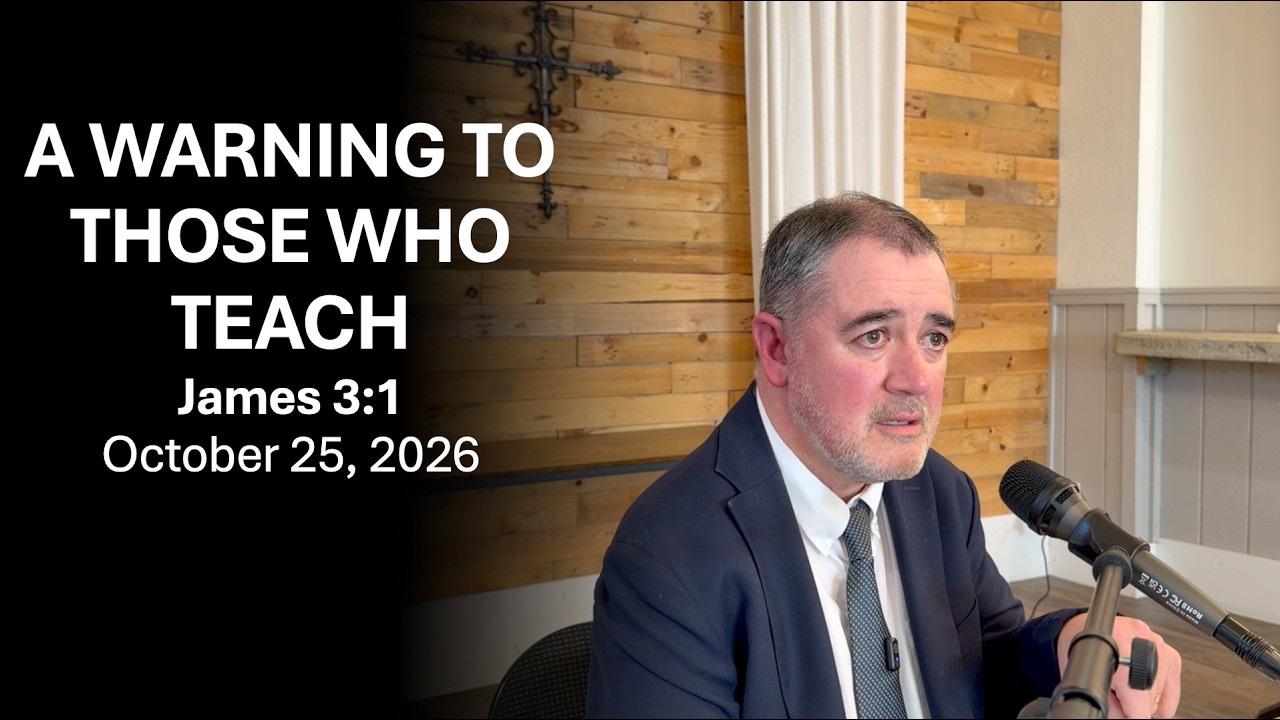
They're just addressing the same thing coming at it from different angles. True faith, saving faith, bears works. And in the same way, was not Rahab the harlot also justified by works when she received the messengers and sent them out by another way? For just as a body without the spirit is dead, so also faith without works is dead. And now chapter 3, we'll read verses 1 and 2, but verse 1 will be our focus this morning. James writes, "Do not many of you become teachers, my brothers, knowing that we will receive a stricter judgment.
For we all stumble in many ways. If anyone does not stumble in what he says, he is a perfect man able to bridle the entire body as well." May God bless the reading of his word. You may be seated. So, we have spent I looked it up last night, 5 weeks on this one passage of scripture, chapter 2, verses 14 through 26, because it is so widely misunderstood and uh so many people, including Martin Luther, initially was um troubled by this passage, but he came to rightly understand it, and I hope that that you have as well. And if you've not, if you'd like to listen to those sermons and you haven't been with us, they're on the church YouTube channel. So, we've been dealing with that, and we've been talking about how God grants faith.
Faith is not something we gin up on our own. It's not something that we muster up within ourselves. True faith is granted to us by God. So, God grants faith, God grants repentance, God grants salvation, and what God gives always bears fruit. And recall that faith is more than just intellectual assent to some basic facts of the gospel. True faith does include intellectual assent to the basic facts of the gospel, but it is more than that.
Because even the demons believe that Jesus is the son of God, that he lived a sinless life, that he died on the cross, that he was raised from the dead. The demons and Lucifer himself believe all of those things. Just like we do. But that that is not a saving faith. That is an intellectual ascent. Saving faith results in a new heart with new desires, new affections, and it always results in tangible fruit.
What kind of fruit does a dead tree bear? None, right? Dead trees don't bear fruit. A dead faith does not bear fruit. Only living trees bear fruit. And so a living faith always bears fruit.
So, as we begin this section, we can think of it as James begins with a pointed warning to teachers, and he's going to flesh this out further along in chapter 3. It's kind of an exposition, if you will, of James, what James had been emphasizing the first uh first couple of chapters. And James has been talking about how we as Christians are to how we are to handle trials, uh how we are to handle temptation, how we are to bridle our tongues. Remember James said we are to be quick to hear, slow to speak, and slow to anger. And so, this is going to be kind of a chapter 3 is going to be a an exposition, a commentary, of all of these things that James has laid out for us in the first couple of chapters. And so, James here in chapter 3 verse 1 is going to give a brief, but a very pointed warning to those who would consider themselves teachers in the church.
Let's read the verse again. Do not many of you become teachers, my brothers, knowing that we will receive a stricter judgement. There is both a general sense and a specific sense in which James uh uses teacher. The term teacher in the New Testament, as many words do, they have a kind of a general meaning and a specific meaning. For For example, elder could refer simply to an older man or it could refer to the office of an elder and teacher is much the same way. In a general sense, the word teacher could refer to rabbis.
Jesus said to Nicodemus in John chapter 3, he said, "Are you the teacher of Israel and do not understand these things?" That was a conversation that Christ had with Nicodemus, of course, about being born again. So, that's in a general sense. Or in a more specific sense, it can refer to a teacher, a pastor, an elder in a local church. And that is, I think, the primary way that James is using it here in chapter 3, though it does have a little bit of a general application. We'll talk about that in just a minute. So, chapter 3, verse 1.
James gives this warning to teachers. And then you'll notice in verse 2, he continues. He says, "For we all stumble in many ways. If anyone does not stumble in what he says, he is a perfect man able to bridle the entire body as well." And he goes on to talk about the dangers of the tongue. Um so, this living faith that James has been writing about, this living faith that bears real and lasting fruit. That fruit is not only visible fruit, it is, but it is also what proceeds out of our heart.
There is a outward tangible fruit, and there's also an inward fruit that might not be visible to the eye, but it works its way out with our tongues. The faith that God grants us, the repentance, the new heart with new desires bears not only outward fruit, but inward fruit. And one of the inward fruits that regeneration bears is that of self-control. Self-control. And dear friends, there are few things that a that are a better barometer of the self-control that you have than what you allow to roll off of your tongue. What you allow to roll off of your tongue is a good barometer of the amount of self-control that you have, and all Christians should have as one of the fruits of the Spirit.
So, the power of speech, what rolls off of our tongues, this is one of the things that sets us as humans apart from the rest of the animals. Animals can't talk. Now, parrots and canaries, they can mimic human speech, but they don't know what they're saying. They can't create their own sentences. They can't express their feelings and emotions and convictions through compound complex sentences. Animals can't do that.
And even a number of years ago, you some of you might remember Koko the gorilla. Remember reading about Koko the gorilla, this gorilla that they said uh they had taught sign language to, and I mean, you would think that Koko gorilla was a reincarnation of a Macbeth and was just signing all kinds of stuff and and having a conversation with people. Well, it turned out that wasn't the case at all. Koko had just been taught a few different things and mimicked what he or she, I guess, saw her handlers do. She wasn't creating. She wasn't talking through sign language.
She was just mimicking actions. It was a big Koko was a big um whole thing was big grift. But at any rate, the gift of speech is one of the things that being made in the image of God means. You and I as humans are created in God's image. The animals are not. And having the gift of speech is one of the things that is unique to the image of God.
Let me read to you Matthew chapter 12 verses 34 through 37. Jesus is speaking here to the Pharisees. And Jesus says, "You brood of vipers, how can you, being evil, speak what is good? For the mouth speaks out of that which fills the heart. The good man brings out of his good treasure what is good. And the evil man brings out of his evil treasure what is evil.
But I tell you that every careless word that people speak, they shall give an accounting for it in the day of judgment." That's a sobering thought, isn't it? "For by your words you will be justified, and by your words you will be condemned." Jesus and his half-brother James agree. The tongue is a revealer of the heart. The tongue is a revealer of the heart. So here in this section, James is going to discuss discuss control of the tongue first to the Christian preacher and teacher and then to believers in general. But this morning we're going to be concerned with verse one.
What James has to say to teachers. "Do not many of you become teachers, my brothers, knowing that we will receive a stricter judgment. As we have seen James do before in the first couple of chapters, James will give a rebuke when a rebuke is warranted. He does not shy away from doing that, but notice that anytime James gives a rebuke to his readers, he always does it with compassion. That's one of the things that has nourished my own soul as we've been walking through James together and I've been preparing sermons and studying for them. It's one of the things that has nourished me and I see James with a heart of a shepherd and he does give rebuke when rebuke is called for, but he always does it lovingly.
He did in chapter 1 verse 19. He says, "Know this, my beloved brothers." And then chapter 2 verse 1, "My brothers, do not hold your faith in our glorious Lord Jesus Christ with an attitude of personal favoritism." Some people in his audience were doing that and he so said, "Don't do that." But he called them my brothers. Then chapter 2 verse 5, "Listen, my beloved brothers." Then verse 14, same chapter, "What use is it, my brothers, if someone says he has faith but has no works?" And then he'll do it again a few verses later in chapter 3 verse 10 and he says, "My brothers, these things ought not to be." So you see the heart of a shepherd here, right? He will correct. He will give a rebuke when one is called for, when it's necessary, but he always does it in love. This is the heart of a shepherd.
A God A God-called shepherd knows the truth, does not yield on the truth, will speak the truth, but he will speak that truth in love. And a God-called shepherd when he sees some of the sheep in his flock straying, he will correct them, but he will always do so in love. Wolves and hirelings beat the sheep. But a God-called pastor shepherds the sheep. And they always strive to offer correction, but do it in love. Now, we should point out that the desire to be a pastor or an elder or a teacher, that desire in and of itself is not a bad thing.
In fact, the desire to be a teacher is a good thing. Paul states this in 1 Timothy chapter 3 verse 1. He said, "It is a trustworthy saying, if a man aspires to the office of overseer, elder, interchangeable terms there, if he aspires to that office, he desires a good work. It's a good thing to have that desire to be a teacher." And James' statement indicates that this is a work, the work of teaching, that is a work that some people in the church should in fact desire. But the negative that he has here, when he says, "Not many of you, my brothers," that negative makes it clear that not all who desire the work of teaching should desire the work of teaching. Some desire it, and some achieve it, but they achieve it wrongfully.
Remember that James had been addressing problems that he saw in the church, right? He saw people who practiced favoritism, so he addressed it. He saw people with empty professions of faith, and so he addressed it. And here we see that there was apparently a movement among some within the body of James' readers, there was a movement among some who wanted to be teachers who were not qualified to be teachers. There were some who were wanting to be teachers who were in fact not even Christians at all. And James is aware of this.
He knows that some sought to be teachers and did so with good intentions. They had no ill will, but some of these individuals were simply not qualified. Others, however, they were seeking to be a teacher not to serve the church, but to exploit the church. They wanted to exploit these early Christians who were naive. And I think many of us can testify that Christians um they we tend to be rather naive because we tend to want to see the best in people, think the best, hope the best. And a lot of Christians have been exploited because of the tendency to think well of others.
And wolves and hirelings and false teachers zero in on that, and they exploit the sheep. So, James here has I think two groups in mind. One is false teachers who know that they're false teachers, and another group is those who really do want to be teachers, they're just not yet qualified. So, let's deal with the first category first. False teachers. And some of you may be thinking, "Oh boy, here here Justin goes on his hobby horse." Talking about false teachers.
It's not my hobby horse, dear ones. It is that there is so much of it in the text. The New Testament has 27 books in it, and 26 of those 27 have multiple warnings about false doctrine, false teachers, commands to mark them, avoid them, expose them, refute them, not to partner with them. It is all throughout the New Testament. Uh in fact, most days when Kathy and I are at home, uh, we Kathy has her iPad running at gty.org, Grace to You, and Grace to You just plays John MacArthur sermons back-to-back-to-back-to-back on this continual loop. And John MacArthur, through his pastoral ministry there, he preached through the entire New Testament verse by verse, and in my office, I can hear it out there in the kitchen.
And just as I've been listening to it, I have been struck by how often John MacArthur addresses false teachers. And the reason he does that is because he's been going verse by verse through the entire New Testament, and you don't have to go very far before you hit these warnings. It's just it's saturates the New Testament, so it's a prominent theme. So, it's not about it being a hobbyhorse, it's that it's just so prominent in the New Testament. Now, in dealing with false teachers, let me say this. There are two different ditches that we can stray off into, and both of them are dangerous ditches.
One ditch is the Pollyannaish ditch. One ditch is how so many people think, "Oh, well, yeah, we don't need to be worried about false teachers, and don't focus on that. You know, let's just focus on the positive things, you know, lovey-dovey, Kumbaya, hold hands, you know, everything's great, sunshine, lollipops, and unicorns, nothing to worry about. We don't need to talk about false teachers." That's one ditch. Then there's this other ditch, though, on the other extreme. And there are some people that I have noticed that you almost get the sense that if there wasn't a false teacher to go after, if there wasn't some dangerous doctrine out there, some wolf, then some people you get the sense that they would almost be disappointed.
And that's the other ditch. And I'm I really uh have been guided by what Jude says in the first few verses of his letter, next to the last book in the New Testament. But Jude writes to his letter he he writes to his readers and he says he says, "Brothers, I made every effort to write to you about our common salvation. But I found it necessary to write to you and exhort you to earnestly contend for the faith once for all handed down to the saints because certain men have crept in unnoticed." He's talking about false teachers. And notice that Jude starts by saying I I wanted to write to you about our common salvation. That's what he said.
I I wanted to just write to you about the gospel. That's what I wanted to do. I just wanted to write to you about the gospel. But I found it necessary to write to you and exhort you, warn you to earnestly contend for the faith because certain men have crept in unnoticed. False teachers. So you see that Jude's heartbeat was to preach about the gospel, write about the gospel, but he had to do this other work, too.
And so I've tried to let that kind of be my guiding principle in the polemical aspect of my ministry. So those two different ditches don't get into the ditch where you think everybody and everything is a false teacher and that's all that you fixate on. That's a ditch. But don't get into the other ditch, either, where you think that they're not a problem. They are, very much so. I want to give you six characteristics of false teachers.
Six characteristics of false teachers for So for you note takers, number one, false teachers are self-appointed. They are self-appointed. Paul writes in 2 Corinthians chapter 11 verse 23, "For such men are false apostles, deceitful workers disguising themselves as apostles of Christ." To be a true apostle of Christ, a man had to be directly appointed by Christ. It's not something that he just decided to do. Christ had to appoint him to be an apostle. And what was happening in the church of Corinth is that there were some men who appointed themselves as apostles.
And they weren't true apostles. They opposed Paul, a real apostle, and they began exploiting and preying upon the sheep in the church of Corinth. They're self-appointed. And it's a striking parallel here to what James says in chapter 3 verse 1. Because literally in the Greek, I want to read this to you in the way in which it's the like the most literal sense in the Greek in James chapter 3 verse 1. James says, "Do not many of you set yourselves up as teachers?" You see the parallel.
False teachers appoint themselves. And James saying, "Do not many of you set yourselves up as false teachers?" It's not wrong to desire to be a teacher. But James is saying, "If you have that desire, you better be sure you're qualified to do it before you do." False teachers are self-appointed. Number two, false teachers are stealthy. They're stealthy. Jude chapter 4, I just quoted it to you.
Jude says that certain men, certain persons have crept in unnoticed. Unnoticed. False teachers are the B-2 bombers in the evangelical church. They fly in under the radar. And once they're in under the radar, then they drop their payloads of false doctrine. A false teacher is not going to show up looking like a wolf.
False teachers are wolves in what? Sheep's clothing. They How does Satan disguise himself? He disguises himself as an angel of what? Light. Satan does not show up to us red and scaly with a bifurcated tail carrying a hayfork.
He's smarter than that. He will disguise himself as an angel of light. False teachers will have some truth. There is some truth in what Benny Hinn says. There's some truth in it. But mixed in with that truth, error, poison.
And the Bible says that a little leaven leavens what? Leavens the whole lump. So, false teachers are stealthy. They're self-appointed and they are stealthy. Number three, self False teachers are self-willed. They are self-willed.
Jude verse 8. Jude writes, "Yet in the same way these men, referring to false teachers, also by dreaming defile the flesh and they reject authority." False teachers reject authority. They are self-willed. The language of 2 Peter chapter 2 verse 10 is the same. Peter writing about false teachers, he says that false teachers go after the flesh in its corrupt lust and they dis- and they despise authority. And then he continues, "Daring, self-willed, they do not tremble when they blaspheme glorious ones." False teachers are self-willed.
They don't like authority. They don't like accountability. Accountability to a false teacher is like kryptonite to Superman. They don't like it. And it's been my observation that the prominent false teachers in the evangelical world, uh they will have a board of directors, but they're all yes-men. They're all appointed by the false teacher.
They all All of the board of directors, they have the same wicked intents and bad theology as the false teacher does. For example, Jesse Duplantis is on the board of Kenneth Copeland. Talk about the What is the fox guarding the henhouse? So, they may have a board, but it's just a kangaroo board. It's not real. There's no meaningful authority in their lives.
They don't like accountability. Mark Driscoll is the same way, infamously so. False teachers do not like to be held to account. So, false teachers are self-appointed. They are stealthy. They are self-willed.
And they are number four, the fourth characteristic of a false teacher, they are sensual. Sensual. False teachers are sensual. In other words, they are sexually immoral. Sexually immoral. Listen to what the Apostle Peter writes.
Second Peter chapter 2, verse 2. Peter writes in reference to false teachers, "Many will follow their sensuality, and because of them the way of truth will be maligned." Many will follow their sensuality. And then a few verses later in verse 14, Peter continues. He says, "They have eyes full of adultery. False teachers have eyes full of adultery. When you look at the history of the charismatic movement, the entire history of the charismatic movement is full of men and women who were not only theological heretics, not only false prophets, not only con artists, but they were sexually immoral.
The men and women that they referred to as God's generals, the men and great men and women of faith of yesteryear that went before them, you know, the the pillars of the charismatic movement, people like Charles Fox Parham, the founder of the Pentecostal movement in the United States, founder of the Pentecostal movement was a homosexual. Aimee Semple McPherson, one of God's generals, she was an adulteress. Kathryn Kuhlman was an adulteress. Jim Bakker, an adulterer. Jimmy Swaggart, an adulterer. Mike Bickle, this is more modern times.
Mike Bickle, Brian Houston, Benny Hinn, Paula White, Carl Lentz, on and on and on. They're adulterers. Sexually immoral, sensual. It goes hand in hand with a false teacher. They are sexually immoral. Why is that?
Because false teachers, by definition, are not regenerate. They're not true Christians. And so, without the indwelling of the Holy Spirit of God, there is no restraint on their flesh. A false teacher can offer up muster up no more restraint on his or her flesh than any other random lost person out in the world can do. And I would say their lives are marked even more so by sexual immorality than your average lost person because this is one of their characteristics. Their hearts are darkened.
They're not merely neutral to the gospel, they're opposed to it, the true gospel. So, they are sensual. Number five, false teachers are self-absorbed. They are self-absorbed. Jude verse 12, Jude writes, "These are the men who are hidden reefs in your love feasts when they feast with you without fear." Excuse me, "Caring only for themselves." Caring only for themselves. They are self-absorbed.
Dear friends, a false teacher does not care about God and he does not care about you. False teachers care only about themselves. They don't care about God. They don't care about you. The only sense in which false teachers care about you is what you can do for them. They only care about you as far as your money goes.
Mark it down. Let me read to you what Jesus said in Matthew chapter 23 verses 5 through 7. Jesus is addressing the scribes and the Pharisees. And he says, "They do all their deeds to be noticed by men." "For they brought in their phylacteries." Now, a phylactery was what Jewish men would wear as like a little a little leather box and inside the little leather box was some scripture written on a little piece of paper. And so, they would have these phylacteries hanging on their garments and it was a sign of sign of spirituality. And the scribes and the Pharisees, they would make their phylacteries bigger cuz they wanted you to see them.
They wanted you to know how spiritual they were. It's just all a show. It's a show for men. So, they brought in their phylacteries, they lengthened the tassels of their garments. They love the place of honor at banquets, the best seats in the synagogues, respectful greetings in the marketplaces, and being called rabbi by men. False teachers want the applause of men.
They don't care about the applause of God. Are they motivated by money? Yes, and we'll talk about that in a second. But, that's not all that a false teacher is motivated by. False teachers love to have their ego stroked. They love to put on this air of false spirituality.
They want you to think that they are holy. They want you to think they are in touch with God. They want you to think they're getting dreams and visions from God. And so, in a modern sense, they enlarge their phylacteries and they lengthen their tassels. They put on this air of spirituality, but they are absorbed with themselves. They don't care about you.
They want you to stroke their ego, but they don't care about you. They're self-absorbed. Uh Benny Hinn Every Every year when he has his birthday, it's December the 6th. Uh Every year when Benny Hinn has a birthday, his he puts on this big birthday party, and he rents out some big venue, and you can be a part of Benny Hinn's birthday party if you give money. And if you give a lot of money, if you give like $5,000, you can even be seated at the same table with Benny Hinn to wish him a happy birthday. You see the self-absorption and sadly, what is common in that movement has made its way even into our theological circles.
And it's an abomination. It truly is. So, they are self-absorbed. They're self-appointed. They're stealthy. They're self-willed.
They're sensual. They're self-absorbed. You'll notice all of these things start with the letter S. I don't I'm not often able to pull off alliteration. This time I did it and I promise you this is all my work, not AI. But in the sixth mark, my alliteration broke down cuz I couldn't find an S for this one.
The sixth mark, they're greedy. They're greedy. Second Peter chapter 2. And in their greed, they will exploit you with false words. If you have the King James, the King James renders it, they will make merchandise out of you. They will make merchandise out of you.
A false teacher only cares about you as far as your money goes. That's it. Benny Hinn right now, as we speak, is in South Africa. And he's holding big crusades in South Africa. And sometimes people have asked me, "Well, why do these prosperity preachers go to Africa? Because Africa is so poor." What they lack in per capita giving in Africa, they make up for in sheer numbers.
When Benny Hinn goes to Africa, the crowds are in the hundreds of thousands. And he is exploiting the poor, the sick, the desperate, and the widows. Paula White does it, promising the sick, "God will heal you of cancer if you give me your money. Sow a seed, reap a harvest." In their greed, they will exploit you with false words. They will make merchandise out of you. That's how they are able to afford their lifestyles, driving Bentleys, and flying in private jets, and all of these things.
They make merchandise out of people. So, that's the first group that James is addressing, the false teachers. And also, James is going to give this warning to people, to teachers, those who would desire to become teachers, he's going to give a warning because some people disqualify themselves as teachers. Undoubtedly, James was warning those who desired to be teachers, um had become teachers, but they disqualified themselves, and yet they continued to teach. They continued their pursuit. To be a teacher, James says, "Do not let many of you desire to become teachers, my brethren, because we will incur, we will have upon us a stricter judgment." To be a teacher, you must meet biblical qualifications.
The biblical qualifications for a pastor and elder are found in 1 Timothy chapter 3 and Titus chapter 1. And the first qualification is that you have to desire that. If you don't have the desire, then of course you wouldn't want to be a teacher, but it's not enough to just desire the position. You have to meet these qualifications. A preacher must be above reproach. He must be the husband of one wife, temperate, sensible, respectable, hospitable, able to teach, not addicted to wine or pugnacious, considerate, peaceable, free from the love of money, leading his own well.
Now, will an elder do all of these things in perfection at all time? No, but that should be the mark of his life. He should have all of these qualities and he should exhibit these qualities consistently. That should be the mark of his life. There is one thing though that he must be perfect in and that is in sexual immorality. If a man is not a one woman man, as soon as he breaks that qualification, he is forever forever disqualified from being in the pulpit.
Sexual immorality is a permanent disqualification. Proverbs chapter 6 verse 32, the writer of Proverbs says this, "The one who commits adultery with a woman is lacking a heart of wisdom. He who would destroy his soul does it. Wounds and disgrace he will find and his reproach will not be blotted out." His reproach will not be blotted out. That is not to say that sexual immorality is the unforgivable sin. It's not.
It can be forgiven just like any other sin can be forgiven, but it is to say that the one who desires to be a teacher, if he engages in sexual immorality, whether it's adultery or whether it is pornography, whatever form that takes, he is forever disqualified from being in the pulpit because it leaves a reproach that will not be blotted out. It leaves a wound, it leaves a stain, it leaves a reproach that will never be blotted out and so he is forever disqualified. It does not mean that he cannot be forgiven. It doesn't mean that he can't be an active member in the church if he repents. It doesn't mean that he can't serve the church in other ways. But it does mean that he should never again get behind the pulpit.
And though it's not listed specifically as a qualification, it is certainly implied and it's kind of like so obvious that it doesn't even need to be listed. But a true teacher must be an honest man. He must be honest. A teacher of God's word must be a man who is known for his honesty. You find a man who is a habitual liar, he's not qualified to be a teacher. He's not above reproach.
So it's so obvious, so fundamental that it doesn't even need to be stated specifically on its own. And I would not say that if an elder, if a pastor is caught in a one-off lie, uh I would not say that that means an automatic, permanent disqualification. That said, he should be called on it. He should be told to repent. And if he does repent, I think there is restoration there. So I don't think a one-off lie.
But if a man is If you notice that a man's life is marked by dishonesty, he's known for not being truthful, he's not qualified to be behind the pulpit. Pastors who are caught lying about claims they have made or things they have said, things they have done, are disqualified. A pastor who is caught called in plagiarism or using AI to write sermons or some kind of form of dishonesty like that, disqualification. If if doesn't repent, it's a permanent disqualification. So, a teacher must be an honest man. So, if he's not honest if he's not above reproach, if he does not meet these qualifications, then a man is disqualified.
Now, there's another group and that is the unqualified. Unqualified and disqualified are not the same thing. Every man who has been disqualified for ministry is also unqualified. But, not everyone who is unqualified is disqualified. Does that make sense? Just because you're unqualified doesn't mean you're disqualified.
So, a man may be a genuine believer, he may be perfectly nice, great husband, great father, and he can serve in the he can serve the church in other areas, he's just not qualified to teach. He just doesn't have the ability to teach. So, he's unqualified, but he's a perfectly uh vital and important part of the life of the local church. Maybe he's a new believer. Um new believers would be unqualified to teach. Doesn't mean that they can't be qualified at some point, but a new believer is not qualified to teach.
He's unqualified. It's no slight to them, it's not that at all. It's just that someone who is young in their faith does not yet have the knowledge, does not yet have the maturity to be a teacher of God's word. Or you can have a very mature believer who is above reproach, meets all of those qualifications, and yet he just doesn't have the desire to teach. And so, in that sense, he is unqualified just because he doesn't want to do it. And that's fine.
I know a lot of men, uh many men who are mature believers in Christ, and they meet all of the qualifications, maybe except for being able to teach, but just because it's just not their desire. It's not the area in which God has gifted them. That is fine. So, there's a difference between being unqualified and being dis- qualified. Now, I want to get to the warning specifically of what James says here. Why does he give this warning?
Do not many of you become teachers, my brothers, knowing that we will receive a stricter judgment. What does that mean, a stricter judgment? Why am I, as a pastor, as a teacher, why am I held to a stricter judgment than you? The first reason I'm held to a stricter judgment is because of the stakes. What is at stake in the act of preaching God's word? What is at stake there?
And what is at stake is nothing less than the eternal destination of people's souls. That is what is at stake. People's eternities are at stake in how I handle the word of God. Now, I think all of you know, I and we at this church, we have a very high view of God's sovereignty in salvation. We believe in the doctrine of election. John 6:37, "All that the Father gives me will come to me." Acts 13:48, "As many as were appointed unto eternal life believed." Who believed?
Everybody who had been appointed to believe believed. So, we have a high view of God's sovereignty of in salvation. Ephesians chapter 1, "He chose us in him before the foundation of the world." High view of God's sovereignty of salvation. Everybody that God has chosen to give as a gift from him to the son, he did in eternity past and all of these individuals will come to Christ in salvation. We believe that, but we also believe that just as the end is ordained by God, so is or so are the means to the end. God's means to his end are just as ordained as the end itself.
And God's ordained means to his ordained end, the salvation of the elect, hinges upon the preaching and the teaching of his word. The preaching of the gospel. Romans chapter 10, verse 14. Paul writes, "Now, this is Paul. This is the author of Romans chapter 9, one of the most, you know, monumental testimonies to the sovereignty of God in salvation, election. In the very next chapter, chapter 10, verse 14, Paul writes, "How then will they call on him in whom they have not believed?
How will they believe in him whom they have not heard? And how will they hear without a sign and wonder? How will they hear without a dream? How will they hear without a vision? No, how will they hear without a preacher? It is the preaching and the teaching of God's word that is is that is his ordained means to his ordained end, the salvation of the elect.
And because these stakes are so high, that is why James says, "We will incur a stricter judgment." We. Notice James says, "We." He uses the first person plural, "We." And again, I'm struck by the humility. He's including himself in this. He's not immune. He said, "I'm I'm part of this. I'm I'm one of those who will incur a stricter judgment." Humility of James is just all throughout his letter.
He's not resting on his laurels of being the half-brother of Jesus or anything like that. All throughout his letter, you see the heart of a shepherd. But, though he is humble, the gravity of his warning must not be missed. The preacher and the teacher of God's word will incur a stricter judgment than most. Let me read to you Luke chapter 12. You can turn there if you'd like, but Luke chapter 12, verses 42 through 48.
The Lord said, "Who then is this faithful and prudent steward whom his master will put in charge of his servants to give them their rations at the proper time? Blessed is that slave whom his master finds so doing when he comes. Truly, I say to you that he will put him in charge of all his possessions. But if that slave says in his heart, 'My master will be a long time in coming and begins to beat the male and female servants and to eat and drink and get drunk,' the master of that slave will come on a day when he does not expect and at an hour he does not know and will cut him in pieces and assign him a place with the unbeliever. And that slave who knew his master's will and did not get ready or act in accord with his will will receive many beatings. But the one who did not know it and committed deeds worthy of a beating will receive but a few.
From everyone who has been given much, much will be required. Into whom they entrusted much, of him they will ask all the more. Preachers and teachers are held to the highest of standards. Dear ones, all of us will be held accountable for the amount of truth to which we have been exposed. And that is why I have said, some of you have heard me say that these false teachers, whether we're talking about Joel Osteen or Benny Hinn or Kenneth Copeland, fill in the blank, those false teachers, barring their repentance before they die, when they die, they will go to hell. And hell will be far worse for them than it will be for Adolf Hitler or some serial killer.
Joel Osteen, I don't care how much he smiles, I don't care how happy he may appear to be, if he dies in his sin and he goes to hell, hell will be worse for him than Adolf Hitler. Why? Because they dared to become teachers. And we are held accountable for the amount of truth that we have. And false teachers have the same Bibles that we've got. Sometimes people have accused me, "Oh, Justin, you're you just you're jealous of Benny Hinn and Kenneth Copeland cuz they have bigger ministries and they have more money than you do and I think, oh boy, if you only knew.
Like jealousy is the last emotion I have when I think of false teachers. The very last one. I'm not jealous of them. I tremble for them. And I would also tremble, even more if it's possible, even more for preachers in our theological circles who really know the truth, who have their theological eyes dotted and tees crossed, and yet even they live lives that are not commensurate with the gospel. I truly shudder for them.
Let me read to you Ezekiel chapter 3, verses 17 through 19. Ezekiel chapter 3. This is God speaking. Son of man, I have given you as a watchman to the house of Israel. So, you will hear a word from my mouth, and you shall warn them from me. Now, let me pause there.
We are not living in the days of the prophets anymore and there are no more prophets today. So, there's no one today who's getting direct divine revelation from God like Jeremiah did and lament uh Daniel or uh Moses or someone like that. We're past that age. But, as a teacher of God's word, it is my responsibility to present God's word to you, to rightly divide God's word of truth. God continues, verse 18, "When I say to the wicked, you will surely die, and you do not warn him or speak out to warn the wicked from his wicked way that he may live, that wicked man shall die in his iniquity, but his blood I will require at your hand. So, what God is saying to the prophets, I am giving you my words to the people and it is your responsibility to communicate to them my words to warn them of impending judgment.
And if you do not do that, those people will die in their sins, but their blood will be on your hands. Verse 19, "Yet if you have warned the wicked and he does not turn from his wickedness or from his wicked way, he shall die in his iniquity, but you have delivered yourself." You have delivered yourself. If a prophet gives a warning and the people hear it and they do not heed it, then the blood of the people is not on the hand of the prophet. But if he does not give the warning and they die in their sin, their blood will be on his hands. Dear friends, if I up here, if I preach to you a false gospel, when you die, you will die in your sin, assuming you don't hear the true gospel from anywhere else, but but if this is the only gospel you're hearing and I'm giving you a false gospel, when you die, you will go to hell. You will die in your sin, but your blood will be on my hand.
And when I die, my eternity will be worse than yours. And you think, "Oh, that's the Old Testament. That was Ezekiel. That's the Old Testament." This same theme is carried over into the New Testament. Hebrews chapter 13 verse 17, and I would Hebrews 13:17, there there's a warning in this verse for both the the sheep, the the people in the church at large, and also a warning for the shepherd. Obey your leaders and submit to them, for they keep watch over your souls as those who will give an account.
It's the responsibility of the sheep to obey their leaders as much as their leaders are obeying God, but it is the shepherd, the under shepherd's responsibility. I am tasked with keeping watch over your soul. And one day, I will have to stand before Christ. And I will have There is a sense in which I am accountable for you. I am accountable for your soul in as much as it is my responsibility to rightly handle God's word of truth and present it before you. And you know what?
That thought terrifies me. No man who is God-called would ever become a pastor to have his ego stroked or because he just thinks it's a good gig. No. Any man who has even a basic understanding of what it means to be a shepherd, he should tremble before he accepts that responsibility. Cuz one day, I'll give an account for you. In as much as I am teaching God's word, It's my responsibility.
That is never far from my mind. You are accountable before God. You must come to Christ on your own. I cannot usher you into heaven. However, in some way that is not fully understood, some mysterious way, I myself, Justin Peters, I will stand one day before Christ and I'll give an account for each and every one of you who's a part of this church. As long as I preach the true gospel, your salvation is on you.
It's between you and the Lord. But your sanctification, how you grow in Christ, while you certainly have your own responsibility in that, I am in no small part, as your preacher, as your pastor, I am in no small part responsible for your sanctification, for your growth in Christ. In that, it's my responsibility to rightly divide God's word of truth and present it to you. It is by scripture and scripture alone that you and I are to, as Peter says in 2 Peter 3:18, grow in the grace and knowledge of the Lord Jesus Christ. You cannot grow in Christ apart from God's word. Can't do it.
It is only through the reading and studying and application of God's word that we grow in our sanctification. And how I handle God's word, over time, you're going to you're going to learn how to handle God's word in the same way. However, I present God's word to you, that's what you're going to learn. Assuming you're paying attention, uh how I preach is going to have a profound impact on your sanctification, your growth in Christ. And one day I will stand before Christ with eyes of flaming fire, with feet of burnished bronze, hair white as wool. I'll stand before the King of kings, the Lord of glory.
And I'm going to have to give an account. And any man who is not sobered by that reality has no business being in the pulpit. If I don't take God's word seriously, chances are you won't either. If I take verses of scripture out of context and I twist their meaning, you will learn how to do that for me and you'll end up doing the same. If I For example, if I take 1 Kings 19, the still small voice, and I say, "You should be listening for a still small voice inside your head telling you what to do on a daily basis." If that's how I present God's word to you, you're going to learn how to do that same thing, and I'm going to be responsible for that because that's not what that verse means. If I take John chapter 10 verse 27, "My sheep know my voice." And you should be hearing the voice of God outside of scripture because that's what that verse means.
By the way, it's not. But if I preach that way to you, you're going to learn how to interpret the Bible the same way, and one day I will give an account for that. And if I preach John chapter 11, Jesus raising Lazarus from the dead, and I so mangle that passage to talk about rolling away the stones in your life, being unbound by the grave clothes that bind you. If that's how I handle God's word, you're going to learn from that to the detriment of your sanctification. And one day I'll stand before Christ and give an account. Let not many of you desire to be teachers, my brothers, knowing that we will encourage stricter judgment.
Have you ever had someone misrepresent you? I think we all have. Have you ever had someone put words in your mouth that you didn't say? Have you ever had someone say, "Oh, well, uh Sally Sue." I don't think we have any Sally Sues in here. "Sally Sue told me da da da da da da." And you know good and well you didn't say that, and they do that to your detriment, and it hurts your reputation. Have you ever had that happen to you?
You know how it not only does it hurt, not only does it hurt your reputation, it angers you, right? I don't know how it couldn't. Can you imagine? Can you imagine how God takes that? When we take his words and mangle his words, when we put words in mouth that he did not say? And he is the only one who is completely without sin and is in the perfect in all of his ways.
None of us is perfect, and we still get upset when people misrepresent us. Imagine how upset, anthropomorphically speaking, God gets when he, the perfect, the glorious one, has sinful creatures mangle his words. It is a terrifying thing to be a preacher. It's a terrifying thing to be a teacher because the one who we are representing John MacArthur wrote this in his commentary. I'll read this to you. John MacArthur said this, quote, "Not only false teachers, but also those who carelessly interpret the word of God in order to impress others with their knowledge are a great danger to the church and are in danger themselves from God.
Teachers who misrepresent God's word can do more spiritual and moral damage to God's people than a hundred atheists or secularists attacking from the outside." Amen. There is no more sober responsibility than to teach God's word. It's not that you shouldn't desire to do it. It's just that not many should desire. And that holds true for pastors and elders, and it also holds true for Sunday school teachers. This is not to completely dissuade you.
I would just say that before you teach God's word, whether it's in a class setting, or before you teach God's word to someone else, just make sure that to the very best of your ability, you're representing God's word rightly. The Puritan preacher John Knox says, "I have never once feared the devil, but I tremble every time I enter the pulpit." Amen and amen. I don't have any fear of Satan. He's a defeated enemy, but I can honestly tell you every time I get behind this pulpit, that my knees knock because I know the weight of the task. Let not many of you desire to become teachers, my brothers. We will incur a stricter judgment.
Just want to close with the gospel. Has there been a in your life when you've been convicted through God's word that you are a sinner, that you have broken God's laws? We are liars, we are thieves, we are blasphemers, we are adulterers at heart at least. We sin against God in word, in deed, and in thought. And just like when we break laws on earth, there's a penalty to be paid. How much more so when we break the laws of God?
But because God is eternal and he is of infinite worth, the punishment is eternal and it is infinite. And there is no amount of good works that we can do to earn our forgiveness, to earn our favor with God. The Bible says that our works are as filthy rags before God. They are worthless. They are worthless. We have no righteousness on our own.
We must have the righteousness of someone else. And his name is Jesus. So, we are condemned in our sins, but God sent his son on a rescue mission. And the Lord Jesus came to this earth. God the son became a man, and God the son took upon himself a human nature. Jesus was truly God, truly man.
And he had to be the God man because only man should pay the penalty of sin. He had to be God because only God can pay the penalty of sin. And so, the God man, the Lord Jesus Christ, lived a perfect life, never breaking any of God's laws. He's the lamb without blemish. He lived a life of perfect righteousness. He lived the life that you and I could not live.
And then he willingly gave his life on the cross. His life was not taken, he gave it. And on the cross, Jesus bore not only the pain of the nails and the thorns and the flagellation and the thirst and all of that and the beatings, he bore the wrath of God. The wrath of God that burns against the sin of his people was poured out on Christ. And Christ satisfied it. He was the propitiation, the wrath-removing sacrifice for our sins.
Satisfied God's wrath on the cross. Died. And on the third day, he was bodily raised from the dead. Proving himself to be who he said he was, God in human flesh. The only way to have the righteousness of Christ is to repent of sin, turn from sin, and place your trust in him. Our sins were imputed to Christ on the cross.
His righteousness is imputed, it is counted towards us when we turn from our sin and place our trust in his finished work on the cross. And then, when we have the righteousness of Christ, God the Father looks at us and though we are still sinners in a practical sense, when he looks at you, when he looks at me, everyone who has placed their faith in Christ, he sees the righteousness of his own son. And there is now therefore no condemnation for those who are in Christ Jesus. All of your sins, no matter how bad they are, no matter how egregious they are, no matter how serious, no matter how ashamed you are of anything you that you've done, it is all covered with the blood of Christ if you'll place your faith in him. And your sins that were scarlet will be white as snow. Completely forgiven.
And when this short vapor of a life is over, Jesus himself is our reward. That is the good news of the gospel. Let's close in a word of prayer.
Read Less